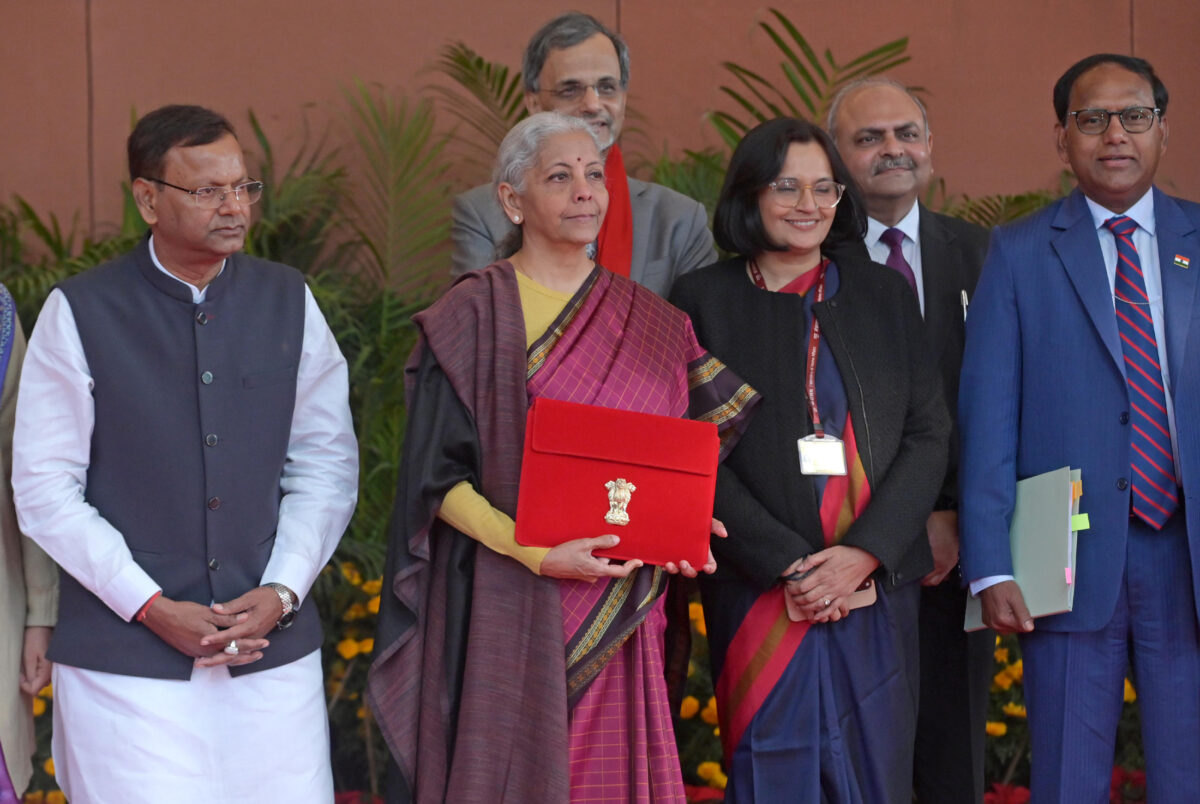





India’s Union Budget 2026–27, tabled in Parliament on Sunday, places a strong emphasis on improving the cost competitiveness of domestic solar and lithium battery manufacturing while building long-term system resilience. The budget also seeks to provide demand visibility for clean energy deployment.
Total allocations for solar projects under central schemes rise to INR 30,539.36 crore for FY27. This includes INR 1,775 crore for grid-connected large-scale solar project scheme, INR 5,000 crore for the PM-KUSUM scheme, and INR 22,000 crore for the PM Surya Ghar Muft Bijli Yojana rooftop programme, along with INR 1,764.35 crore for interest payments and bond issuance expenses. Additional allocations include INR 599.99 crore for green energy corridors and INR 600 crore for the National Green Hydrogen Mission.
On manufacturing, the budget extends basic customs duty (BCD) exemptions on the import of capital goods used for lithium-ion cell production for battery energy storage systems (BESS), as well as capital goods required for processing critical minerals in India. It also removes the 7.5% BCD on sodium antimonate used in solar glass manufacturing.
The budget proposes a INR 20,000 crore outlay over five years to promote carbon capture, utilisation and storage (CCUS) technologies across power, steel, cement, refineries and the chemicals sector. The measure is expected to support decarbonisation in hard-to-abate industries while providing long-term policy clarity for thermal assets.
“This enhances long-term regulatory clarity for thermal power assets and strengthens their ESG positioning, reinforcing the expectation that thermal generation will continue to play a critical role in the energy mix,” CareEdge said.
India Ratings described the CCUS allocation as a critical first step toward long-term emissions reduction. “The allocation for FY27 is modest at INR 5 billion, with investments likely to gradually scale up. While its commercial viability of CCUS technologies is yet to be established, this is an important first step given that other levers like alternative fuels, green power, clinker reduction can only contribute to around one-third of the targeted emission reduction for 2070,” it added. In October 2025, the government set mandatory emission-intensity reduction targets for 186 cement plants for the first time.
The budget also proposes dedicated rare earth corridors in Odisha, Kerala, Andhra Pradesh and Tamil Nadu, a INR 10,000 crore SME Growth Fund, and a INR 2,000 crore top-up to the Self-Reliant India Fund to support micro enterprises. At the same time, BCD exemptions for silicon used in un-diffused wafers and solar cell manufacturing will lapse from April 1, 2026.
Overall, the budget signals a shift from capacity-led expansion toward strengthening manufacturing depth and long-term resilience across India’s solar and energy storage ecosystem.
Here is the industry stakeholders’ feedback on the budget:
Raju Kumar, Partner and Energy Tax Leader, EY India:
“Energy transition as a question of Industrial resilience and system reliability, not just capacity expansion seems to be the key mantra of Budget 2026. The establishment of Rare Earth Corridors in Odisha, Andhra Pradesh, Kerala and Tamil Nadu, alongside customs-duty exemptions for capital goods used in critical-mineral processing, directly addresses input security for renewables, storage and electric mobility.
“The INR 20,000-crore CCUS programme provides a credible pathway to decarbonise power, steel and cement, while extending customs-duty exemptions for nuclear projects till 2035 strengthens long-term baseload stability.
“On the tax front, exemptions for battery energy storage systems, lithium-ion cells, solar-glass inputs and biogas-blended CNG materially improve project viability. Collectively, these measures are likely to compress project costs, unlock private capital, and accelerate deployment of storage-backed renewables, while the restructuring of PFC and REC could improve credit flow and execution discipline across the power sector.”
CareEdge:
“Establishing dedicated rare earth corridors in Odisha, Kerala, Andhra Pradesh and Tamil Nadu will promote mining, processing, research, and manufacturing of rare earth minerals. This, coupled with customs duty exemption on capital goods used for manufacturing lithium-ion cells for battery energy storage systems, is expected to diversify supply away from China and accelerate the domestic ore-to-magnet value chain—bringing down input costs for electric vehicles, renewable power, industrial applications and consumer electronics. Higher budgeted PLI For Advanced Chemistry Cell (ACC) Battery Storage outlay of INR 86 crore for FY27 vis-à-vis INR 26 crore for FY26 (RE) will foster growth and boost localisation.”
Ashwin Jacob, Partner and Energy, Resources and Industrials Industry leader, Deloitte India:
“The Budget 2026 shows the government’s intent on ensuring that India’s net-zero target of 2070 remains in focus. While specifics will need to be studied, the allocation of INR 20,000 Cr over 5 years across hard-to-abate sectors such as Power, Cement, Steel, Refineries, and Chemicals builds on the R&D Roadmap outlined by the Department of Science and Technology in December 2025 and is welcome. This is particularly timely, as it will enable the Indian industry to enhance export competitiveness and leverage the EU FTA amid regulations such as CBAM. The Budget also recognises the vulnerability that India faces from Climate events and has allocated ~INR 2,700 Cr to climate prediction across Mission Mausam (1,342 Cr), Deep Ocean Mission (625 Cr) and Prithvi Vigyan (800 Cr). This is in addition to various measures to reinforce the renewable energy value chain within India’s energy basket, such as BCD exemptions on capital goods for critical minerals processing, lithium-ion cell manufacturing, and raw materials for solar glass manufacturing.”
Ankit Hakhu, Director, Crisil Ratings:
“The Union Budget enhances competitiveness of domestic manufacturing in the renewable energy sector by extending the Basic Customs Duty exemptions on capital goods for lithium-ion cell production—particularly battery energy storage systems (BESS)—and exempting duties on sodium antimonate for solar glass. These moves, which seek to address India’s high reliance on imports for BESS and specialised solar glass, mark a step towards self-reliance and the vision of Viksit Bharat, even if immediate competitiveness gains are limited.”
Dr Vibha Dhawan, Director General, TERI:
“The Union Budget 2026 consolidates India’s long-term transition towards clean, secure, and innovation-driven growth. The continued emphasis on green energy—particularly renewed attention to nuclear power alongside solar and battery energy storage—highlights the importance of diversifying India’s energy mix with reliable baseload capacity, especially for hard-to-abate sectors. Equally significant is the Budget’s push to mainstream artificial intelligence across sectors, from manufacturing to public services, with a clear focus on AI-led productivity gains, efficiency, and digital transparency.”
Sambitosh Mohapatra, Partner and Leader, Climate and Energy, PwC India:
“India’s latest Union Budget marks a decisive shift from chasing capacity targets to building true system resilience. It signals a bold ambition: to lead the global green industrial revolution.
“The launch of the INR 20,000 crore CCUS Mission and the SMR Nuclear Mission shows that the government is directly addressing hard-to-abate sectors that define the next frontier of decarbonisation. The restructuring of Power Finance Corporation (PFC) and Rural Electrification Corporation (REC) is a transformative move—unlocking deep capital pools which are critical to powering the ₹12.2 lakh crore capex cycle.
“At the same time, focus on the semiconductor ecosystem, critical mineral corridors, and permanent magnet manufacturing tackles the biggest vulnerability in the clean energy transition: supply chain sovereignty. For industry, extended customs duty exemptions for Battery Energy Storage System (BESS) and a simplified Income Tax Act offer predictability and a clearer fiscal runway.
“This isn’t just a green budget—it’s a competitive industrial strategy. One that positions India as a global hub for cleantech and biopharma innovation, while maintaining fiscal discipline with a 4.3% deficit. India is no longer merely participating in the energy transition but is positioning itself to shape it.”
Ankit Jain, Vice President & Co Group Head – Corporate Ratings, ICRA:
“The Union Budget continued its focus on clean energy with measures such as exemption of the basic custom duty (BCD) for capital goods for manufacturing Lithium-ion cells for batteries as well as battery energy storage systems (BESS). Further, budget also provides BCD exemptions on import of goods required for all nuclear power plants till 2035. Both these measures can aid in the tariff competitiveness of BESS as well as nuclear power projects in India.
“Increased allocation on PM Surya Ghar Muft Bijli Yojana and continued focus on PM Kisan Urja Suraksha evam Utthaan Mahabhiyan will support the renewable capacity addition in the country. Additionally, the tax relief towards data center investments for foreign entities providing cloud servicing from India is likely aid the renewable capacity addition, given the sustainability focus.”
Aarti Khosla, Founder & Director, Climate Trends:
“The budgetary allocation to the ministry of new and renewable energy has been enhanced further to a record high of INR 32,914 crore (BE 2026-27) and a bulk of that (INR 22,000 crore) is allocated for the flagship solar rooftop scheme PM Suryaghar Yojana. Coupled with the exemption given to battery manufacturing, VGF for BESS and grant to CCUS, the focus of the government is rightly tilting towards building an energy transition ecosystem. Continued boost to power distribution reforms would bring 360-degree improvement in India’s green energy supply chain. However given the extent of air pollution, the focus on mitigating air pollution could have been stronger including accelerating EV adoption, fast charging and such areas.”
Labanya Prakash Jena, Director, Climate and Sustainability Initiative:
The restructuring of PFC and REC can be a major boost for the power sector by improving credit allocation and supporting the clean energy transition. Exemptions on capital goods for critical minerals will help companies set up domestic processing and refining capacity, strengthening raw material supply chains for green technologies. Duty exemptions on inputs such as sodium antimonate used in solar glass manufacturing will reduce costs and further support the green transition.
Trishant Dev, Deputy Programme Manager, Centre for Science and Environment (CSE):
“With measures like duty exemptions for capital goods for lithium-ion cell manufacturing or for inputs used in solar glass production, the budget frames India’s energy transition within a broader push for industrial competitiveness and resilient supply chains, supporting domestic production of critical inputs and access to key minerals.”
Kushagra Nandan, Co-Founder, LNK Energy:
“The exemption of Basic Customs Duty on sodium antimonate used in solar glass manufacturing addresses a critical input constraint, while the extension of BCD exemption on capital goods used for manufacturing Lithium-Ion cells to Battery Energy Storage Systems supports domestic capability creation in energy storage manufacturing.
“While exemptions continue for critical components such as EVA/PoE encapsulants, backsheets, and copper used in photovoltaic ribbons, the scheduled lapse of certain silicon-related exemptions from April 1, 2026, sends an important signal for manufacturers to accelerate domestic capacity creation and supply-chain readiness. These measures provide long-term direction for investors looking to build scale and depth in India’s solar manufacturing value chain.
“In parallel, the decision to exclude the full value of biogas when calculating excise duty on biogas-blended CNG is a practical step to improve affordability and accelerate adoption of sustainable fuels.
“The Solar Power (Grid) scheme, with an allocation of INR 1,775 crore, targets the commissioning of 7,000 MW through Solar Parks and 1,100 MW through CPSU-led projects, providing visibility on utility-scale capacity addition. Similarly, strengthening the PM-KUSUM scheme with an outlay of INR 5,000 crore will energise decentralised and agricultural solar adoption.
“From a financing perspective, the proposed restructuring of Power Finance Corporation (PFC) and Rural Electrification Corporation (REC) to improve credit disbursement and efficiency is a positive development. Faster and more predictable flow of capital from these institutions can materially support renewable energy developers and manufacturers alike.
“The Budget also makes provision for enabling infrastructure. The Green Energy Corridor allocation of INR 599.99 crore, aimed at constructing additional intra-state transmission lines, is designed to facilitate the integration of more renewable energy capacity.
“Taken together, these measures reflect a more execution-oriented approach by linking capacity targets, manufacturing scale, and enabling infrastructure. The focus now must be on timely implementation, so that these clearly articulated outlays and outcomes translate into competitive domestic manufacturing, reliable capacity addition, and sustained growth across the renewable energy ecosystem.”
Sameer Gupta, Chairman, Jakson Group:
“Union Budget 2026-27 outlines a clear growth-oriented roadmap with public capital expenditure increased to ₹12.2 lakh crore, reflecting the government’s continued focus on energy and infrastructure-led development. The introduction of the Infrastructure Risk Guarantee Fund, along with greater use of REITs and asset monetisation mechanisms, is expected to enhance investor confidence and support more efficient project execution.
“The emphasis on domestic manufacturing, energy security, and future-oriented technologies, including the allocation of INR 20,000 crore for carbon capture, contributes to strengthening India’s long-term economic resilience.
“Commitments towards freight corridors, inland waterways, high-speed rail corridors, and City Economic Regions indicate a structured approach to improving transport, logistics, urban infrastructure, and industrial connectivity. With focused attention on capacity building, employment generation, and the development of Tier II and Tier III cities, the Budget supports broad-based and inclusive growth.
“Overall, the Budget reinforces the role of energy and infrastructure in India’s long-term development objectives and provides a stable and predictable framework for scaling sustainable energy solutions and infrastructure manufacturing in line with the vision of Viksit Bharat.”
Chandra Kishore Thakur, Global CEO, Sterling and Wilson Renewable Energy Group:
“This budget has rightly prioritized India’s energy security, especially the increasing role of renewables towards fulfilling this objective over the long term.
“The relief in customs duty for the import of sodium antimonate used in the manufacture of solar glass is a step in the right direction. This move will reduce input costs for solar panel manufacturers and thereby augment domestic solar equipment production, giving an impetus to the entire sector in terms of atmanirbharta.
“The extending of basic customs duty exemption for capital goods used for manufacturing Lithium-Ion Cells for batteries, and to those used for manufacturing Lithium-Ion Cells for battery energy storage systems (BESS) is also a welcome decision. We must remember that BESS significantly enhances the viability of solar power by addressing its intermittency and enabling efficient energy management. BESS stores excess solar generation for use during low-production periods, thereby augmenting overall system reliability and economics in the solar industry.”
Surendra K Gupta, Executive Director and CFO, AMPIN Energy Transition:
“The Union Budget 2026–27 reiterates the Government’s continued focus on energy transition, with specific emphasis on renewable energy (RE) and allied sectors. While certain positive measures have been announced, this budget falls short of fully addressing key expectations of the renewable energy industry.
“Key positive announcements for the RE sector include reduction of Basic Customs Duty (BCD) from 7.5% to NIL on Sodium Antimonate used in the manufacture of solar glass, nil BCD on specified capital goods used for manufacturing lithium-ion cells for Battery Energy Storage Systems (BESS), an outlay of INR 20,000 crore over the next five years proposed for CCUS, signalling intent to support decarbonisation beyond conventional renewables. In addition, it proposes restructuring of Power Finance Corporation (PFC) and Rural Electrification Corporation (REC). Given their sectoral focus, this is expected to improve availability of long-term financing for power and RE projects at competitive rates, subject to further clarity on the restructuring framework.
“While the above measures are encouraging, the industry believes that certain critical issues still need to be addressed through suitable amendments in the final budgetary provisions to accelerate renewable energy deployment in the country. We request the government to consider it positively:
1. Clarity on delays in signing of PPAs and PSAs, particularly for centrally bid and state-level projects. The uncertainty is affecting investors and lender’s sentiments. We request the government to specifically address this.
2. Introduction of a dedicated PLI scheme for BESS component manufacturing to strengthen domestic supply chains.
3. Extension of ALMM applicability to solar cells, we request this to be extended for a further period of 2 years till March 2028, considering the current mismatch between the cell demand and its domestic availability.
4. Extension of the concessional 15% corporate tax rate for new renewable energy manufacturing entities for a minimum of five years.
5. Reduction in GST rates on BESS and on corporate guarantees from 18% to NIL, to help improve project viability.”
Chetan Shah, Chairman & Managing Director, Solex Energy Ltd:
“The Union Budget 2026–27 clearly positions manufacturing at the heart of India’s energy transition. By extending customs duty exemptions for batteries, energy storage systems, critical mineral processing, and nuclear infrastructure, the government has provided long-term policy certainty that will accelerate domestic value addition and global-scale manufacturing in India.
“This budget recognises that energy security, clean energy deployment, and industrial competitiveness are deeply interconnected. The strong push for solar integrated with storage, coupled with support for advanced manufacturing and R&D, reinforces India’s ambition to ‘Make in India for the World’—not just as a market for clean technologies, but as a trusted global manufacturing hub driving the energy transition.”
Shyam Sunder Jindal, Promoter, BC Jindal Group:
“In the Budget 2026, it is encouraging to note the Government’s focus on domestic manufacturing of lithium-ion batteries and solar glass to augment India’s goal of installing 500 GW of non-fossil energy capacity by 2030. Extending the exemption of the basic customs duty on capital goods used for manufacturing lithium-ion cells for battery energy storage systems and on sodium antimonate used in solar glass are welcome steps. This move is poised to play a constructive role in building a power sector that is capable of seamlessly catering to India’s growing energy needs while supporting the country’s clean energy transition.”
Sumant Sinha, Founder, Chairman & CEO, ReNew:
“Built like a roadmap designed for both sharp turns and long highways, the Union Budget 2026 delivers clarity and confidence in a world defined by rapid shifts and long‑term challenges. It balances the immediate need for employment generation among the youth with disciplined fiscal consolidation, ensuring stability without slowing momentum.
“By lowering or removing import duties on essential inputs and machinery, the Budget makes it cheaper and easier for India to build domestic manufacturing for strategic and export‑oriented products like batteries, semiconductor chips, garments, and apparels. Its focus on critical minerals, carbon capture and utilization, and next‑generation nuclear technologies marks a decisive push into the energy‑transition future. Together, these measures signal a clear intent to build a resilient, competitive, and opportunity‑ready economy poised to lead in the next‑generation clean‑energy sectors.”
Vineet Mittal, Chairman, Avaada Group:
“Budget 2026–27 strikes balance between ambition, growth and discipline. With sustained public capex of INR 12.2 lakh crore, a clear fiscal consolidation path, and reforms like the Infrastructure Risk Guarantee Fund, it focuses on building long-term productive capacity rather than short-term stimulus. The emphasis on infrastructure, MSME scaling, transport, digital and logistics readiness sends a strong signal that India is investing for durable growth, competitiveness, and investor confidence.”
D.V. Manjunatha, Founder and CMD, Emmvee Photovoltaic Power Ltd:
“Union Budget 2026 reinforces policy stability for renewable energy and manufacturing. The focus is clearly shifting from incentives to execution, scale, and quality. For companies that have invested early in domestic solar manufacturing, this consistency provides long-term confidence and greater visibility for planning and expansion. With the policy direction firmly in place, the emphasis now is on operational excellence, cost competitiveness, and building depth across the value chain. This approach strengthens India’s position as a credible global manufacturing hub for clean energy solutions and supports sustainable, long-term growth.”
Suhas Donthi, CEO, Emmvee Photovoltaic Power Ltd:
“Union Budget 2026 sends a clear and confident signal of stability and continuity. By staying the course on fiscal discipline, sustained public capex, and ease of doing business, the government has reinforced the predictability that capital-intensive sectors like renewable energy manufacturing need to plan, invest, and scale with confidence. The consistency in tax policy and clarity in the operating framework provide strong visibility for long-term decision-making. The continued emphasis on energy transition, demand creation, and infrastructure readiness reflects a firm commitment to India’s clean-energy ambitions. As the focus shifts to execution, access to capital, and building deeper domestic value chains, India is well positioned to strengthen its manufacturing competitiveness and establish itself as a reliable global hub for energy and industrial solutions.”
Bikesh Ogra, Vice Chairman and Global CEO, Jakson Green Ltd:
“This budget clearly places India on the international map as a serious long-term player in the global clean energy and manufacturing chain. The focus on capital expenditure, domestic manufacturing, critical minerals, and energy security indicates a clear shift from capacity building to global competitiveness.
“From a corporate perspective, the policy consistency of infrastructure-driven growth and sustainable energy is a strong message to global investors and MNCs seeking stable, scalable, and technology-driven markets. With the diversification of global supply chains and the acceleration of energy transition globally, India is poised not only as a consumption market but also as a solutions destination for renewable energy, green manufacturing, and integrated EPC solutions.
“For corporations operating at the nexus of clean energy and infrastructure, this budget has further reinforced confidence in India’s ability to deliver large-scale, export-quality, and future-ready energy solutions.”
Laxit Awla, CEO & Executive Director, SAEL Industries Ltd:
“We commend Budget 2026’s strong push to scale manufacturing and strengthen energy security which is key to a competitive, future-ready India. Measures such as customs duty exemptions for lithium-ion battery energy storage system capital goods, relief on sodium antimonate for solar glass, and targeted support for carbon capture reflect a holistic approach to the energy value chain and industrial decarbonisation.
“The tax holiday for foreign cloud service providers using Indian data centres is equally significant, catalysing investment and growth while driving demand for reliable, affordable, and clean power. SAEL has consistently advocated a vertically integrated solar and energy storage ecosystem to build domestic capability and self-reliance in clean energy.’’
CA Baratam Satyanarayana, Chief financial officer & Director, Bondada Group:
“The Budget provides a clear operational framework for the next phase of expansion, driven by accelerated infrastructure creation, improved renewable energy economics, and rising demand from sectors such as data centres and advanced manufacturing. The emphasis on rail connectivity and the growth of Tier II and III hubs aligns perfectly with our execution-driven approach in power, solar, and industrial infrastructure.
“A key benefit is the reduced import duty on solar glass, which will lower project costs and accelerate the deployment of renewable energy projects, thereby improving their overall feasibility.
“These initiatives, taken together, boost scalability, strengthen domestic supply chains, and facilitate quicker on-ground execution. We view this as a critical juncture, where clear policy converges with opportunity, enabling us to broaden our presence and make a significant contribution to Bharat’s upcoming era of sustainable, infrastructure-driven growth.
Rajiv Ranjan Mishra, Managing Director, Apraava Energy:
“Union Budget 2026 reflects a balanced and forward‑looking approach to strengthening India’s energy ecosystem, with a clear focus on reliability, sustainability and long‑term system resilience.
“Policy support for battery energy storage directly addresses priority requirements of grid reliability and renewable integration. The extension of customs duty exemptions on capital goods used for lithium‑ion cells to include battery energy storage systems (BESS), along with duty relief on key inputs such as sodium antimonate for solar glass, will help improve cost structures and support the scale‑up of grid‑level storage infrastructure that is essential for a flexible power system.
“The proposed INR 20,000 crore outlay over five years for Carbon Capture, Utilisation and Storage (CCUS) further strengthens the transition pathway for emission‑intensive sectors such as power, steel, cement, refineries and chemicals. Enabling CCUS at scale allows critical infrastructure to decarbonise while continuing to meet growing energy and industrial demand.
“Complementing these measures, the launch of India Semiconductor Mission 2.0, with an outlay of INR 40,000 crore, reinforces the development of enabling technologies and domestic manufacturing capabilities that underpin modern energy systems.”
Sanjeev Aggarwal, Founder and Executive Chairman, Hexa Climate:
“Budget 2026 is a decisive ‘Execution Budget’ that correctly identifies storage and finance as the twin pillars of our energy transition. The extension of customs duty exemption for Battery Energy Storage Systems (BESS) manufacturing is a game-changer; it signals that the government views storage not as a luxury but as essential grid infrastructure.
“Furthermore, the historic capital expenditure target of INR 12.2 lakh crore, combined with the restructuring of PFC and REC to improve efficiency, provides the financial backbone we need to scale. By lowering input costs for solar glass and securing the supply chain for critical minerals, this budget gives the private sector the confidence to move from planning to aggressive deployment.”
Prof. Dheeraj Kumar, Deputy Director, IIT (ISM) Dhanbad; Project Director, TEXMiN (TTRP, DST, GoI):
“The Union Budget 2026 places significant emphasis on strengthening India’s strategic minerals ecosystem and aligning academic research with industrial growth. The government’s focus on rare earth permanent magnets, critical mineral processing, and exemption of customs duties on capital goods for mineral processing reflects a forward-looking strategy to reduce import dependency and enhance domestic manufacturing capabilities. Additionally, the development of 20 new National Waterways connecting mineral-rich areas to ports and industrial centres will improve logistics efficiency for the mining sector.
“From an academic perspective, the announcement of five university townships near industrial and logistics corridors and expanded telescope infrastructure strengthens India’s scientific research and skill-development ecosystem. The Budget’s focus on higher education infrastructure, especially STEM hostels in every district, can help increase participation and capacity building. These measures will strengthen industry–academia collaboration, enabling advanced research in mineral processing, sustainability, and responsible mining practices. Overall, the Budget reflects a strong commitment towards positioning India as a global hub for critical minerals while nurturing future talent through integrated higher education and research investments.”
Prashant Mathur, CEO, Saatvik Green Energy:
“This Budget 2026 sends a strong and well-balanced signal for India’s clean-energy manufacturing ecosystem and marks a major step forward for India’s solar manufacturing story. By locking in long-term domestic demand through a record ₹12.21 lakh crore capital expenditure outlay and a nearly 29% increase for the PM Surya Ghar Muft Bijli Yojana, the government has created much-needed visibility for large-scale investments across the solar value chain. The extension of customs duty exemptions for lithium-ion cell manufacturing to battery energy storage systems directly strengthens both energy transition and energy security, while the exemption on critical inputs such as sodium antimonate for solar glass will improve cost competitiveness and accelerate domestic capacity creation in a strategically vital segment.
“At the same time, rationalisation of customs exemptions and correction of duty inversions signal a shift from protection to performance supporting domestic manufacturing while enhancing export competitiveness. The continued focus on carbon capture technologies and long-term support for nuclear power underline a technology-agnostic approach to decarbonisation.”
Tanmoy Duari, CEO, AXITEC Energy India:
“We welcome the Union Budget 2026 as a pragmatic and forward-looking fiscal blueprint for India’s energy transition. The allocation of INR 1,775 crore to the solar power (grid) segment underscores the government’s continued commitment to expanding clean energy capacity, while full exemption from Basic Customs Duty on energy transition equipment and solar glass inputs will significantly reduce costs and strengthen the competitiveness of solar manufacturing and deployment.
“Equally significant is the strategic restructuring of REC and PFC, which will enhance financing capacity for renewable projects and unlock greater investment flows across the sector. These measures align with India’s ambitious renewable targets and provide confidence to investors, developers and manufacturing ecosystems.
“As solar and renewable energy increasingly power India’s growth story, we urge policymakers to complement these budgetary initiatives with deeper incentives for energy storage, grid integration and distributed generation, which together will accelerate the transition to a resilient, affordable and sustainable energy future.”
Siddharth Bhatia, Managing Director, Oyster Renewables & AB Energia:
“Union Budget 2026 lays out a clear growth roadmap anchored in the three Kartavyas of infrastructure expansion, domestic capability building and long-term security. The strong push on infrastructure and record capital expenditure will significantly improve ease of doing business, strengthening grid readiness and accelerating renewable energy deployment.
“Targeted support for MSMEs through a dedicated growth fund will deepen participation across the clean energy value chain, from manufacturing to services.
“The focus on rare earth corridors and advanced manufacturing is particularly critical, as it secures essential minerals for battery storage and power electronics. As data centres emerge as a key driver of India’s digital and manufacturing economy, the need for reliable, round-the-clock clean power will only intensify. In this context, customs duty exemptions for battery storage and solar manufacturing inputs will play a vital role in scaling firm renewable energy solutions that support both energy security and sustained economic growth.”
Sunil Mathur, MD and CEO, Siemens Limited:
“We welcome the government’s consistent focus on long-term economic growth and structural transformation in the Union Budget 2026-27. The record INR 12.2 lakh crore capital expenditure allocation, sustained emphasis on infrastructure development, and a fiscal deficit target of around 4.3% reflect a continued and disciplined approach to strengthening India’s growth foundations.
“The budget’s focus on technology-led manufacturing, digital infrastructure such as data centers, and next-generation mobility including high-speed rail supports India’s ambition to become a global innovation and manufacturing hub. Continued support for MSMEs, skilling, and ease of doing business will be critical in ensuring that growth is broad-based and resilient. As industries navigate rapid technological change, the government’s spotlight on scale, execution, and investments in connectivity, smart infrastructure, and talent development provides a clear and credible roadmap for sustainable and inclusive growth.”
Rahul Munjal, Chairman and Managing Director, Hero Future Energies:
“The budget sets a roadmap for inclusive, sustainable and accelerated economic growth, with a clear focus on robust infrastructure and connectivity, domestic manufacturing excellence, balanced regional growth and creation of a future ready workforce. The government’s reform agenda marks a decisive shift from improving the ‘ease of doing business’ to accelerating ‘the speed of doing business’, through simplified regulations and technology-enabled approvals.
“Targeted customs duty exemptions for lithium-ion cells, battery energy storage systems and key clean-energy manufacturing inputs will help scale domestic capacity and improve project viability. The commitment to carbon capture, utilisation and storage acknowledges the need for credible transition pathways for sectors such as power, steel, cement and refining, while long-term support for nuclear energy creates a stable framework for capital-intensive energy investments.”
Rupal Gupta, Founder, Managing Director & Chief Executive Officer, TrueRE Oriana Power:
“Budget 2026–27 marks an important inflection point in India’s energy transition by formally recognising that decarbonisation cannot rely on renewable power alone but must also address emissions from hard-to-abate sectors through credible carbon management solutions.
“The proposed INR 20,000 crore multi-year outlay for Carbon Capture, Utilisation and Storage (CCUS) is a significant and timely intervention. It signals a shift from viewing carbon purely as a liability to treating it as a managed resource, particularly for sectors such as power, cement, steel and refining. If implemented through cluster-based deployment and clear utilisation pathways, CCUS can become a foundational pillar of India’s industrial decarbonisation strategy rather than a niche technology experiment.
“Equally important are the Budget’s enabling measures that strengthen the surrounding ecosystem. Customs duty rationalisation for lithium-ion cells used in battery energy storage systems, along with support for critical solar and wind manufacturing inputs, will help improve grid stability and cost competitiveness as renewable penetration deepens. The proposed restructuring of PFC and REC to improve credit velocity can further ease financing constraints for large, long-gestation clean energy projects.
“However, to fully unlock private capital at scale, sharper execution frameworks are still needed, particularly around payment security for renewable PPAs and clarity on how CCUS projects will be contracted, certified and monetised. Clear standards for measurement, reporting and long-term offtake will be critical to making CCUS bankable. Also, a clearer demand-side support for green hydrogen will be critical to accelerate large-scale deployment of green hydrogen and clean fuels.”
Tarunesh Madan, Co-Managing Partner, Amrop India:
“The CCUS allocation reflects a pragmatic transition strategy—focused on decarbonising hard-to-abate industries rather than headline renewable targets. Commercial scalability will determine its impact.
“Duty exemptions supporting battery energy storage systems and inputs for solar glass manufacturing strengthen India’s clean energy infrastructure ambitions. This will drive leadership demand in capex project execution, manufacturing scale-up, supply chain security, ESG and regulatory navigation, as firms expand across storage and solar value chains. Energy transition scale-up will be led by leaders who can execute industrial growth with compliance and supply resilience.
Akshat Jain, CEO, KLK Ventures:
“By reducing duties on solar panels and related components, the government aims to lower costs and accelerate solar adoption across industries and households, reinforcing the ‘Make in India’ vision. Customs duty exemptions for critical inputs such as sodium antimonate used in PV glass and capital goods for lithium-ion batteries will enhance the competitiveness of domestic manufacturing and attract greater investment across the solar value chain. Together, these measures are expected to improve affordability, strengthen supply chains, and fast-track India’s transition to clean energy—supporting long-term sustainability goals while empowering solar entrepreneurs and consumers alike.”
Anand Jain, Founder, Aerem Solutions:
“The Union Budget 2026–27 sends a clear signal that India is serious about building long-term energy security on the back of renewables, storage and critical mineral value chains. The decision to extend basic customs duty exemptions on capital goods for lithium-ion cells to battery energy storage systems, and to waive duty on inputs like sodium antimonate for solar glass, will lower project costs across the solar-plus-storage stack and accelerate grid-scale as well as C&I deployments.
“By pairing these measures with support for processing of critical minerals and an ambitious Carbon Capture, Utilization and Storage roadmap with a INR 20,000 crore outlay, the Budget recognizes that deep decarbonization needs clean electrons, flexible storage and hard-to-abate sector solutions working together. For a capital-intensive sector like ours, this policy continuity, combined with higher public capex of INR 12.2 lakh crore and a strong push on infrastructure and city economic regions, creates a more predictable environment for long-duration investments in distributed solar, open access and behind-the-meter storage.
“Equally important is the recognition of MSMEs as growth champions, with a three-pronged strategy on equity, liquidity and professional support. The proposed INR 10,000 crore SME Growth Fund and the top-up to the Self-Reliant India Fund aim to channel risk capital to MSMEs and micro enterprises, while TReDS-based measures mandating CPSE purchases on the platform, adding CGTMSE-backed guarantees, linking GeM, and enabling securitisation of receivables can ease working capital constraints for smaller firms that want to adopt clean energy. The creation of ‘Corporate Mitras’ through ICAI, ICSI and ICMAI will also help MSMEs manage compliance at lower cost, freeing bandwidth and capital for productivity-enhancing investments, including solar and storage.”
Anurag Choudhary, CMD and CEO, Himadri Speciality Chemical Ltd:
“We applaud the Union Budget 2026-27 for its visionary focus on fortifying India’s strategic manufacturing independence. The establishment of dedicated Rare Earth Corridors across Odisha, Kerala, Andhra Pradesh, and Tamil Nadu is a watershed moment; it will create the integrated infrastructure needed to transform raw minerals into high-value components for the EV and defense sectors.
“Furthermore, the exemption of Basic Customs Duty (BCD) on critical inputs-specifically sodium antimonate for solar glass and materials for lithium-ion cell manufacturing-is a decisive move. These measures will significantly lower capital costs for domestic battery production, making ‘Make in India’ energy storage solutions globally competitive.
“This Budget moves India from intent to execution—laying the foundation for a self-reliant, innovation-led, and sustainable green-manufacturing future, a pretext move towards our goal of Atmanirbhar Bharat.”
Sanjay Gupta, CEO, Apollo Green Energy Ltd:
“What is encouraging in this Budget is that it treats the energy transition not merely as a deployment exercise, but as a holistic mission focused on manufacturing strength and long-term resilience. It addresses several of the practical building blocks of solar scale-up that often sit beneath the headline targets. Something as specific as easing the cost of solar glass inputs may sound technical, but it directly shapes project economics and the competitiveness of domestic supply chains. Equally, the push toward battery storage manufacturing reflects an important truth: the future of solar is not limited to daytime generation, but lies in delivering dependable, round-the-clock, grid-integrated clean power. The emphasis on critical minerals also matters because the energy transition is ultimately a materials transition, and long-term energy security will depend on how strongly we build these capabilities at home. Overall, these measures signal a serious effort to strengthen the sector’s foundations, enabling India’s solar growth to be not only rapid but structurally resilient, and positioning the country as a credible manufacturing partner in the global clean energy transition.”
Kartik Daftari, Managing Director & CEO, Hi-Tech Radiators:
“The Union Budget 2026 sends a strong and reassuring signal to industry by placing technology-led manufacturing at the centre of India’s growth strategy. The INR 40,000 crore India Semiconductor Mission 2.0, expanded electronics manufacturing incentives and record capex of INR 12.2 lakh crore will significantly strengthen domestic supply chains and reduce import dependence in critical components. Equally important is the focus on rare earth corridors, chemical and capital goods parks and MSME enablement, which will deepen upstream capabilities and improve export competitiveness. This is a budget that translates scale into opportunity – driving investment, job creation and sustained global relevance for Indian manufacturing.”
Amod Anand, Co-Founder & Director, Loom Solar:
“The announcements around India Semiconductor Mission (ISM) 2.0, electronics manufacturing, critical minerals, and rare earth corridors signal a fundamental shift in India’s clean energy trajectory. For the solar sector, this goes far beyond capacity expansion toward building deep technological sovereignty. India is moving from being a hardware assembler to owning critical layers of the energy-tech IP stack—control systems, forecasting platforms, and grid software that power modern solar and storage ecosystems.
“The rare earth corridors address a hidden but critical solar bottleneck by securing access to materials essential for high-efficiency motors, power electronics, and advanced energy systems, significantly reducing strategic dependence on China. Complementing this, customs duty exemptions for critical mineral processing, lithium-ion cell manufacturing for storage, and inputs like sodium antimonate for solar glass strengthen domestic value chains across materials, components, and technology—forming the backbone of India’s long-term energy transition and energy security infrastructure.”
Deepak Acharya, CEO of INOX India Ltd:
“The Union Budget 2026–27 sets an ambitious stage for India’s emergence as a powerhouse of advanced manufacturing and next-generation energy systems. By prioritising long-term capital investment and accelerating the build-out of national infrastructure, the Budget lays the foundation for India to lead in technologies that will define global industry for decades.
“The Budget’s sustained focus on energy through increased support for infrastructure, technology, and critical industrial sectors reinforces India’s commitment to expanding reliable, low-carbon capacity while accelerating the shift toward cleaner fuels and future-ready technologies. These measures create a stable policy environment for investments in areas such as cryogenics, clean fuels, renewable energy components and high-value industrial equipment.
“The enhanced fiscal space created through substantial resource transfers to states INR 25.43 lakh crore in FY27 will further enable state governments to advance clean-energy projects, industrial corridors, and large-scale infrastructure that support India’s growing energy and manufacturing needs.
“Overall, the Budget strikes a prudent balance between fiscal responsibility, structural reforms and targeted public investment. It lays a strong foundation for accelerating India’s energy transition, scaling advanced manufacturing, and building resilient infrastructure areas where INOX India remains deeply committed to contributing with world-class engineering and technology.”
Meenu Singhal, Regional Managing Director, Socomec Innovative Power Solutions:
“The Union Budget 2026–27 charts a decisive course for India’s evolution into a global technology leader. The enhanced capital outlay of ₹12.2 lakh crore and the launch of the India Semiconductor Mission 2.0 reaffirm the government’s commitment to deep-tech indigenization. The INR 40,000 crore allocation for electronics component manufacturing is a strategic intervention that propels the ecosystem toward advanced engineering and value creation. The focus on establishing Rare Earth Corridors further strengthens the foundation for a secure and self-reliant supply chain. The budget’s emphasis on providing skilling programmes will encourage the youth in providing quality employment opportunities.”
Hiren Pravin Shah, Managing Director, CEO, Replus Engitech:
“Union Budget 2026 marks a decisive inflection point for India’s battery and BESS ecosystem by shifting the narrative from mere capacity creation to system readiness and grid stability. The formal recognition of BESS as infrastructure assets, combined with faster VGF payouts, GST rationalisation across advanced chemistries, and zero-duty access to critical machinery and minerals, materially improves project bankability and developer liquidity. Equally important is the clear push towards upstream localisation through ACC-PLI 2.0 and circular economy measures like the Battery Aadhaar, which will strengthen domestic supply chains and reduce import dependence. The inclusion of storage under PM Surya Ghar 2.0 further unlocks a large residential market, signalling that energy storage is now central to India’s clean energy transition rather than a peripheral add-on.”
Riju Jhunjhunwala, Managing Director, Bhilwara Energy Ltd:
“The Union Budget 2026-27 reflects a strong and forward-looking commitment to sustainable growth, anchored in fiscal discipline and strategic investment. The projected fiscal deficit of 4.3 per cent of GDP and ongoing fiscal consolidation provide a stable foundation for long-term investments in the energy sector.
“The increase in capital expenditure to ₹12.2 lakh crore demonstrates a clear push toward infrastructure and technology-driven development, creating an enabling environment for clean energy integration and long-term renewable projects. Key measures such as the India Semiconductor Mission 2.0 and customs duty exemptions for battery energy storage systems and solar glass directly support technology adoption and energy security, making renewable energy projects more feasible and cost-effective.
“Overall, the Budget reinforces confidence in scaling clean energy solutions, strengthening energy infrastructure, and advancing India’s transition to low-carbon, resilient, and future-ready energy systems.”
Ankur Khaitan, MD & CEO, TACC Ltd:
“With India’s projected 7.4% GDP growth and resilience in inflation and demand as key enablers The Union Budget 2026 reinforces the government’s long-term commitment to building a robust domestic manufacturing eco system keeping India on a global growth platform with higher productivity, growth and being a powerhouse of manufacturing.
Specifically for lithium-ion battery manufacturing ecosystem, continued emphasis on manufacturing-led growth, along with the extension of basic customs duty exemptions on critical mineral processing equipment, is a positive step that lowers capital intensity and supports localisation of advanced battery materials.
“The Budget’s alignment with the National Critical Mineral Mission, with an outlay of approximately INR 34,500 crore, is particularly significant. This mission builds on the Ministry of Mines’ 2023 notification identifying 30 critical minerals under the MMDR framework, including graphite, acknowledging its strategic importance for energy storage and electric mobility. However, while upstream minerals are rightly prioritised, there is further push expected towards explicit policy incentives or manufacturing support for synthetic graphite-based, battery-grade anode materials. Synthetic graphite is a foundational input for lithium-ion cells, and greater policy clarity or targeted incentives would be critical to deepen domestic value chains and ensure the long-term effectiveness of the ACC PLI scheme.
“Budget 2026’s allocation of INR 20,000 crore over five years for Carbon Capture, Utilisation and Storage (CCUS) also marks an important step toward industrial decarbonisation.
“Overall, the Budget sets a strong direction, and we remain confident that future policy measures will place sharper focus on advanced anode materials to fully strengthen India’s battery ecosystem and clean energy ambitions.”
Bharat Bhushan, Executive Director, Radius Synergies International:
“The Union Budget underscores the government’s commitment to strengthening India’s power and energy ecosystem through policy stability and long-term reforms. Continued focus on clean energy transition, grid modernization, and regulatory clarity will be critical in accelerating investments across renewable and conventional power segments. A predictable policy framework, coupled with emphasis on efficiency and sustainability, will help the sector scale responsibly while supporting India’s broader energy security and decarbonization goals.”
This content is protected by copyright and may not be reused. If you want to cooperate with us and would like to reuse some of our content, please contact: editors@pv-magazine.com.




2 comments
By submitting this form you agree to pv magazine using your data for the purposes of publishing your comment.
Your personal data will only be disclosed or otherwise transmitted to third parties for the purposes of spam filtering or if this is necessary for technical maintenance of the website. Any other transfer to third parties will not take place unless this is justified on the basis of applicable data protection regulations or if pv magazine is legally obliged to do so.
You may revoke this consent at any time with effect for the future, in which case your personal data will be deleted immediately. Otherwise, your data will be deleted if pv magazine has processed your request or the purpose of data storage is fulfilled.
Further information on data privacy can be found in our Data Protection Policy.