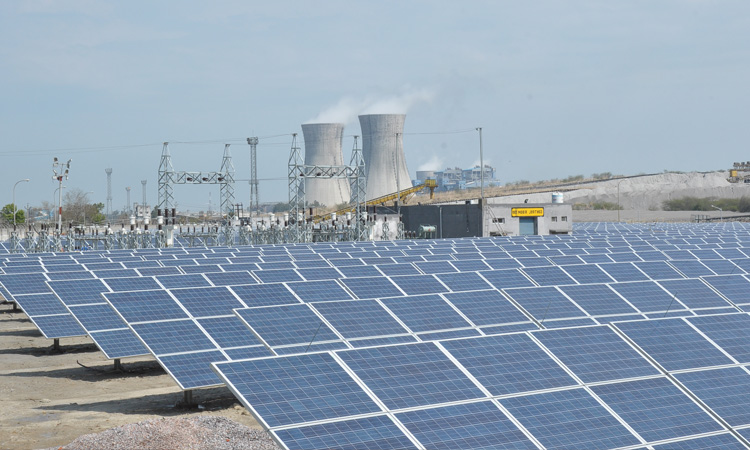





In FY 2025, India’s nine largest state-run energy firms invested INR 2.33 trillion ($28 billion) in fossil fuel-based projects, nearly eight times their combined INR 0.30 trillion investment in clean energy, according to a new analysis by the International Institute for Sustainable Development (IISD).
The analysis report, Mapping India’s Energy Transition: A Data Dive into the Strategic Role of State-Owned Enterprises in the Energy Sector, says that progressively redirecting a share of this investment could free up close to INR 2 trillion annually for clean energy. This would help bridge the gap between near-term capital expenditure plans and India’s long-term net-zero ambitions, while aligning with the growing role of renewables and electrification in energy security.
“While a significant share of PSUs’ current fossil fuel CapEx is tied to ongoing projects, new and incremental investments can be progressively rebalanced toward clean energy,” said Deepak Sharma, a consultant at the International Institute for Sustainable Development. “By prioritizing firm and dispatchable renewables, storage, critical minerals, and electrification, India’s state energy firms can reduce exposure to volatile global fuel markets while cutting emissions and strengthening long-term energy security.” [State-owned enterprises are known nationally as public sector undertakings (PSUs) in India.]
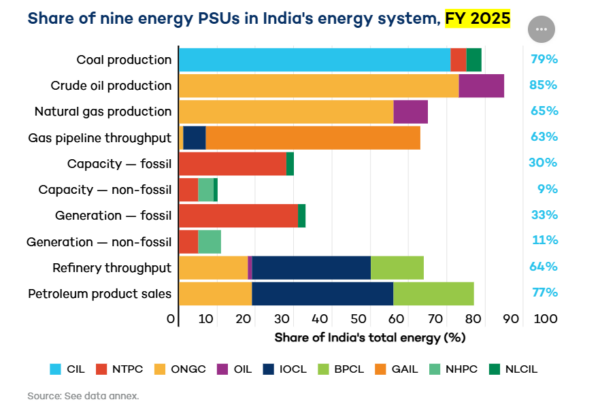
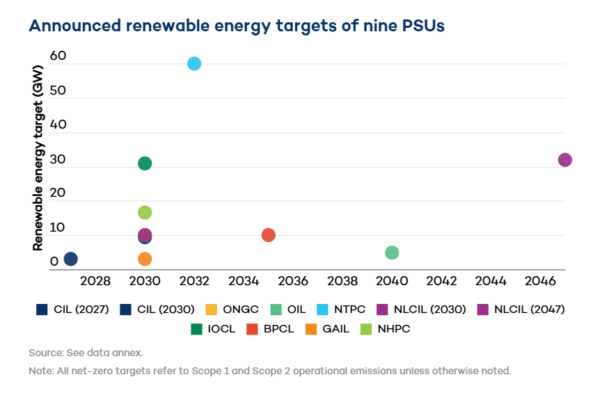
In FY 2025, these PSUs generated INR 26 trillion in revenues—nearly 8% of India’s gross domestic product (GDP)—highlighting the scale at which they can shape the country’s energy future. They also transferred nearly INR 6 trillion to governments through taxes and dividends, giving them exceptional leverage to align public finances with long‑term investment priorities. It is precisely this intersection, argues the analysis, that makes them decisive actors in boosting energy security by accelerating India’s clean energy transition.
“Nine major PSUs do more than run operations—they help shape and drive the entire energy system,” Sharma added. “India’s public sector energy companies are foundational to both the economy and the energy system. Their scale, institutional reach, and public ownership give them a level of influence no other group of actors can match. With a clear mandate to deliver a share of national clean energy targets, they can turn economic strength into a decisive force for delivering India’s energy transition at speed and scale, addressing the security risks of a fossil-intensive energy system.”
The report finds that eight of the nine energy PSUs (excluding National Hydroelectric Power Corp. Ltd India) account for about 11% of India’s greenhouse gas emissions on a Scope 1 basis—direct emissions from their own operations. This figure rises sharply when Scope 3 emissions are included: the downstream combustion of fuels and products these PSUs sell across the wider economy adds a further 33 percentage points, taking their combined footprint to nearly 44% of national emissions. These companies are also closely interdependent—coal mined by Coal India Ltd is burned by National Thermal Power Corp. (NTPC), and grid electricity from NTPC reaches PSU refineries — meaning that coordinated action within the group can deliver outsized system-wide emissions reductions.
“India’s public ownership of the energy system gives it a rare strategic advantage in managing this carbon interdependence,” Sharma added. “With aligned mandates, common ownership, and coordinated planning, PSUs can move together—redirecting capital, managing risks, and accelerating emissions reductions at a system level. How effectively the government mobilizes this collective potential will be decisive for India’s low‑carbon transition.”
India’s energy PSUs have the financial strength, access to low-cost financing, and system-wide influence needed to scale clean and reliable energy. As India’s transition shifts from rapid capacity addition to delivering reliable power—requiring storage, stronger grids, and firm renewable energy—PSUs are becoming central. NTPC, for instance, began scaling renewables through long-term contracts with private developers and is now pursuing a 60 GW target for clean energy, expanding its own portfolio while investing in more stable, dispatchable clean power—a model for how PSUs can evolve their role in the energy system.
“PSUs are where India’s energy, economic, and climate realities converge,” Sharma concluded. “They absorb global fuel shocks, shape public finances, and anchor millions of livelihoods. What they do next will determine how fast India can reduce import dependence, scale clean and reliable power, and ensure the transition is both orderly and just.”
This content is protected by copyright and may not be reused. If you want to cooperate with us and would like to reuse some of our content, please contact: editors@pv-magazine.com.







By submitting this form you agree to pv magazine using your data for the purposes of publishing your comment.
Your personal data will only be disclosed or otherwise transmitted to third parties for the purposes of spam filtering or if this is necessary for technical maintenance of the website. Any other transfer to third parties will not take place unless this is justified on the basis of applicable data protection regulations or if pv magazine is legally obliged to do so.
You may revoke this consent at any time with effect for the future, in which case your personal data will be deleted immediately. Otherwise, your data will be deleted if pv magazine has processed your request or the purpose of data storage is fulfilled.
Further information on data privacy can be found in our Data Protection Policy.