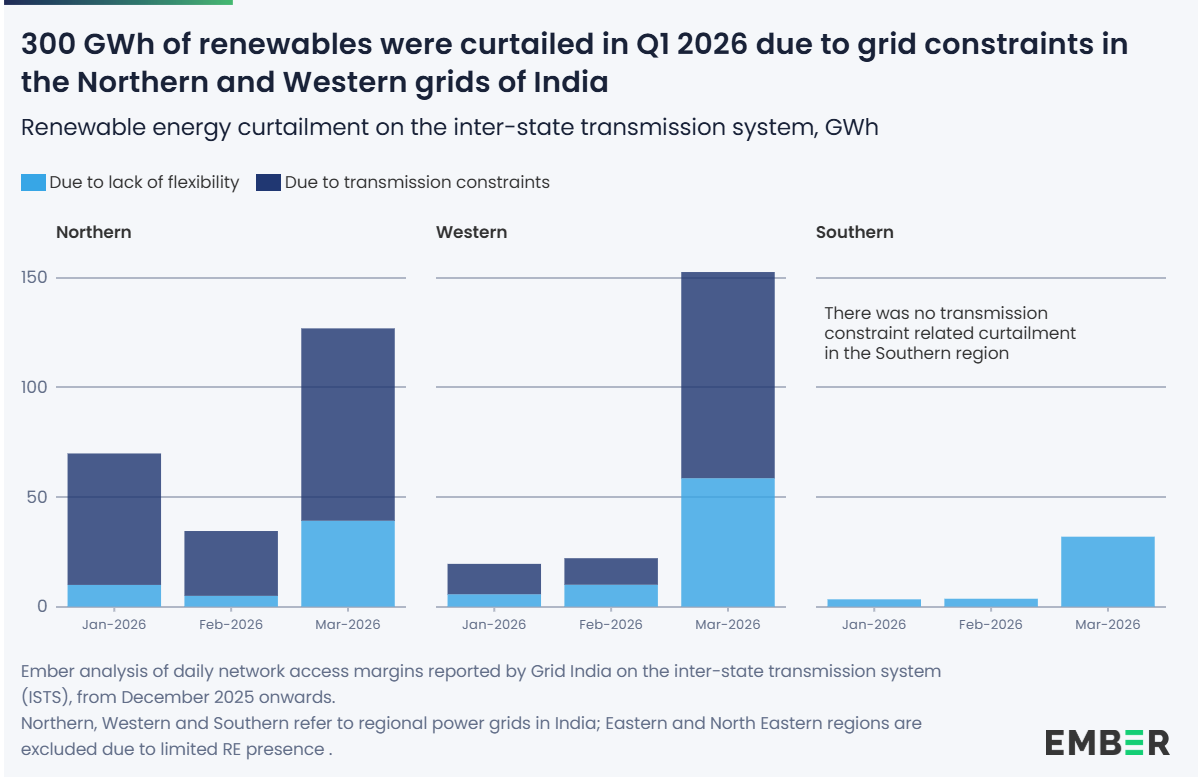





Transmission constraints led to the loss of 300 gigawatt-hours (GWh) of clean electricity in India during January – March 2026, particularly across the Northern and Western regional grid pooling stations, according to a new analysis by energy think Ember. On March 30, 2026 alone, the country lost 34 GWh of clean generation, equivalent to the daily power use of about 5 million urban middle-class households.
Ember’s analysis estimates total renewable energy curtailment at around 470 GWh in the first quarter (Q1) of 2026, of which nearly 300 GWh was attributable to transmission constraints while the remaining 170 GWh was linked to system inflexibility.
The Northern region accounted for 178 GWh and the Western region for 122 GWh. The Southern region recorded none, reflecting better synchronisation between generation and grid build-out.
“India’s renewable energy curtailment arising from transmission constraints is beginning to reach materially significant levels,” says the report’s author Duttatreya Das, Energy Analyst – Asia at Ember.
The report highlights that the core of the problem is a growing mismatch between the pace of renewable energy development and the readiness of the transmission infrastructure. It found that India has met only about 80% of its annual transmission targets over the past five years, and the financial year (FY) 2026–27 ISTS target has now risen to 25,146 circuit kilometres (ckm). One in four major schemes is already running a year or more behind schedule. As a result, 20 GW of renewable energy capacity is likely to face connectivity delays of more than four months in FY2026-27.
“Over time, the system will need to move away from generation-led transmission planning towards a model where generation and transmission are co-optimally planned and executed,” Das highlighted.
At a time when India is exploring austerity measures, the lost clean electricity may have reduced reliance on costly natural gas imports or freed up domestic gas supplies for higher-priority uses outside the power sector at a time when spot gas prices were nearly twice the levels prevailing before the US-Israel war against Iran in West Asia.
In the short-term, the report recommends using batteries for “transmission-as-a-service”. Ember’s report last year already highlighted that batteries are a “multitool” for the power sector, and this report showcases that with the right regulatory changes, the commercial case is there for batteries to plug India’s transmission gaps in the short-term.
“Battery storage at pooling stations is the fastest available fix to resolve transmission constraints. Roughly 3–4 GW of two-hour storage could have absorbed most of the curtailed generation, against 236 GW of plug-and-play BESS headroom already available at major pooling stations. The technical pieces are in place; the gap is regulatory and commercial,” says Das.
The report recommends two regulatory measures to unlock such a solution. First, an intermediary government-backed entity could aggregate power from renewable energy projects that only have a temporary general network access (T-GNA) and contract it to BESS developers. This would remove the contracting risk that comes from plants entering and exiting the T-GNA queue.
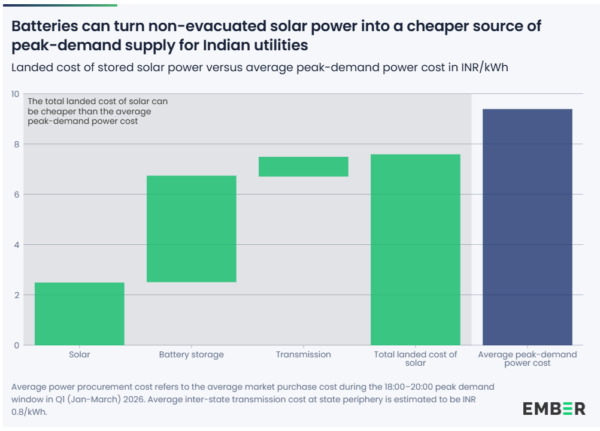
Second, BESS can be procured as a transmission asset just like any other grid element, with capacity payments socialised across states in the same way as transmission charges. With the levelised cost of storage at INR 4.0–4.5/kWh and solar at around INR 2.5/kWh, the combined delivered cost lands at INR 7–8/kWh, well below the INR 10/kWh that many states currently pay for peak power.
“Enabling such regulatory mechanisms could be among the fastest interventions for reducing transmission constraint-related renewable energy curtailment,” Das added.
Other near-term measures can also help decongest the grid. Regulatory reforms such as harmonising curtailment compensation frameworks and making intra-state connectivity procedures more transparent and structured can encourage developers to shift towards intra-state project deployment, easing pressure on existing ISTS transmission corridors. In parallel, technological interventions such as dynamic line rating and reconductoring can enhance the transfer capacity of existing lines, enabling the deferral of new transmission infrastructure by a few years.
This content is protected by copyright and may not be reused. If you want to cooperate with us and would like to reuse some of our content, please contact: editors@pv-magazine.com.




By submitting this form you agree to pv magazine using your data for the purposes of publishing your comment.
Your personal data will only be disclosed or otherwise transmitted to third parties for the purposes of spam filtering or if this is necessary for technical maintenance of the website. Any other transfer to third parties will not take place unless this is justified on the basis of applicable data protection regulations or if pv magazine is legally obliged to do so.
You may revoke this consent at any time with effect for the future, in which case your personal data will be deleted immediately. Otherwise, your data will be deleted if pv magazine has processed your request or the purpose of data storage is fulfilled.
Further information on data privacy can be found in our Data Protection Policy.