




Localization of EV and battery manufacturing in India cannot be achieved through central policies alone. States control key levers—including land acquisition, power tariffs, logistics infrastructure, and regulatory clearances—that shape project viability and investment decisions, according to a report by the International Institute for Sustainable Development (IISD).
While central government schemes provide the strategic direction for EV and battery manufacturing, states play a decisive role in translating these signals into investable, operational projects. However, localization for several high-cost EV components including batteries, motors, DC-DC convertors, and on-board chargers remains below 20% in India—underscoring continued reliance on imports.
By mapping state-level policy support and identifying gaps, the report highlights why getting state policy design right is central to deepening the localization of EV and battery manufacturing in India.
The IISD report identifies three priorities for closing that gap. Policy support across central and state levels must do more to de-risk capital-intensive, first-of-their-kind investments. States must move beyond fragmented incentive packages toward integrated ecosystems that combine industrial infrastructure, testing and certification capacity, workforce development, and small and medium enterprise integration. And demand certainty—through public procurement, zero-emission vehicle mandates, and low-emission zones—will be essential to reduce market risk and draw private investment across the value chain.
While 33 of 36 states and union territories now have EV policies, most focus on deployment. Supply-side measures to promote EV and battery manufacturing exist in some states but are often spread across industrial, electronics, and EV policies. The result is that net localization remains below 20% for several high-value components, including battery cells, motors, convertors, and on-board chargers—showing a gap between policy intent and policy support.
“States have laid the foundation for EV manufacturing in India through common incentives like financial support, land concessions and tax waivers,” said Swasti Raizada, senior policy advisor, IISD. “The next step is to design policies that are built on each state’s industrial strengths and by targeting support to the most capital and technology-intensive parts of the supply chain.”
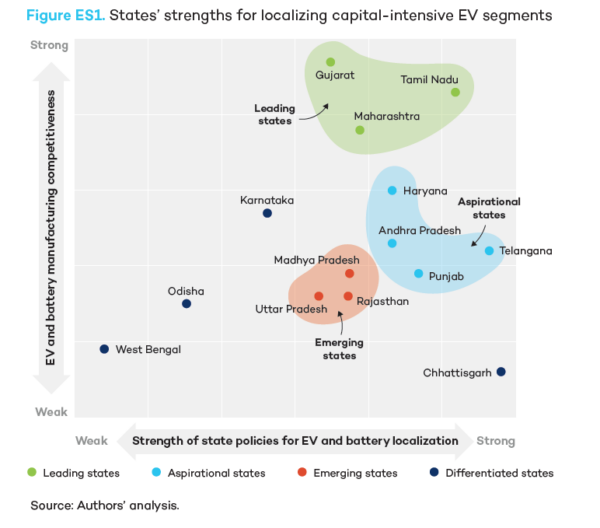
A comparative assessment of 14 major automotive states in the IISD report reveals that India’s EV manufacturing push is broad but uneven. While vehicle and battery assembly capacity is expanding, upstream and midstream segments—where capital requirements, technological complexity, and supply chain risks are highest—continue to receive comparatively less policy attention at the state level. States show wide differences in manufacturing maturity, policy coherence, and readiness to support capital‑ and technology-intensive segments of the EV and battery supply chain.
State that aligns policies—and target specific segments of the EV and battery value chain—based on their comparative advantage, can better attract investments, deepen local value addition and create integrated manufacturing ecosystems.
“Deepening localization of EV and battery manufacturing will require states to effectively use risk-sharing tools beyond subsidies,” adds Raizada. “States need to lower entry barriers and support the creation of intellectual property—drawing lessons from India’s semiconductor push—to differentiate themselves, accelerate progress in high-value battery segments, and reduce import dependency.”
Optimizing state policies is critical to future-proofing India’s automotive manufacturing base that delivers local jobs, serves rising domestic demand, and reduces India’s exposure to volatile fuels and component imports.
This content is protected by copyright and may not be reused. If you want to cooperate with us and would like to reuse some of our content, please contact: editors@pv-magazine.com.





By submitting this form you agree to pv magazine using your data for the purposes of publishing your comment.
Your personal data will only be disclosed or otherwise transmitted to third parties for the purposes of spam filtering or if this is necessary for technical maintenance of the website. Any other transfer to third parties will not take place unless this is justified on the basis of applicable data protection regulations or if pv magazine is legally obliged to do so.
You may revoke this consent at any time with effect for the future, in which case your personal data will be deleted immediately. Otherwise, your data will be deleted if pv magazine has processed your request or the purpose of data storage is fulfilled.
Further information on data privacy can be found in our Data Protection Policy.