Magenta Power and Mahindra Susten partner to offer customised rooftop solar solutions
Magenta Power, a Mumbai-based solar power and electric vehicle charging solutions provider, and Mahindra Susten, renewable arm of US$20.7-billion multinational Mahindra Group, will jointly work towards developing technological solutions and rooftop solar power installations.

The long read: The untapped potential of the MENA region
The region’s climate, developing economies and demographic growth are driving increased electricity demand in the Middle East and North Africa. However, as a hub of conventional energy supply, the region has been slow to embrace PV. To capture more of the value chain and deliver the full potential of solar, there are increasing calls for distributed generation deployment to play a bigger role.

Will solar power take root in India’s smallest state?
Subsidies from central and state bodies will help photovoltaics get within reach of similarly sponsored conventional electricity, which begs the question, why not remove subsidies for both?

By 2030, solar tariffs in India could fall below Rs 2 per unit
The cost of wind would fall to Rs 2.3-2.6/kWh, while solar tariff would reduce to Rs 1.9-2.3/kWh. The cost of storage will fall by about 70%, according to a report.

Azure to set up 1 GW solar capacity across Uttar Pradesh
The project is one among 300 odd projects worth Rs 65,000 crore including solar parks to be launched during a ground breaking ceremony in Kanpur later this month.
Lobby group demands expansion of net metering in Uttar Pradesh
The National Solar Energy Federation Of India says the recent decision to exclude commercial and industrial premises, as well as public buildings, from self consumption remuneration unfairly penalizes businesses and public bodies which have gone down the solar path.
India will add 11.4 GW of solar capacity annually: S&P Global
Owing to the general elections this year, little progress on the policy front is expected in the near term, according to the report.

The long read: PV’s Polish cold turkey
Considering the remarkable advances made by the solar sector since the Rio ‘Earth Summit’ of 1992, PV was notable by its absence at the Convention of Parties climate change summit held by the UN in Poland.
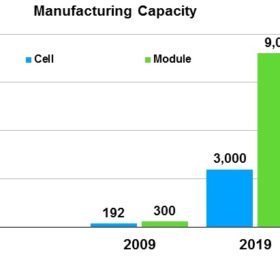
Solar in India: The 10 Year Challenge
The last 10 years have seen India emerge as a solar superpower, setting an example from which many emerging countries in Africa and Southeast Asia are eager to learn.

New approach to measure solar potential of urban areas could be used in all climates
Dutch researchers have come up with a system they claim has a maximum estimation error of less than 10% and which reduces the computational requirements for calculating the output of PV systems in complex environments. The approach is based on the correlation between a skyline’s profile and annual irradiation.