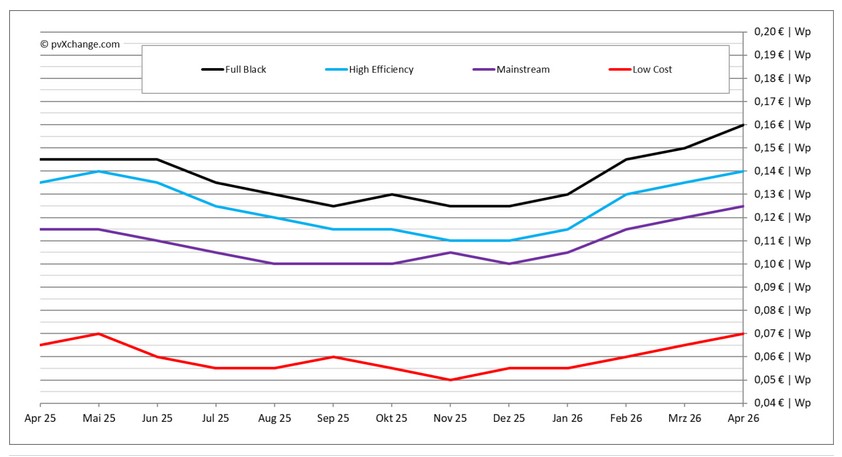





For the fourth consecutive month, photovoltaic module prices have risen across all technologies. Although the pace of increase has slowed compared to the start of the year, the upward trend remains intact. Between March and April, average prices rose by 5.5%, with all-black modules recording the strongest increases.
This development contrasts with several supply-side signals. Polysilicon prices have declined for weeks amid weak global demand, and the removal of Chinese export tax credits, effective April 1, would typically be expected to exert downward pressure on module prices.
Market dynamics are instead being shaped by a combination of resilient demand and constrained supply. Global economic and energy market uncertainty continues to support investment in energy independence, sustaining demand for photovoltaic and storage systems. Installers report strong order books, while developers and investors continue to pursue large-scale projects even in the absence of subsidies.
At the same time, supply has tightened due to production adjustments in China. At the beginning of 2026, several manufacturers reduced capacity to avoid renewed price competition, shutting down older lines or operating at lower utilization rates. As a result, the previous oversupply situation in Europe has eased, including the accumulation of module stocks at ports such as Rotterdam.
Today, modules are largely delivered on a just-in-time basis or under contractually secured volumes, limiting flexibility in responding to demand spikes. This has led to longer lead times and upward pressure on prices. The residential segment is particularly affected, as it relies heavily on high-power all-black modules, which are in limited supply and often sell out quickly. In some cases, price adjustments are being accepted on existing contracts to secure delivery.
Overall, rising demand driven by energy security concerns, combined with tighter supply, is creating a strained market environment. Future price developments will depend on geopolitical conditions and the industry’s ability to adjust to the current market phase.
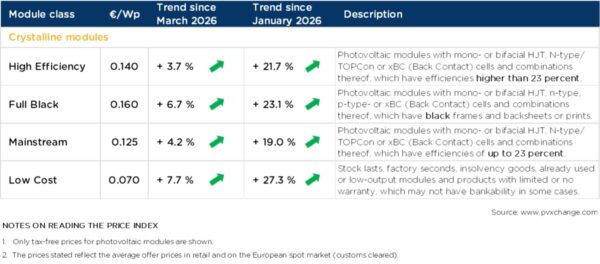
Module prices by technology as of April 13, 2026, including monthly variations:
 About the author: Martin Schachinger has studied electrical engineering and has been active in the field of photovoltaics and renewable energy for almost 30 years. In 2004, he set up the pvXchange.com online trading platform. The company stocks standard components for new installations and solar modules and inverters that are no longer being produced.
The views and opinions expressed in this article are the author’s own, and do not necessarily reflect those held by pv magazine.
This content is protected by copyright and may not be reused. If you want to cooperate with us and would like to reuse some of our content, please contact: editors@pv-magazine.com.





By submitting this form you agree to pv magazine using your data for the purposes of publishing your comment.
Your personal data will only be disclosed or otherwise transmitted to third parties for the purposes of spam filtering or if this is necessary for technical maintenance of the website. Any other transfer to third parties will not take place unless this is justified on the basis of applicable data protection regulations or if pv magazine is legally obliged to do so.
You may revoke this consent at any time with effect for the future, in which case your personal data will be deleted immediately. Otherwise, your data will be deleted if pv magazine has processed your request or the purpose of data storage is fulfilled.
Further information on data privacy can be found in our Data Protection Policy.