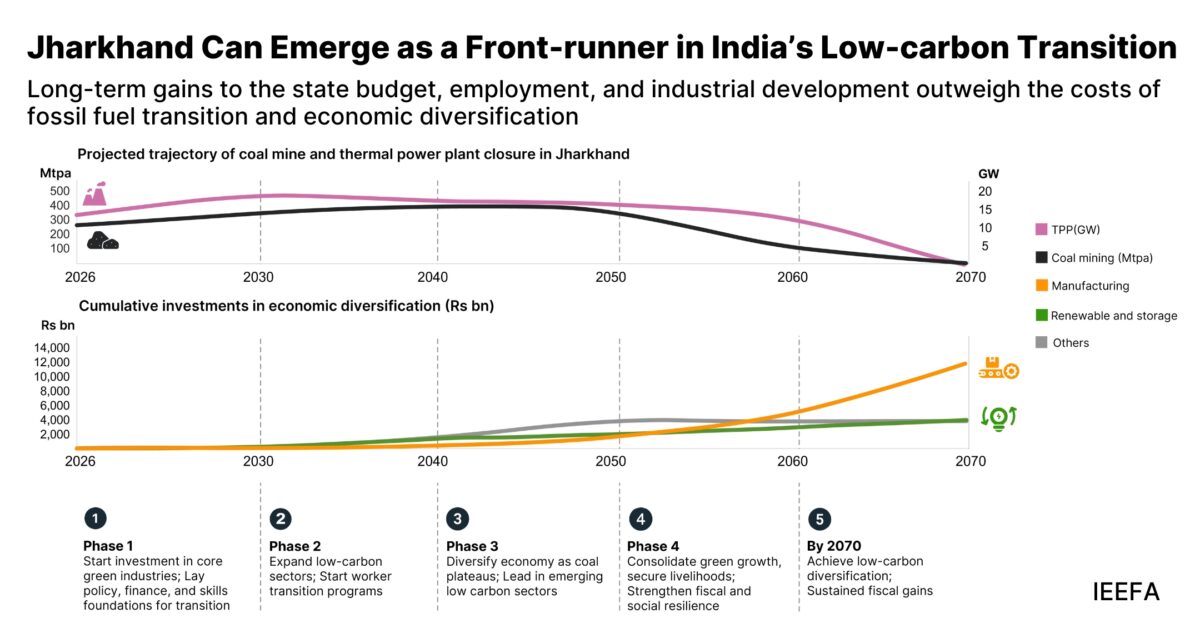





The concentration of heavy industries makes Jharkhand an ideal proving ground for a Just Transition to a diversified, low-carbon economy that could become a model for other states and key to India’s achieving its ambitious climate targets, says a new report by IEEFA.
The report estimates that $256 billion will be needed between 2026 and 2070 for Jharkhand’s transition from fossil fuels, covering coal mining and thermal power, decarbonizing the steel sector, providing social support, and driving economic diversification into low carbon sectors to maintain both social stability and economic growth.
The report—Jharkhand’s Just Transition: A roadmap for economic growth and diversification—was prepared by IEEFA South Asia as part of the state government’s Task Force on Sustainable Just Transition.
The roadmap details the costs of coalmine and thermal power plant closure and remediation, and of steel sector decarbonisation, these sectors being prioritised for their size, economic importance, and just transition implications. It then models decadal transition expenditures, identifies high-potential diversification sectors, and proposes an integrated sustainable finance framework designed to mobilise private capital while ensuring an equitable transition for all stakeholders.
“This shift entails phasing out carbon-intensive assets, building new low-carbon capacity, and mobilising unprecedented levels of capital,” says co-author Shantanu Srivastava, IEEFA’s research lead, sustainable finance and climate risk.
While these upfront costs are significant, the report underscores that the long-term benefits in terms of new revenues, jobs, and industrial ecosystems will far outweigh them.
Crucially, the study underscores that while public funds will play a catalytic role, most of the required financing will need to come from beyond state government budgets, through private investment, multilateral concessional capital and innovative blended finance structures. With clear and consistent policies, Jharkhand can attract billions in private and concessional capital, unlocking new infrastructure, industrial clusters, and clean energy innovation.
This massive upfront investment required will also deliver a healthy financial dividend, with a net gain of INR 6.7 lakh crore ($79.3 billion) to the state government budget by 2070, IEEFA estimates. This does not include any resultant increases in central government taxes and duties.
Jharkhand’s vast renewable energy potential, combined with its industrial base and critical mineral reserves, positions the state to emerge as a hub for low-carbon manufacturing, ranging from EVs, solar panels and battery energy storage systems (BESS) to green hydrogen production. At the same time, natural farming and other, nature-based solutions can strengthen rural livelihoods, open opportunities in carbon markets, and enhance climate resilience.
“Diversifying the state’s economy into new, low-carbon sectors will add to its GDP, contributing materially towards Jharkhand’s economic growth,” Srivastava says. “Thus, the transition will more than compensate for the state’s lost coal-based revenues.”
Beyond the fiscal dimension, the transition promises wide-ranging just transition benefits. More than US$12.5 billion (Rs1.05 lakh crore) will be required to reskill, compensate, and support workers and communities dependent on coal, but this social investment will ensure that vulnerable communities are not left behind, but thrive in a low-carbon economy.
The report emphasises, however, that these outcomes will not materialise automatically. Achieving them will require strong political commitment, early investments in human capital, and an enabling financial and regulatory ecosystem. Governance and institutional capacity must also be strengthened to ensure transparent implementation and to secure the confidence of different stakeholders.
“This transition is both a high-risk challenge and a high-return opportunity. If Jharkhand acts now, it can not only safeguard its economy and workforce from the decline of coal but also position itself at the forefront of India’s low-carbon growth story,” says co-author Soni Tiwari, energy finance analyst, South Asia, at IEEFA.
This content is protected by copyright and may not be reused. If you want to cooperate with us and would like to reuse some of our content, please contact: editors@pv-magazine.com.





By submitting this form you agree to pv magazine using your data for the purposes of publishing your comment.
Your personal data will only be disclosed or otherwise transmitted to third parties for the purposes of spam filtering or if this is necessary for technical maintenance of the website. Any other transfer to third parties will not take place unless this is justified on the basis of applicable data protection regulations or if pv magazine is legally obliged to do so.
You may revoke this consent at any time with effect for the future, in which case your personal data will be deleted immediately. Otherwise, your data will be deleted if pv magazine has processed your request or the purpose of data storage is fulfilled.
Further information on data privacy can be found in our Data Protection Policy.