EU funding ban on high-risk inverters, including Chinese suppliers, extends to BESS
The new policy has already applied, and impacts billions in funding from the European Investment Bank on renewable projects including standalone and co-located storage.
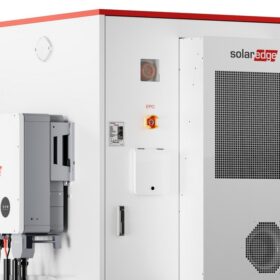
SolarEdge targets C&I with new all-in-one battery
SolarEdge has a new commercial focused battery system, with the new model scaling up to as high as 1 MW / 4 MWh depending on the inverter choice.
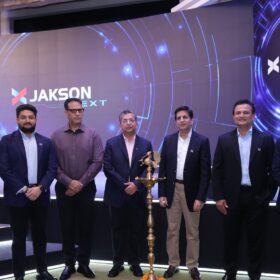
Jakson Group launches rooftop solar kit, battery storage systems
Jakson Group has expanded its energy solutions portfolio with the launch of rooftop solar kit and battery energy storage systems (BESS).
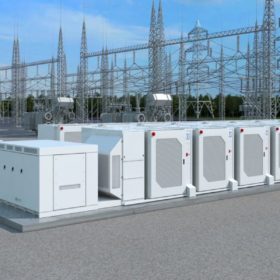
Enviro Infra Engineers enters battery storage segment with 930 MWh EPC orders
Enviro Infra Engineers Ltd (EIEL), an infrastructure company focused on water and wastewater treatment solutions, has entered the battery energy storage system (BESS) segment by securing EPC contracts totaling 930 MWh.
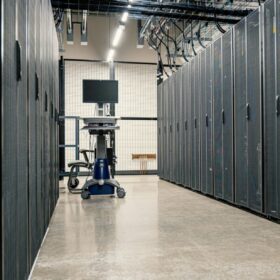
Why battery storage is becoming the engine of AI growth
Data centers are using batteries to run more AI on the same grid connection.
ACME Solar commissions additional 155 MW/470 MWh battery storage projects in Rajasthan
ACME Solar Holdings Ltd (ACME Solar), through its various subsidiaries, has commissioned additional 155 MW/470.25 MWh of battery energy storage systems (BESS) in the Indian state of Rajasthan. With this addition, the company’s total commissioned BESS capacity reaches 297.67 MW/951.74 MWh, out of the total planned BESS capacity of 835 MW/3,114.64 MWh through these special-purpose vehicles.
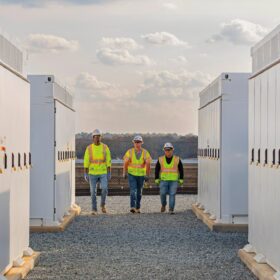
On-site batteries accelerate grid access for data center developers
Battery energy storage systems (BESS) are increasingly used in uninterruptible power supply (UPS) applications for data centers and to speed grid connections, offering services beyond what gas turbines can provide, including emerging approaches such as bring your own capacity (BYOC) and flexible grid connections (FGC).

Renewables’ share to reach 26% of total power generation by FY2026-end: Infomerics Ratings
Infomerics Ratings expects renewable energy (RE) to account for 26% of India’s total power generation by the end of FY2026, despite softer demand conditions.
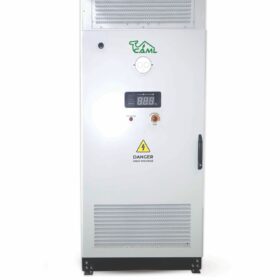
Loom Solar launches 125 kW/261 kWh BESS for C&I applications
Indian solar manufacturer Loom Solar has launched a 125 kW/261 kWh CAML battery energy storage system (BESS) for commercial and industrial (C&I) applications. The BESS is scalable up to 1 MWh.
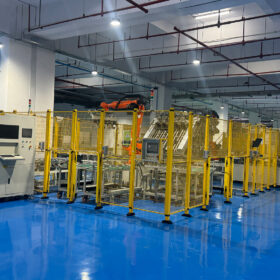
GoodEnough Energy starts production at 7 GWh battery storage factory in Noida
GoodEnough Energy has commissioned a 7 GWh battery energy storage system (BESS) factory in Noida, marking the largest such facility in India. The company plans to expand the facility’s capacity from 7 GWh to over 25 GWh over the next three years.