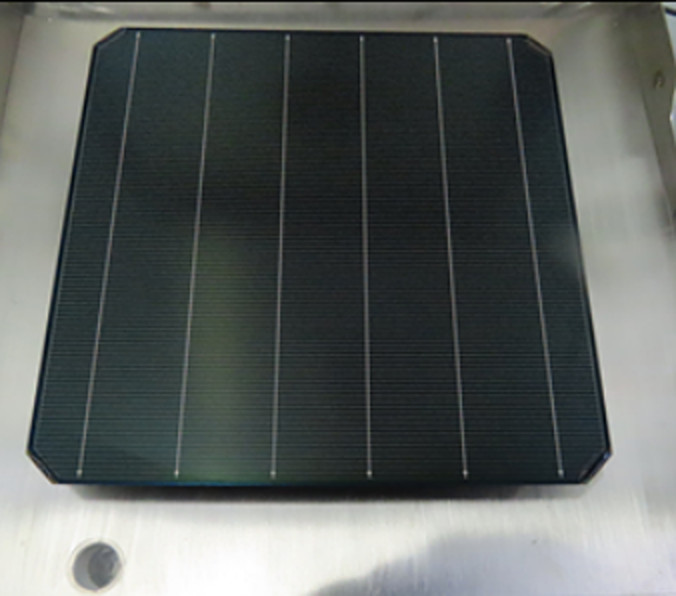





A few hours after Trina Solar revealed it achieved the world’s highest efficiency for silicon solar cells with 28.0%-efficient device TOPCon-compatible hybrid back-contact solar cell (THBC), Chinese module manufacturer Longi announced it achieved a higher efficiency of 28.13% with a hybrid nterdigitated-back-contact (HIBC) solar cell.
The result was independently confirmed by Germany’s Institute for Solar Energy Research Hamelin (ISFH).
Longi also said that HIBC-based modules with an efficiency of 26.4% were certified by the U.S. National Renewable Energy Laboratory (NREL). “These breakthroughs in technological capability have already translated into a leading edge in mass production,” the company said in a statement.
Longi outlined details of its HIBC solar cell architecture in a scientific paper published in November. The company said the device combines passivated tunneling contacts, dielectric passivation layers, and both n-type and p-type contacts.
The cell is built on a high-resistivity half-cut M10 wafer featuring edge passivation and optimized n-type contacts produced through a combined high- and low-temperature process. An indium tin oxide (ITO) layer improves lateral transport, while multilayer aluminum oxide (AlOx) and silicon nitride (SiNx) coatings reduce surface recombination.
The researchers also reduced phosphorus doping in the n-type polycrystalline silicon layer to limit dopant diffusion into the wafer. The company’s in situ passivated edge technology enables edge passivation during fabrication. In addition, deep-trenched metal fingers and selective ITO etching help prevent leakage between n-type and p-type contacts, while a thicker amorphous silicon layer improves junction coverage and sidewall encapsulation. To reduce contact resistivity without compromising passivation, the amorphous silicon layer is crystallized using a pulsed green nanosecond laser.
Longi said the technology could be scaled for heterojunction solar cell manufacturing, although additional improvements are still needed to reduce resistive losses in the p-type contact.
This content is protected by copyright and may not be reused. If you want to cooperate with us and would like to reuse some of our content, please contact: editors@pv-magazine.com.





By submitting this form you agree to pv magazine using your data for the purposes of publishing your comment.
Your personal data will only be disclosed or otherwise transmitted to third parties for the purposes of spam filtering or if this is necessary for technical maintenance of the website. Any other transfer to third parties will not take place unless this is justified on the basis of applicable data protection regulations or if pv magazine is legally obliged to do so.
You may revoke this consent at any time with effect for the future, in which case your personal data will be deleted immediately. Otherwise, your data will be deleted if pv magazine has processed your request or the purpose of data storage is fulfilled.
Further information on data privacy can be found in our Data Protection Policy.