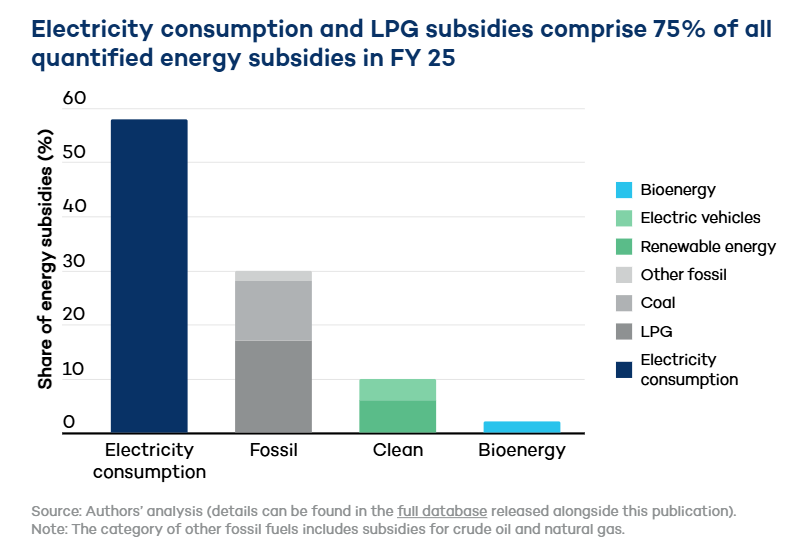





A new analysis from the International Institute for Sustainable Development shows that rising levels of broad-based fossil fuel subsidies are limiting the fiscal space for government to scale clean energy—precisely the solution India needs to decouple its energy system from volatile fossil fuel imports. Fossil fuel subsidies are currently around three times higher than the support going to clean energy.
The report, Mapping India’s Energy Policy 2026: Power Subsidies and Supply Shocks Tightening Clean Energy Support, outlines how this subsidy burden is expected to increase this fiscal year if global prices remain elevated, and domestic prices for petrol, diesel, and LPG continue to be capped.
The report stated that India spent at least INR 4.3 lakh crore ($51 billion) on energy subsidies last fiscal year, 75% of which were consumption subsidies for electricity and LPG, highlighting the scale of public spending currently required to manage energy affordability. While subsidies like this have played a critical role in expanding energy access and protecting households from high, volatile fuel prices, they risk becoming an unsustainable burden for governments.
Electricity subsidies are growing faster than consumption due to higher cut-off limits for eligible consumers in some states, and LPG subsidies are tied to factors outside of the government’s control, such as surging global fuel prices.
Among fossil fuel subsidies, liquefied petroleum gas (LPG) subsidies were the largest at INR 71,718 crore in FY 2025, nearly half of which are under-recoveries (the losses oil and marketing companies incur when retail prices are kept below cost). India imports around 60% of its LPG, exposing subsidy spending to global price volatility.
“The recent tensions in the Gulf highlight India’s exposure to global LPG price volatility,” said Sunil Mani, policy advisor at IISD. “If prices remain elevated at current levels, under-recoveries could exceed INR 60,000 crore in FY 2026–27, increasing pressure on public finances. Scaling alternatives such as electric cooking and decentralized biogas, while better targeting LPG support, can improve affordability and reduce long-term fiscal risks.”
Subsidies for electricity consumption account for INR 2.41 lakh crore, or 58% of total energy subsidies in FY2025—nearly double their level a decade ago. These subsidies are equivalent to 20% of annual revenues for some states, with a growing share used to cover routine operating costs of power distribution companies rather than long-term efficiency improvements. The report finds that some states need to better target electricity subsidies to low-income households to ensure support reaches those who need it most while leaving fiscal room for investments in grid upgrades and clean energy.
“Electricity subsidies have played an important role in expanding access to energy and protecting consumers, but their current scale and recurring nature have entrenched fiscal and operational stress for state governments,” said Godwin Paul Chandra Sekar of IISD. “Without better targeting and deeper reforms, rising subsidies risk crowding out spending on welfare priorities and long-term energy improvements.”
Subsidies for renewable energy reached INR 26,406 crore (USD 3 billion) in FY 2025, with nearly half of this directed to decentralized solutions such as rooftop solar and farmer-led renewable energy systems. Support for electric vehicles also rose to INR 16,812 crore, reinforcing their role in reducing oil dependence. Together, these shifts ease long-term fiscal pressures and strengthen energy security if supported by targeted policy and investment. However, India’s clean energy subsidies currently still account for only about 10% of the total pot.
“The energy crisis is yet another opportunity for India to boost clean energy supplies,” said Swasti Raizada, senior policy advisor at IISD. “Strategic, targeted support—that combines investments in decentralized renewables, clean cooking alternatives, and electric mobility— strengthens India’s energy security and mitigates economic risk over time.”
This content is protected by copyright and may not be reused. If you want to cooperate with us and would like to reuse some of our content, please contact: editors@pv-magazine.com.






By submitting this form you agree to pv magazine using your data for the purposes of publishing your comment.
Your personal data will only be disclosed or otherwise transmitted to third parties for the purposes of spam filtering or if this is necessary for technical maintenance of the website. Any other transfer to third parties will not take place unless this is justified on the basis of applicable data protection regulations or if pv magazine is legally obliged to do so.
You may revoke this consent at any time with effect for the future, in which case your personal data will be deleted immediately. Otherwise, your data will be deleted if pv magazine has processed your request or the purpose of data storage is fulfilled.
Further information on data privacy can be found in our Data Protection Policy.