




Kärcher aims to build a closed-loop cleaning ecosystem for India’s solar industry, covering both PV manufacturing environments and the long-term maintenance of PV plants.
“Our goal is to provide a closed-loop cleaning ecosystem for the Indian solar sector,” said Puneet Sharma, managing director of Kärcher India. “From the moment a PV panel is manufactured in a dust-free environment using our KIRA robots, to its 25-year operational life where it is maintained by our iSolar systems, Kärcher aims to ensure that ‘clean’ equals energy efficiency.”
PV plant cleaning solutions
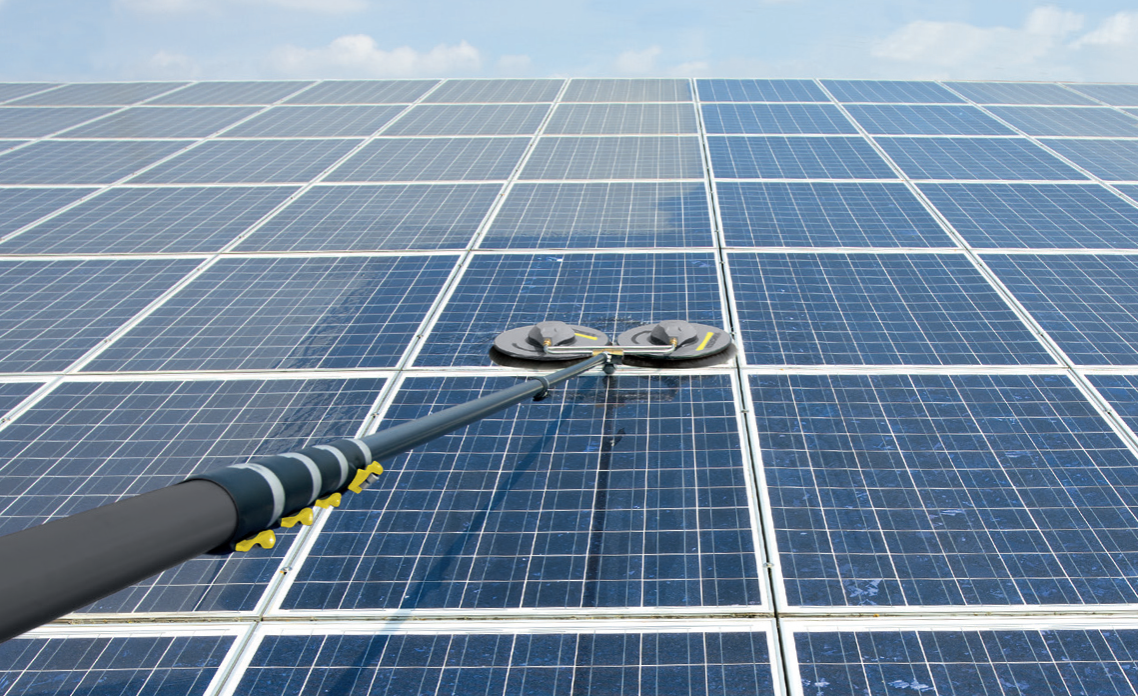
To maximize energy yield in dusty environments, Kärcher offers modular PV cleaning systems that combine mechanical agitation with controlled water pressure. The company’s iSolar module cleaning solutions are designed to remove dust while minimizing water consumption.
The iSolar 400 disc brush has a working width of 400 mm and is suited for small to medium-sized PV installations. Its lightweight design allows operators to clean elevated systems with relative ease. The water-driven iSolar 800 brush head with 800 mm working width works with two contra-rotating disc brushes. The contra-rotation balances transverse forces, enabling operators to guide the unit with limited physical effort during extended cleaning shifts.
Unlike conventional pressure washing, the iSolar system uses the water stream primarily to drive the brushes and rinse the surface. The telescopic wand made from a carbon-fiberglass composite extends up to 14 meters, enabling operators to clean entire rows of modules from the ground or from designated walkways.
Cleaning solutions for manufacturing facilities
With its industrial cleaning solution, Kärcher also targets India’s expanding solar module and battery manufacturing sector, where maintaining dust-free production floors is critical for product quality.
Kärcher provides both autonomous and manual floor-cleaning systems for industrial environments.
KIRA (Kärcher Intelligent Robotic Applications) series robots are designed for cleaning large production halls and logistics warehouses. Models KIRA B 50 and KIRA CV 50 operate autonomously and are equipped with docking stations where the robot automatically refills fresh water, drains wastewater, and recharges its lithium-ion batteries. “Equipped with LiDAR sensors and 3D cameras, the robots can operate safely alongside human workers and automated guided vehicles, making these ideal for the high-traffic floors of a battery gigafactory,” stated the company.
This content is protected by copyright and may not be reused. If you want to cooperate with us and would like to reuse some of our content, please contact: editors@pv-magazine.com.



By submitting this form you agree to pv magazine using your data for the purposes of publishing your comment.
Your personal data will only be disclosed or otherwise transmitted to third parties for the purposes of spam filtering or if this is necessary for technical maintenance of the website. Any other transfer to third parties will not take place unless this is justified on the basis of applicable data protection regulations or if pv magazine is legally obliged to do so.
You may revoke this consent at any time with effect for the future, in which case your personal data will be deleted immediately. Otherwise, your data will be deleted if pv magazine has processed your request or the purpose of data storage is fulfilled.
Further information on data privacy can be found in our Data Protection Policy.