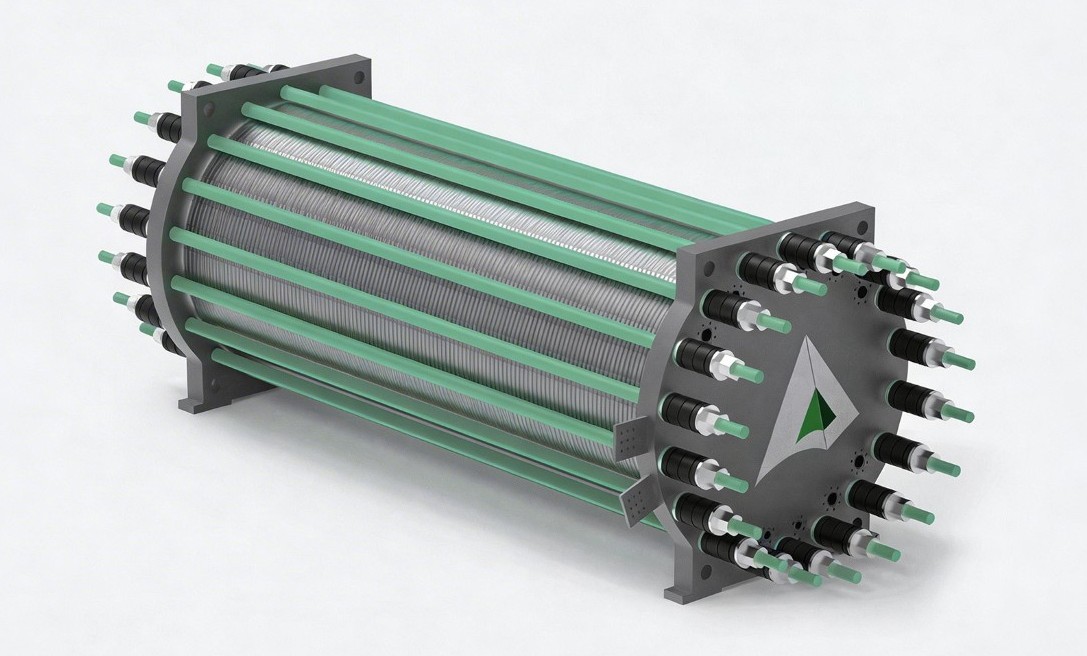





Advait Greenergy, a subsidiary of NSE-listed Advait Energy Transitions Ltd, has inaugurated a 30 MW alkaline electrolyser assembly facility in Mehsana, Gujarat. The facility is designed as a scalable platform, with a roadmap to expand from 30 MW to 100 MW by the end of 2026, 300 MW by 2027, and ultimately 1 GW of annual manufacturing capacity. This modular expansion pathway is intended to support the expected growth in green hydrogen demand across industrial sectors such as fertilisers, refining, steel manufacturing and heavy transport.
India’s National Green Hydrogen Mission, which targets the production of 5 million metric tonnes of green hydrogen annually by 2030, has catalysed significant investment across the hydrogen value chain. From renewable power generation to electrolyser manufacturing and hydrogen utilisation, multiple segments of the industry are beginning to scale rapidly. Advait Greenergy’s facility in Mehsana represents one of the early industrial-scale responses to this policy framework, establishing domestic assembly capability for electrolyser systems required for large-scale hydrogen production.
“Over the past decade, Gujarat has built strong industrial infrastructure supported by renewable energy corridors, port connectivity and long-standing policy stability. These factors have attracted investments across solar manufacturing, battery storage, renewable energy development and now hydrogen technologies, positioning Gujarat as a central hub for India’s emerging clean energy economy. Advait’s Mehsana facility is part of this wider ecosystem that continues to attract participation from both technology companies and industrial partners,” stated Advait Greenergy.
Advait Greenergy has been selected and received approval for 300 MW capacity under the Production Linked Incentive (PLI) programme for electrolyser manufacturing, alongside participation in a 100 MW green hydrogen project component.
Beyond hydrogen technologies, Advait Energy Transitions continues to expand its presence across multiple clean energy verticals. The company currently has 200 MW+ of solar EPC projects under execution.
Advait Greenergy also has 400 MWh+ of Battery Energy Storage System (BESS) projects currently under development. In addition, the company is establishing a 2.5 GWh BESS manufacturing facility scheduled for commissioning in 2026.
Speaking at the electrolyser facility launch, Shalin Sheth, Director, Advait Greenergy Pvt. Ltd., said: “Gujarat has always led where India needed to go first. From textiles to petrochemicals to renewables, this state has never waited for the future — it has built it. When we chose Mehsana for our electrolyser facility, we were not simply selecting a location. We were placing our confidence in a manufacturing ecosystem that has proven, time and again, that it can deliver at scale. Advait is proud to be part of that legacy.”
Vatsal Kundalia, Managing Director, Advait Greenergy Pvt. Ltd., added: “Prime Minister Modi’s vision for India as a global manufacturing leader finds some of its strongest expression right here in Gujarat. The state’s industrial depth, its policy clarity, and its ambition are precisely what a technology like electrolyser manufacturing requires to move from promise to production. Advait’s facility in Mehsana is our contribution to that vision — and we believe Gujarat will be to green hydrogen what it has already become to solar energy: the state that showed India how it is done.”
This content is protected by copyright and may not be reused. If you want to cooperate with us and would like to reuse some of our content, please contact: editors@pv-magazine.com.




By submitting this form you agree to pv magazine using your data for the purposes of publishing your comment.
Your personal data will only be disclosed or otherwise transmitted to third parties for the purposes of spam filtering or if this is necessary for technical maintenance of the website. Any other transfer to third parties will not take place unless this is justified on the basis of applicable data protection regulations or if pv magazine is legally obliged to do so.
You may revoke this consent at any time with effect for the future, in which case your personal data will be deleted immediately. Otherwise, your data will be deleted if pv magazine has processed your request or the purpose of data storage is fulfilled.
Further information on data privacy can be found in our Data Protection Policy.