




From ESS News
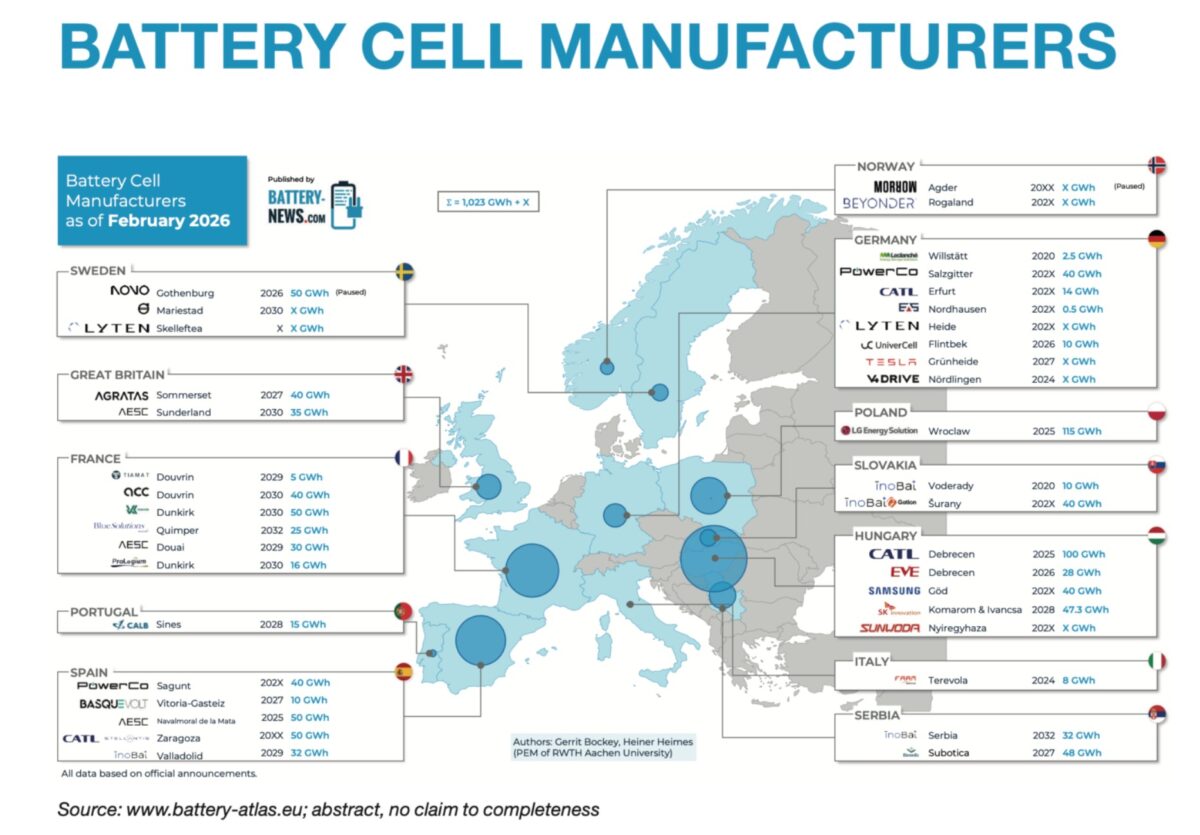
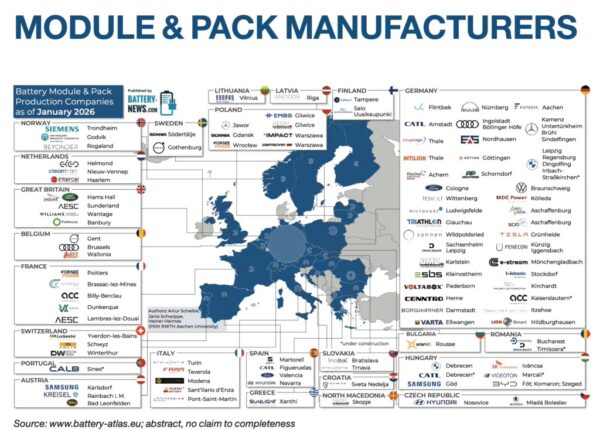
RWTH Aachen University has published the third edition of the “Battery Atlas 2026,” produced by the Production Engineering of E-Mobility Components (PEM) Chair. The free online report maps the European lithium-ion battery value chain.
Titled “Mapping the European Lithium-Ion Battery Industry,” the publication provides a data-driven overview of the sector, covering the entire industry landscape from cell production to modules and packs. It also examines related segments such as machinery, materials, quality control, recycling, and the development of next-generation battery technologies.
The report features detailed listings of companies across the battery ecosystem, including battery cell manufacturers, module and pack producers, equipment suppliers, battery quality control firms, active material suppliers, recycling companies, battery testing facilities, passive component suppliers for battery cells and battery systems, as well as solid-state battery developers.
The report also reflects the consolidation phase the European battery market is undergoing. While over 2,000 GWh of cell production capacity was announced in 2023, the realistic forecast for early 2026 is around 1,190 GWh, of which approximately 673 GWh is led by Asian companies. This market correction is further illustrated by the frequent use of vague dates such as “202X” or “20XX” in numerous projects, highlighting delays and a lack of concrete schedules.
To continue reading, please visit our ESS News website.
Author: Pilar Sanchez Molina
This content is protected by copyright and may not be reused. If you want to cooperate with us and would like to reuse some of our content, please contact: editors@pv-magazine.com.




By submitting this form you agree to pv magazine using your data for the purposes of publishing your comment.
Your personal data will only be disclosed or otherwise transmitted to third parties for the purposes of spam filtering or if this is necessary for technical maintenance of the website. Any other transfer to third parties will not take place unless this is justified on the basis of applicable data protection regulations or if pv magazine is legally obliged to do so.
You may revoke this consent at any time with effect for the future, in which case your personal data will be deleted immediately. Otherwise, your data will be deleted if pv magazine has processed your request or the purpose of data storage is fulfilled.
Further information on data privacy can be found in our Data Protection Policy.