




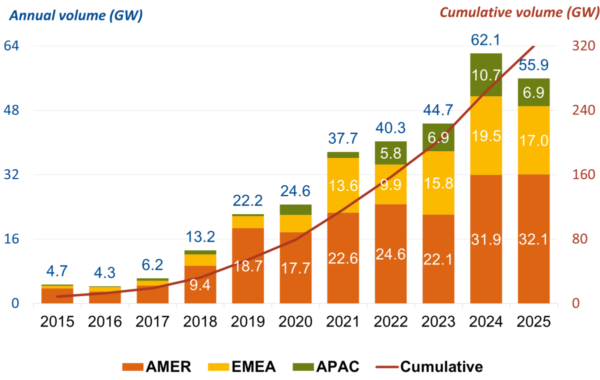
AI-driven electricity demand ensured 2025 was the second-highest year on record for corporate clean-energy power purchase agreements (cPPA), according to a new report from BloombergNEF. The analyst recorded 712 offsite cPPAs totaling 55.9 GW of capacity, down 10% on 2024. Technology giants Meta, Amazon, Google and Microsoft accounted for 49% of global activity.
Nayel Brihi, corporate energy analyst at BloombergNEF told pv magazine that policy uncertainty in the United States and other markets, increasing negative power prices in some regions, and questions over the future of carbon accounting standards contributed to the dip in cPPA volumes.
“It’s a cocktail of the above,” said Brihi. “In Western Europe, negative power prices are really bringing new risks that even corporate energy sellers weren’t fully aware of a few years ago. Add in policy uncertainty, carbon accounting questions, and other market factors, and you can see why activity has slowed in those markets.”
BloombergNEF records offsite cPPAs that are publicly disclosed or submitted to the researcher. Deals counted by BloombergNEF have contract durations greater than one year, and the technologies considered clean energy in the report include, solar, wind, hydro, biomass, geothermal and nuclear energy. Gas turbines with carbon capture are excluded, as are battery energy storage (BESS) assets not paired with a generator.
The Americas (AMER) region led in 2025 with 32.1 GW of cPPA deals signed, including 29.5 GW in the United States alone. Europe, the Middle East and Africa (EMEA) accounted for 17 GW of the global total, with the remaining 6.9 GW found in the Asia Pacific (APAC) region.
Source: BloombergNEF
AMER was the only region to maintain its performance from 2024, up around half a percent in 2025, with EMEA down 13% and APAC down 35%.
Despite being the biggest loser in capacity terms, Brihi said the outlook for APAC remains positive. The 2025 decline reflected a lack of mega-deals, such as Rio Tinto procuring more than 2 GW of power across two cPPAs in Australia in early 2024, as well as some policy uncertainty in India and South Korea. Brihi added BloombergNEF’S team in India estimates actual cPPA volume may be higher than the public data, there are new corporate PPA frameworks opening up in Malaysia, the Japanese market is maturing and demand remains strong in Australia.
The United States market was buoyed by increasing demand from Big Tech, as the number of unique companies signing cPPAs tumbled 51% from 68 in 2024 to 33 in 2025. Government policy on tariffs, changes to energy tax credits in the One Big Beautiful Bill Act and increased operating costs for some businesses were all highlighted by Brihi as potential headwinds.
Demand for cPPAs in Europe was not uniform, with some markets facing challenges while others thrived. Brihi noted that the United Kingdom and Finland both had record years, deal volumes increased in Poland and Italy remains a gigawatt-scale market. BloombergNEF also found a trend toward hybrid PPAs in Europe, such as combining solar with wind.
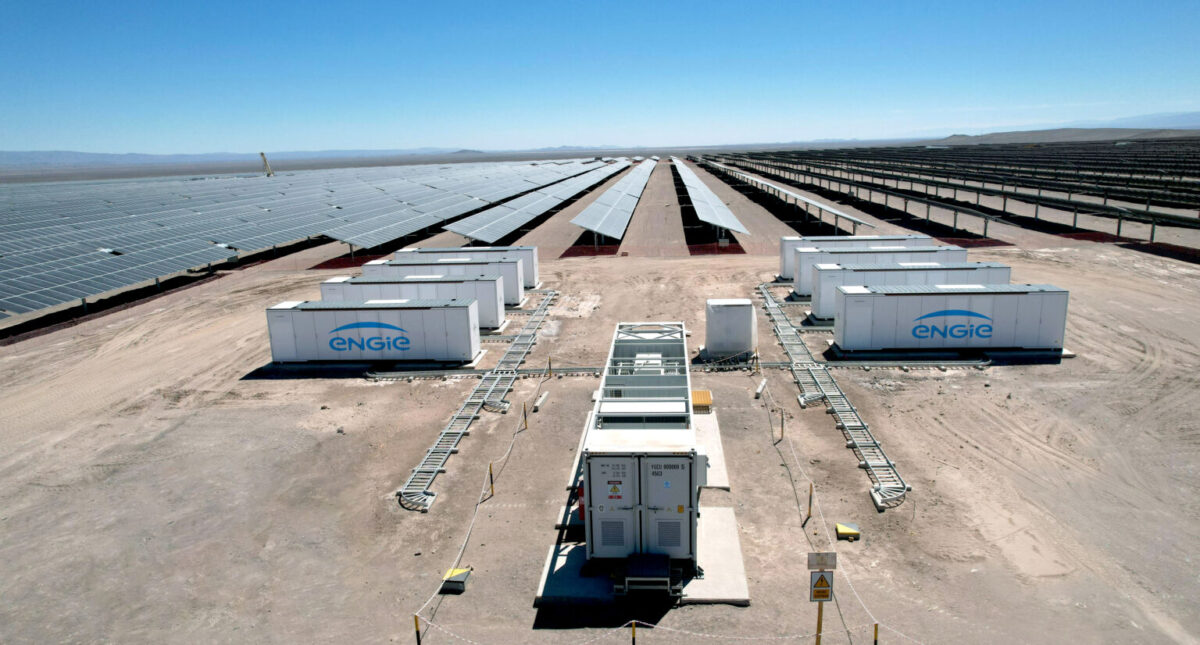
Engie was the top developer on the selling side of cPPAs, contracting 3.6 GW globally – the majority of which was solar. Developers offering clean, firm power solutions to were increasingly prevalent, with BloombergNEF reporting seven of the top 10 engaging in such contracts – including solar and storage, hybrid solar and wind, or nuclear PPAs. Products described as “baseload-like” by BloombergNEF accounted for 5.2 GW of the cPPAs signed in 2025.
“We’re seeing a transition from standalone products to more hybridized products or structured solutions,” Brihi explained. “How quickly this shift will happen is really going to depend on how competitively priced those alternative structured solutions are.”
Despite hybrid cPPAs becoming more prevalent, solar remains the top pick for clean energy procurement.
“Solar is still the main procurement option globally,” Brihi said. “Especially in those newer markets that are not really plagued with negative power prices.”
The full “1H 2026 Corporate Energy Market Outlook: Cooling Off Down, but not out” report on cPPAs is available from BloombergNEF.
This content is protected by copyright and may not be reused. If you want to cooperate with us and would like to reuse some of our content, please contact: editors@pv-magazine.com.


By submitting this form you agree to pv magazine using your data for the purposes of publishing your comment.
Your personal data will only be disclosed or otherwise transmitted to third parties for the purposes of spam filtering or if this is necessary for technical maintenance of the website. Any other transfer to third parties will not take place unless this is justified on the basis of applicable data protection regulations or if pv magazine is legally obliged to do so.
You may revoke this consent at any time with effect for the future, in which case your personal data will be deleted immediately. Otherwise, your data will be deleted if pv magazine has processed your request or the purpose of data storage is fulfilled.
Further information on data privacy can be found in our Data Protection Policy.