




Driven by the “Make in India” strategy, India has made significant progress and is becoming a global manufacturing powerhouse, currently ranking as the world’s fifth-largest manufacturing country, behind only China, the United States, Japan, and Germany. Besides the explosive growth in electronics exports, the impact of the Production-Linked Incentive (PLI) scheme, and the shift of high-tech manufacturing investments from China to India, the country has also made breakthroughs in multi-chip module exports, and the widespread adoption of battery electric vehicles (BEVs) and the use of battery energy storage systems (BESS) to power various industries and neighborhoods are positioning India favorably on its path to becoming the world’s fourth-largest economy sooner or later.
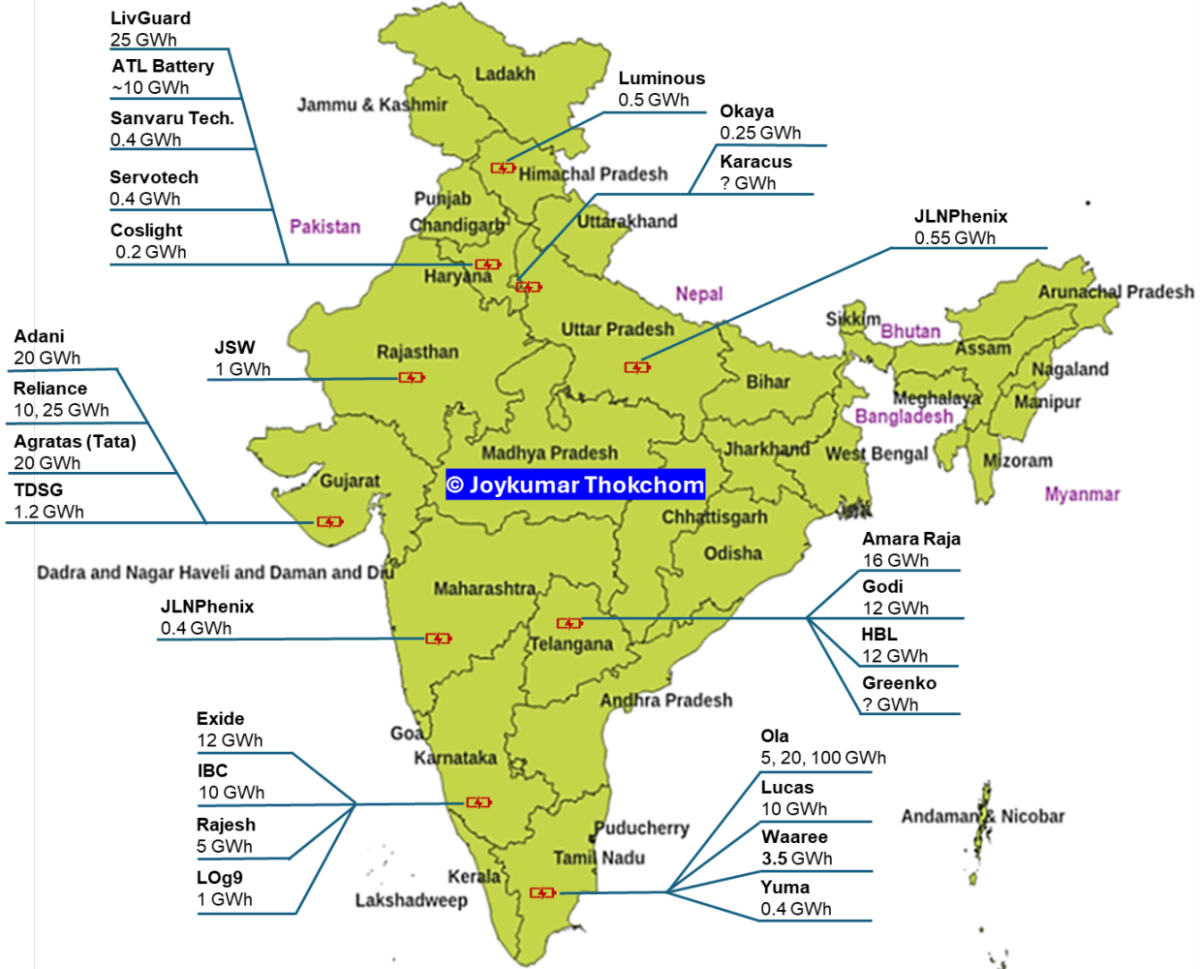
India’s battery manufacturing capacity is expanding rapidly, based on manufacturing plan shown in Figure 1, aiming to power hundreds of thousands of BEVs, thousands of BESS, and more. This growth is driven by significant investments and numerous gigawatt-scale projects from companies such as Adani, Agratas (Tata), Amaraja, Exide, Godi, HBL, IBC, Lucas, Ola, and Reliance. However, challenges such as raw material and skilled labor shortages, insufficient R&D investment, and a lack of long-term strategic planning remain.
By the end of 2025, India had set a target of approximately 50 GWh for lithium-ion battery manufacturing capacity to meet domestic demand for BEVs and BESS. However, the actual operational capacity is only about 1.4 GWh (2.8% of the target) (primarily from Ola Electric), indicating a significant delay in project progress. Various obstacles have hindered the construction of actual production capacity. It is projected to achieve a production capacity of 100 GWh by 2026 by establishing manufacturing plants in key states such as Karnataka, Tamil Nadu, and Gujarat, but challenges such as supply chain and implementation obstacles have slowed down the actual construction progress.
Key Development & Capacity
Rapid growth:
The number of operational gigafactories will increase significantly, with more than 30 manufacturing sites expected to be in operation by 2030, targeting a total production capacity exceeding ~290 GWh. This capacity will be sufficient to power hundreds of thousands of BEVs, thousands of BESS, renewable energy storage facilities, industrial power plants, telecommunication nodes, and data centers across the country. Approximately 30% of this total capacity is expected to be used for BEVs.
Some of the Key Players: As shown in Figure 1, approximately 30 companies are currently involved, working towards India’s goal of achieving a battery manufacturing capacity of 290 gigawatt-hours by 2030.
Joykumar Thokchom
The following lists some of the key players and provides detailed information about their battery chemistry, application areas, and planned production scale.
Adani Power:Ahmedabad, Gujarat; LFP chemistry; BEV/BESS applications; Plan for 20GWh
Agratas Energy (Tata): Sanand, Gujarat; LFP chemistry; BEV/BESS; Plan for 20GWh
Amara Raja: Karakambadi/Divitipally, Telangana; LFP chemistry; BEV/BESS; Plan for 16GWh
Exide Industries: Greenfield, Karnataka; LFP/Other chemistry; BEV/BESS; Plan for 12GWh
Godi Energy: Hyderabad, Telangana; LFP/Other chemistry; BEV/BESS; Plan for 12.5GWh
HBL Power Systems: Hyderabad, Telangana; LFP/Other chemistry; BEV/BESS/Other; Plan for 12GWh
International Battery Co.: Bengaluru, Karnataka; LFP/Other chemistry; BEV/BESS/Other; Plan for 10GWh
LivGuard Energy: Manesar, Haryana; LFP/Other chemistry; BEV/BESS/Other; Plan for 25GWh
Lucas TVS:Chennai, Tamil Nadu; LFP/Semi solid chemistry; BEV; Plan for 10GWh
Ola Electric: Krishnagiri, Tamil Nadu; NMC/Other chemistry; BEV; Plan for 20GWh
Rajesh Exports: Dharwad, Karnataka; LFP/Other chemistry; BEV/BESS; Plan for 5GWh
Reliance Industries: Jamnagar, Gujarat; LFP chemistry; BEV/BESS/Other; Plan for 25GWh
Toshiba-Denso-Suzuki Group: Hansalpur, Gujarat; LTP/Other chemistry; BEV; Plan for 1.2GWh
Other major players in the industry, including companies such as Su-Kam Power, Panasonic, Jindal, Hero Future Energy, and Mahindra, are in the process of deciding on the locations for their manufacturing plants. In addition, many other manufacturers, such as Amtek, Battrixx, ITP, PPAP Tech, QMax Ion, and Relicell, offer customized battery solutions for mobile, solar, and telecommunications applications. These solutions use lithium-ion cells from around the world, often sourced from Chinese manufacturers to meet high battery demands.
Challenges & Outlook
Supply Chain Gaps and need for autonomy: Despite increasing battery production, India still faces persistent shortages in the supply of cathode materials, anode materials, and lithium salts used in liquid electrolytes, relying primarily on supplies from Asian countries such as China, South Korea, and Japan.
Despite India’s recent push to build several gigawatt-scale manufacturing plants, a long-term bottleneck in achieving strategic autonomy lies in its inability to fully control the production of key lithium salts (such as LiPF6 and Li2CO3/LiOH). These lithium salts are crucial raw materials for manufacturing liquid electrolytes and cathode active materials like lithium iron phosphate (LFP)/nickel manganese cobalt oxide (NMC), areas currently almost entirely dominated by China.
Ecosystem Development: Compared to other major Asian countries mentioned above, establishing a complete ecosystem that includes raw materials and specialized suppliers is a long-term challenge for India.
Strategic Importance: India actively supports this development to reduce its reliance on imports from the aforementioned major Asian countries, promote the development of a circular economy, and ensure the resilience of supply chains.
India’s strengths:
Manpower: Large numbers of educated youths will have the opportunity to join mainstream industries such as battery manufacturing, supply chain management, services, and research and development.
Recycling: The numerous battery recycling plants located near Indian port cities are a key factor in meeting the domestic and international demand for recycling used batteries. This will facilitate the production and supply of recycled battery materials, such as LFP/NMC materials, copper and aluminum current collectors, and battery pack components used in the manufacture of new batteries.
Electronics and software: India’s strong capabilities in electronics design and manufacturing, as well as battery management system (BMS) software development, will play a crucial role in this industry. India has the experience of building one of the world’s most robust IT service ecosystems, supporting global banks, airlines, telecommunications networks, and enterprises. This same force for transformation and innovation can be applied to the battery industry, driving the widespread adoption of BEVs and BESS. This will enable to achieve the strategic goal to decarbonize transport, stabilize its rapidly growing renewable energy grid by 2030, and achieve net-zero goals, creating a massive market for local manufacturing and grid integration, despite challenges in tender execution and infrastructure.
Non-chemical battery parts: India can procure or manufacture other battery components, such as copper and aluminum current collectors, battery separators, solvents/additives, and battery packaging materials/components. India also possesses the capability to domestically produce machinery and robots.
Summary
India’s battery gigafactory capacity is booming, with significant investment and production growth transforming this sector from a vision into a reality and is expected to achieve the strategic goal of scaling up battery manufacturing to approximately ~290 gigawatt-hours by 2030.
Establishing a fully integrated and self-sufficient supply chain remains a challenging and ongoing endeavor. In the short term, India can procure or manufacture other battery components such as copper and aluminum current collectors, battery separators, solvents/additives, and battery packaging materials/components, while also leveraging its ample supply of recycled battery materials, machinery, robotics, electronics, and software. However, to achieve long-term strategic autonomy, India needs to gain complete control over the production of key raw materials used to manufacture liquid electrolytes (e.g., LiPF6) and cathode active materials (such as LFP)/NMC), areas currently almost entirely dominated by China.
Most importantly, given current industry trends and massive investments in the sector, India’s goal of achieving 100% electrified transportation by 2035, and its efforts to reach 500 gigawatts of renewable energy by 2030, which will ultimately lead to net-zero emissions, present a very promising outlook.
Joykumar Thokchom is vice president-R&D at a US-based company.
The views and opinions expressed in this article are the author’s own, and do not necessarily reflect those held by pv magazine.
This content is protected by copyright and may not be reused. If you want to cooperate with us and would like to reuse some of our content, please contact: editors@pv-magazine.com.



By submitting this form you agree to pv magazine using your data for the purposes of publishing your comment.
Your personal data will only be disclosed or otherwise transmitted to third parties for the purposes of spam filtering or if this is necessary for technical maintenance of the website. Any other transfer to third parties will not take place unless this is justified on the basis of applicable data protection regulations or if pv magazine is legally obliged to do so.
You may revoke this consent at any time with effect for the future, in which case your personal data will be deleted immediately. Otherwise, your data will be deleted if pv magazine has processed your request or the purpose of data storage is fulfilled.
Further information on data privacy can be found in our Data Protection Policy.