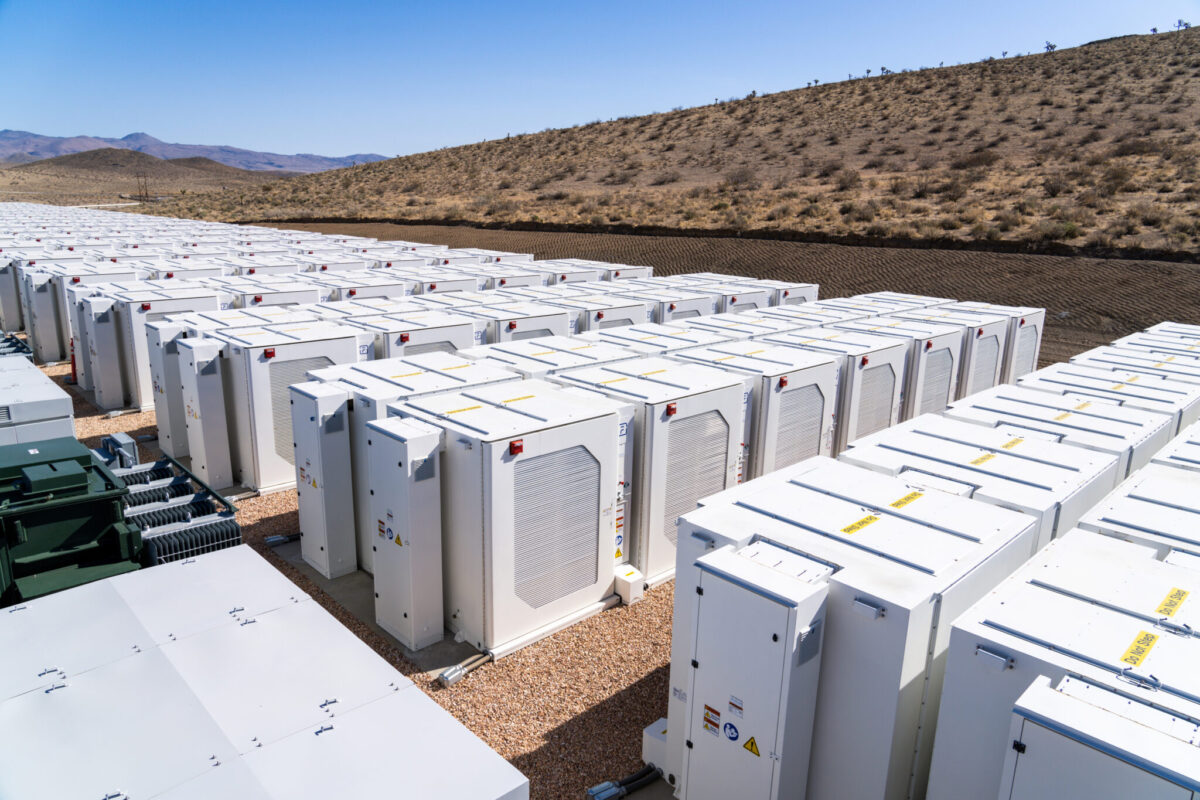





A new analysis from energy think tank Ember shows that the cost of storing electricity with utility-scale batteries has fallen to just $65/MWh as of October 2025 outside China and the US, making it economically feasible to deliver solar power when it is needed.
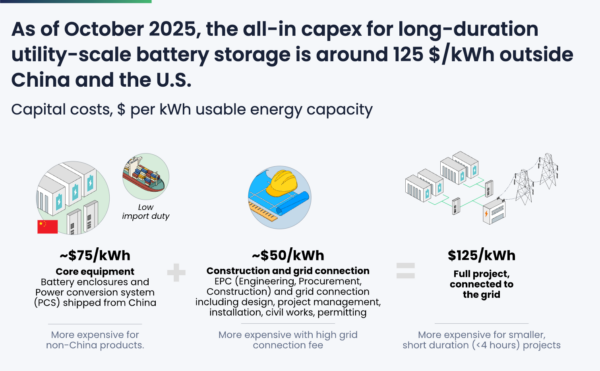
Battery costs have fallen dramatically over the past two years. The analysis shows that after a particularly steep drop in 2024, costs have continued to decline significantly this year.
Ember’s assessment of storage costs as of October 2025, is based on recent auctions in Italy, Saudi Arabia and India and on interviews with active developers across global markets.
Kostantsa Rangelova, Global Electricity Analyst at Ember, said: “After a 40% fall in 2024 in battery equipment costs, it’s clear we’re on track for another major fall in 2025. The economics for batteries are unrecognisable, and the industry is only just getting to grips with this new paradigm.”
This marks a major shift in how quickly battery storage has become affordable and how close it is to providing reliable clean electricity that can be delivered when it is needed.
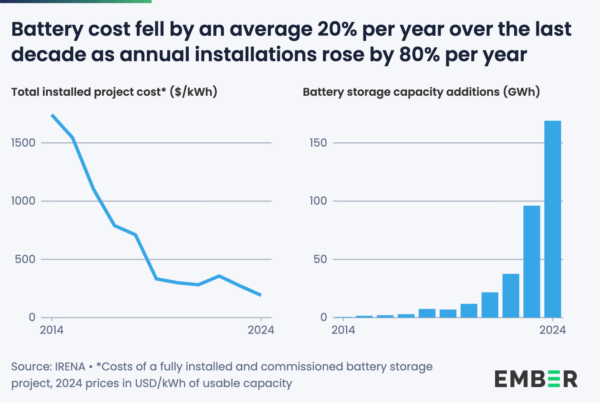
The research assesses the cost of a full battery storage system connected to the grid as only $125/kWh as of October 2025. This is for long-duration (four hours or more) utility-scale battery projects in global markets outside China and the US. Core battery equipment delivered from China now costs around $75/kWh, while installation and grid connection typically add about $50/kWh.
This has pushed down the price of storing electricity. The Levelised Cost of Storage (LCOS) is assessed at just $65/MWh, based on the $125/KWh capital cost and real-world project assumptions of financing costs, lifetime, efficiency and degradation.
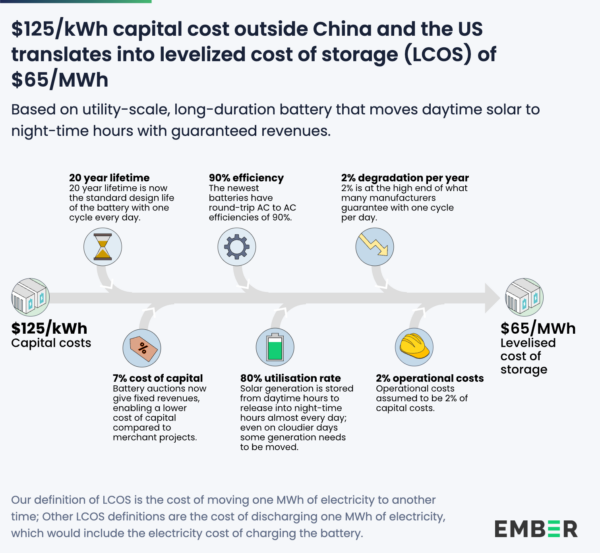
The report states that low LCOS is not only the result of cheaper batteries—longer lifetimes, higher efficiencies and lower financing costs supported by clearer revenue models like auctions have all helped to push the LCOS down sharply. Ember has developed a live calculator that allows users to work out the LCOS using their own assumptions.
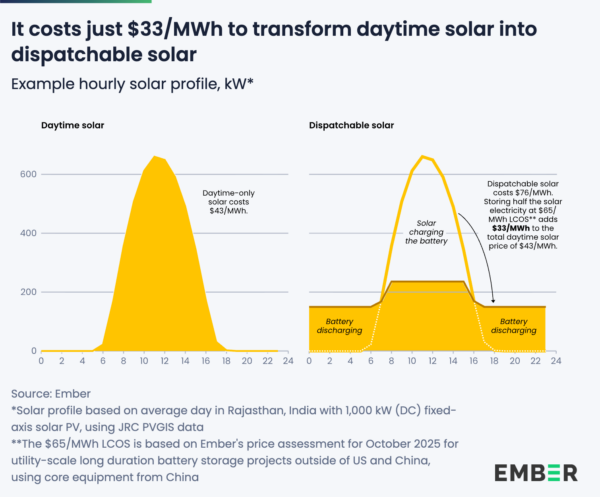
Most solar generation is used during the day, so only part of it needs to be stored to provide dispatchable supply. If half of daytime solar generation is shifted to the night, then the $65/MWh storage cost adds about $33/MWh to the total cost of solar. The global average price of solar in 2024 was $43/MWh. Turning this cheap daytime electricity into a dispatchable profile that is closer to an actual demand profile would therefore result in a total electricity cost of $76/MWh.
“Solar is no longer just cheap daytime electricity, now it’s anytime dispatchable electricity. This is a game-changer for countries with fast-growing demand and strong solar resources.” Rangelova added.
This content is protected by copyright and may not be reused. If you want to cooperate with us and would like to reuse some of our content, please contact: editors@pv-magazine.com.




3 comments
By submitting this form you agree to pv magazine using your data for the purposes of publishing your comment.
Your personal data will only be disclosed or otherwise transmitted to third parties for the purposes of spam filtering or if this is necessary for technical maintenance of the website. Any other transfer to third parties will not take place unless this is justified on the basis of applicable data protection regulations or if pv magazine is legally obliged to do so.
You may revoke this consent at any time with effect for the future, in which case your personal data will be deleted immediately. Otherwise, your data will be deleted if pv magazine has processed your request or the purpose of data storage is fulfilled.
Further information on data privacy can be found in our Data Protection Policy.