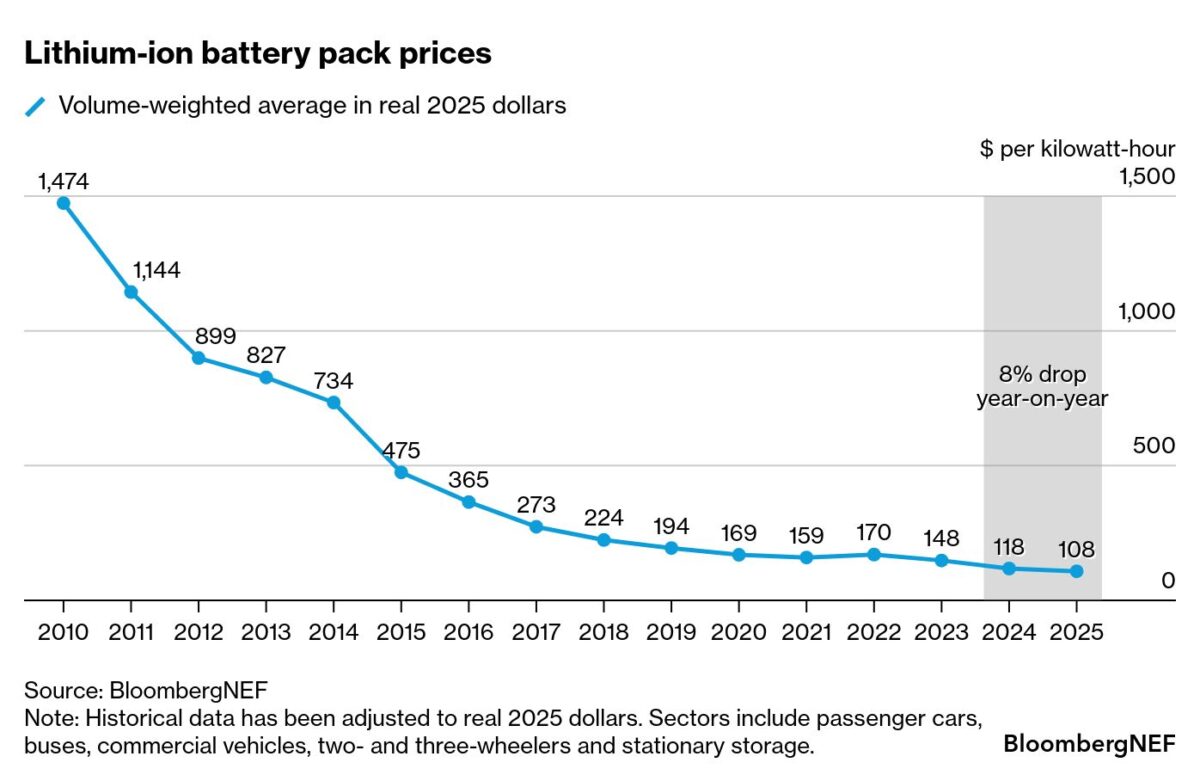





While the pace of price decreases has slowed, lithium-ion battery packs have reached a new record low in 2025. According to the latest analysis by BloombergNEF (BNEF), prices have fallen 8% since 2024 to $108/kWh, making them 93% lower than in 2010.
Despite an increase in battery metal costs, continued cell manufacturing overcapacity, intense competition and the ongoing shift to lower-cost lithium iron phosphate (LFP) batteries helped drive down pack prices, according to BNEF’s 2025 Lithium-Ion Battery Price Survey.
Battery metal prices rose in 2025 due to supply risks in Chinese lithium operations and new cobalt export quotas in the Democratic Republic of Congo. However, higher metal costs did not increase cell or pack prices, as the industry offset them through LFP adoption, long-term contracts, and hedging. China’s consistent oversupply of cells has fueled intense competition, especially in stationary storage, while its dominance in LFP production met nearly all global demand.
BNEF’s battery price survey – which spans multiple end uses, including various electric-vehicle types and stationary-storage applications – reveals pronounced differences across sectors. Battery pack prices for stationary storage fell to $70/kWh in 2025, 45% lower than in 2024. This was the steepest decline of any segment, making stationary storage the lowest-priced category for the first time. In the transport sector, battery-electric vehicle packs were the cheapest at $99/kWh, marking the second consecutive year they remained below the $100/kWh threshold.
Average LFP battery pack prices across all segments came in at $81/kWh while nickel manganese cobalt (NMC) packs were at $128/kWh.
To continue reading, please visit our ESS News website.
This content is protected by copyright and may not be reused. If you want to cooperate with us and would like to reuse some of our content, please contact: editors@pv-magazine.com.





By submitting this form you agree to pv magazine using your data for the purposes of publishing your comment.
Your personal data will only be disclosed or otherwise transmitted to third parties for the purposes of spam filtering or if this is necessary for technical maintenance of the website. Any other transfer to third parties will not take place unless this is justified on the basis of applicable data protection regulations or if pv magazine is legally obliged to do so.
You may revoke this consent at any time with effect for the future, in which case your personal data will be deleted immediately. Otherwise, your data will be deleted if pv magazine has processed your request or the purpose of data storage is fulfilled.
Further information on data privacy can be found in our Data Protection Policy.