




From pv magazine France
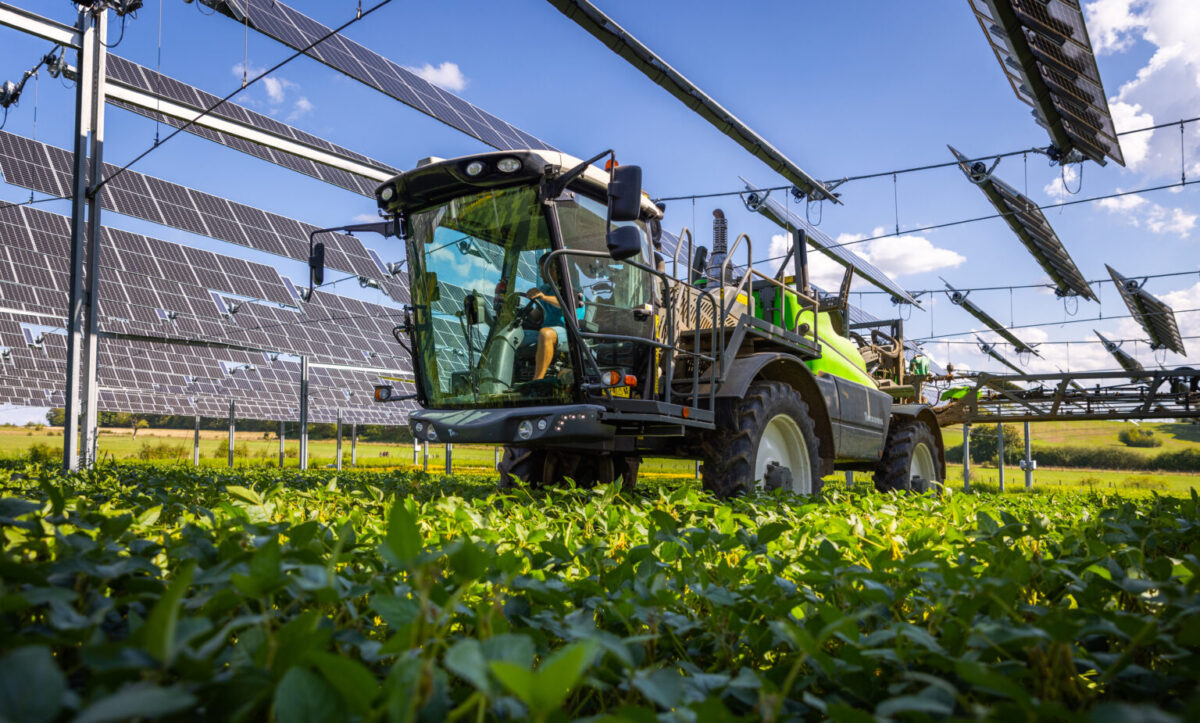
TSE says consolidated field data from three years of agrivoltaic canopy trials in France with INRAE, agricultural cooperatives, and Chambers of Agriculture indicate measurable climate-control benefits for crops and livestock across multiple sites and seasons.
While 2025 was warmer and sunnier than usual, TSE said that the panels provided notable climate protection during periods of water stress.
“We have a year of data, and we’ve observed that during periods of intense heat, the tonnage of dry matter harvested under the canopy nearly doubled, thanks to a canopy specifically designed for agriculture,” said Yoann Bizet, a farmer in Souleuvre-en-Bocage who uses an agrivoltaic canopy.
Observations also showed that when temperatures reached 20 C, the control herd waited at the gate to enter the building, while the herd under the shaded canopy was less affected by the heat.
Microclimate control
Average temperature reductions reached 1.4 C on the hottest days, with drops of up to 7 C during heatwaves recorded in Amance on June 30, 2025, and in Brouchy on July 18, 2025. Canopy areas also saw increases of 2 C on the coldest nights, with temperature ranges reduced by about 1 C across a full day on average throughout the year.
Crop yields
Trials demonstrated higher yields under the system with agroclimatic control, with an 18% increase compared to uncontrolled areas in Verdonnet in 2025. Total annual yields remained comparable between canopy and control areas, but resilience was higher during dry conditions in Souleuvre-en-Bocage from 2024 to 2025.
Water balance
Potential evapotranspiration fell by an average of 35% in Verdonnet in 2025. Stress days for soybeans decreased by 75% over the full cycle in Amance in 2022.
Animal comfort
Shading reduced solar radiation and improved livestock comfort. During the 2025 heatwaves, cows rested under the canopy, while those in control areas sought shelter in buildings.
Agricultural partnerships
TSE is also expanding its agrivoltaic portfolio through agricultural partnerships across multiple sites in France. In Brouchy, the company is developing a 2.9 MW installation with Noriap and the Somme Chamber of Agriculture.
In Verdonnet and Amance, TSE is collaborating with Alliance BFC – Dijon Céréales on 2.9 MW and 2.4 MW projects. In Souleuvre-en-Bocage, the company is working with IDELE, the Normandy Chamber of Agriculture, and INRAE on a 2.9 MW installation.
This content is protected by copyright and may not be reused. If you want to cooperate with us and would like to reuse some of our content, please contact: editors@pv-magazine.com.




We appreciate for Vrttical solarpanel performanes.especially for India.Irecommend the veryical panel research because of indias grest succeds in Highwsys fsdt track,which are protectrd by cctv,if necesssry by drones. We have 40000km. We can accommdste HJT bifacial vertical module solsr panel 4x rowsx800Wp Huasun and generate -32000MW solar power without canablaizind land.Further each urban ,village can be supplied with vertical solar power.
HJT760Wp already certified and 800Wp isunder tedt.
India must widup Topcan series 8 step process and dumping old models and .foceing dealers for DCR.
India should go for higher technoly silicon Ga,Ar.
Promote research. SPACE sOLAR power plant.Lader,microwave trsnsmission yo grounf for 24 hour solar ability
I had requedtrd PV magaxine toorganize a forum from 2018 solar industrial owners ,vendors rebiew the performance.Are they able to payback their EMI,operational problem,Did they really solved employment problems ….,but I see many many many invedters fumping on old process solar modules mamufacturing topcan and low capacity..