‘An immediate transition to copper is technically and economically feasible’
With silver prices rising, more large solar manufacturers are expected to switch to copper for cell metallization. Radovan Kopecek of ISC Konstanz tells pv magazine that he expects the entire industry to follow. Ning Song of the University of New South Wales says a small efficiency tradeoff may be acceptable if the cost savings are significant and do not introduce new reliability risks.
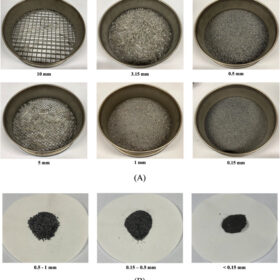
New sieving tech for solar cell silver recovery
Researchers at University of New South Wales have reported details about a novel sieving-aids technology that improves the separation of metal fragments from other components when recycling end-of-life PV panels. The patented process reportedly enhances the recovery of silver.
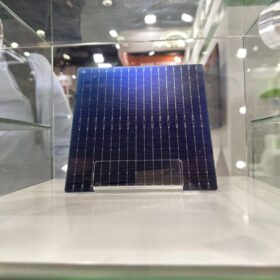
All solar cell efficiencies at a glance – updated
The research group led by Professor Martin Green has published Version 64 of the solar cell efficiency tables. There are 19 new results reported in the new version.
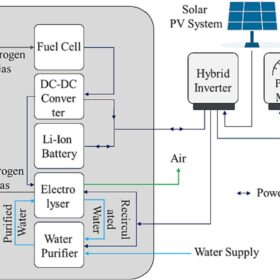
Hydrogen batteries vs. lithium-ion batteries
Researchers in Australia have compared the technical and financial performances of a hydrogen battery storage system and a lithium-ion battery when coupled with rooftop PV. They evaluated two commercially available systems – LAVO and Tesla Powerwall 2 – and found that the lithium-ion battery provides better financial profits, whereas the hydrogen battery offers more battery lifespan for long duration of energy storage.
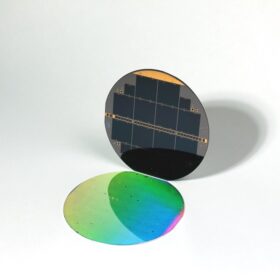
All solar cell efficiencies at a glance – updated
The research group led by Professor Martin Green has published Version 63 of the solar cell efficiency tables. There are six new results reported in the new version.
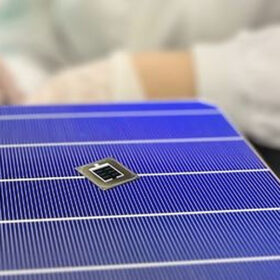
All solar cell efficiencies at a glance – updated
The research group led by Professor Martin Green has published Version 62 of the solar cell efficiency tables. There are 21 new results reported in the new version, a record number for the Tables.
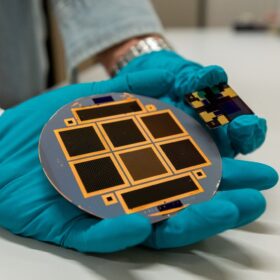
The PV scientific community’s rush to the latest efficiency record
Perovskite-silicon tandem technology expert Gianluca Coletti explains what cycles the PV industry and scientific community experience every time there are new jumps in power conversion efficiencies at cell level. According to him, we are experiencing a much faster turnover of efficiency records typical of the early stage of development of a new technology holding an incredible potential.
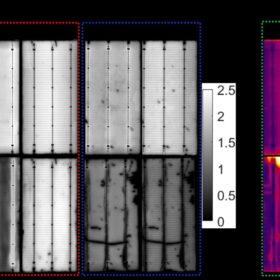
Scientists warn of heat-induced failure risks in HJT glass-backsheet PV modules
University of New South Wales researchers have identified four failure modes caused by damp heat in heterojunction solar panels with a glass-back sheet configuration. The failures could result in power losses ranging from 5% to 50%.
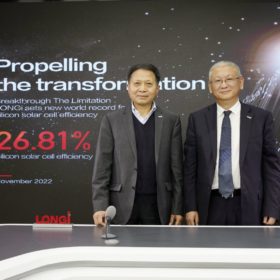
Longi claims world’s highest efficiency for silicon solar cells
Longi said it has achieved a 26.81% efficiency rating for an unspecified heterojunction solar cell, as confirmed by Germany’s Institute for Solar Energy Research Hamelin (ISFH).
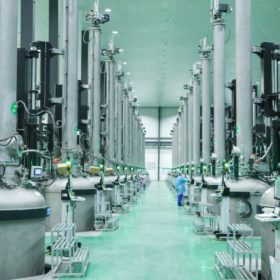
The PV industry needs 12 times more polysilicon production capacity by 2050
New research from the University of New South Wales (UNSW) predicts cumulative polysilicon demand of 46-87 Mt will be required to achieve 63.4 TW of PV installed by 2050.