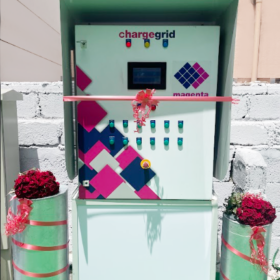
Magenta Mobility unveils EV charger with 12 outputs
Magenta Mobility has launched an electric vehicle (EV) charger that can charge 12 EVs simultaneously. The charger is especially suited for charge point operators, fleet operators, community parking bays, and residential complexes.

Germany launches 33 kW prototype highway PV system
Germany has deployed a 33 kW prototype highway PV system in collaboration with Austria and Switzerland. The system aims to harness solar energy from highway infrastructure.

WindStream launches hybrid wind-solar street light system
Telangana-based WindStream Energy Technologies has launched a hybrid wind-solar street light system for hilly, coastal, and rural areas.

Italian supplier unveils new PV garden system
Italy’s Giulio Barbieri has developed a solar pergola for gardens that can be combined with battery storage, offering 3 kW to 5 kW of power and a storage capacity of 5 kWh.
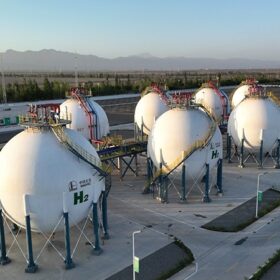
The Hydrogen Stream: China starts world’s biggest solar-to-hydrogen site
China’s Sinopec has switched on the world’s largest solar-to-hydrogen project in Xinjiang, while India has unveiled a new plan to incentivize green hydrogen and electrolyzer production.

Green Gravity links with miner to fast track gravity energy storage tech
Australian renewable energy startup Green Gravity has teamed with underground mining contractor RUC to accelerate the commercialisation of its gravitational energy storage technology which rests on moving weighted objects through disused mine shafts.
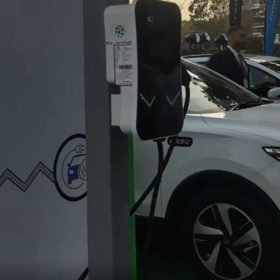
Sodium-ion vs lithium-ion batteries
Lithium-ion batteries remain the preferred choice for electric mobility applications in India due to their higher energy density, well-established infrastructure, and safety record. However, the development of sodium-ion batteries continues, and they may have potential advantages in terms of cost and environmental impact, making them a promising alternative in the future.

All antireflective solar module coating techs at a glance
Scientists in the United Kingdom have investigated the durability and performance of all antireflecting coatings for solar modules and said further work is needed to improve industry standards. Their review addresses single-layer and multi-layer techniques and provides insight on their costs and viability.
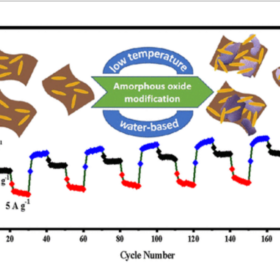
New high-performance anode material for lithium-ion batteries
Indian researchers have synthesized an amorphous manganese dioxide-modified iron oxyhydroxide ternary composite as an anode material for lithium-ion batteries. The ternary composite anode exhibited stable cycling performance at high rates.
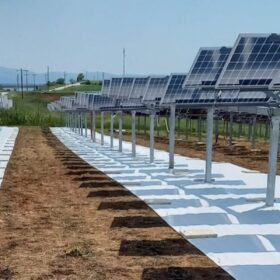
Developer using membranes to increase bifacial solar module yield by 6.4%
Germany-based Solar Kapital has used membranes at three of its PV plants in Greece. It claims that the payback time of the new solution is relatively short.