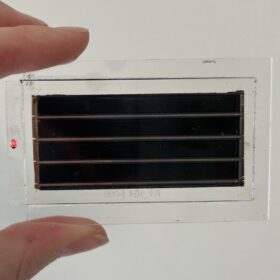
Canadian startup offers 35%-efficient indoor perovskite PV modules
Canada’s Solaires Entreprises says its indoor perovskite modules are suitable for powering a range of electronic devices, such as wireless keyboards, smart door locks, electronic shelf labels, and sensors.
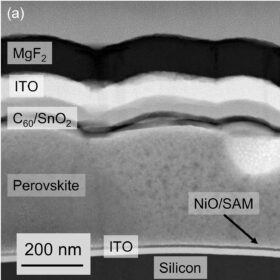
Monolithic perovskite-PERC tandem solar cell with 23.7% efficiency
Dutch scientists have developed a perovskite-PERC tandem solar cell based on a new type of tunnel recombination junction that reportedly offers an improved device efficiency distribution. The cell uses a nickel(II) oxide layer that is intended to reduce electrical shunts in the perovskite top cell.
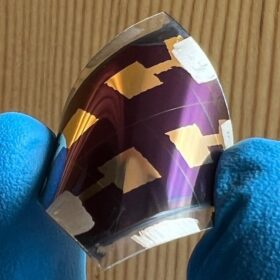
Flexible indoor perovskite solar cell achieves 32.5% efficiency
Italian scientists have developed a flexible indoor perovskite solar cell with 32.5% efficiency. Their design uses a PET substrate combined with a tetrabutylammonium bromide layer over the perovskite absorber. This additional layer effectively reduces defect density and enhances the stability of the underlying 3D perovskite structure.
Indoor perovskite PV solar cells with 32.0% efficiency
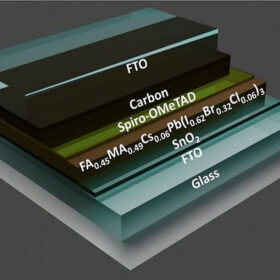
Scientists in Thailand built an indoor perovskite solar cell with low-cost carbon electrode architecture. The manufacturing process is based on antisolvent deposition and vacuum thermal annealing (VTA) and reportedly results in higher perovskite film quality.
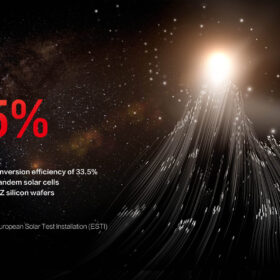
Longi claims 33.5% efficiency for perovskite/silicon tandem solar cell
The European Solar Test Installation (ESTI) has confirmed the results of Longi’s new perovskite/silicon tandem solar cell. It is currently the second-highest efficiency record in the world for a perovskite/silicon tandem cell.
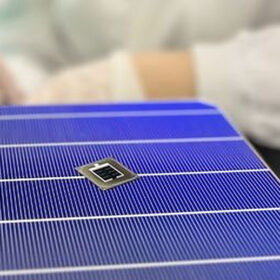
KAUST claims 33.7% efficiency for perovskite/silicon tandem solar cell
The European Solar Test Installation (ESTI) has confirmed the results of King Abdullah University of Science and Technology’s (KAUST) new perovskite/silicon tandem solar cell. The 1 cm2 device also achieved an open-circuit voltage of 1.974 V, a short-circuit current density of 20.99 mA/cm2, and a fill factor of 81.3%.
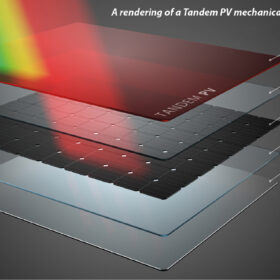
Pushing perovskite PV limits
The perovskite solar race is heating up, with a cue of manufacturers forming to test products at the US Department of Energy’s (DoE) PV commercialization facilities, and academics on both sides of The Pond announcing new advances in recent months.
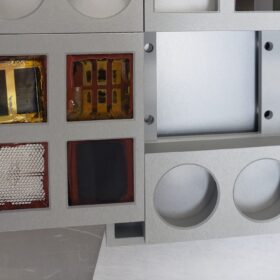
NASA makes unusual discovery while testing perovskite solar cells in space
NASA has discovered that perovskite solar cells tested in space exhibit less degradation than reference devices tested on Earth. The agency acknowledged that it is uncertain about the specific factors in the space environment that contributed to the superior performance of the perovskite absorber film.
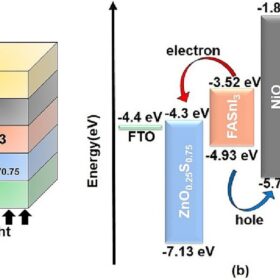
Indian researchers design 31.57% efficient, lead-free perovskite solar cell device
Researchers at the National Institute of Technology (NIT) Silchar, Assam, have designed a formamidinium tin iodide (FASnI3) active layer-based perovskite solar cell that achieves an admirable power conversion efficiency of 31.57% while scoring well on other performance parameters too.
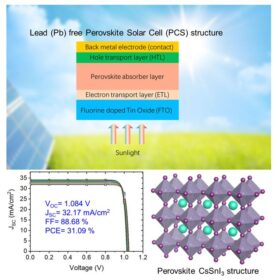
New perovskite solar cell design promises 31.09% efficiency
Chinese researchers have developed a solar cell using CsSnI3 perovskite, known for its unique phase transitions and near-IR emissions. By simulating the device with various electron transport layers (ETLs) and hole transport layers (HTLs), they determined that the optimal cell could be created using a titanium oxide (TiO2) ETL and a nickel(II) oxide (NiOx) HTL.