Indian solar market leaders in 2021
ReNew Power was the top utility-scale solar developer in 2021, commissioning the largest amount of capacity. Tata Power Solar led in rooftop solar installations, accounting for 20% of total annual additions.
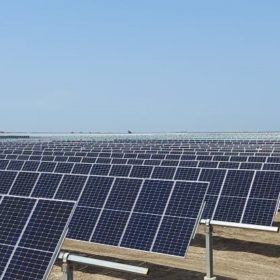
SJVN awards 1 GW solar EPC project to Tata Power
State-owned hydropower producer SJVN has awarded a 1 GW solar engineering, procurement, and construction project to Tata Power Solar. The PV installation will be built in Rajasthan with an investment of around INR 5,492 crore ($720 million).

Salt producer tenders 1 GW of solar in Gujarat
State-owned Hindustan Salts Ltd. has invited bids to build and operate 1 GW of solar capacity on 5,000 acres of disused land in the Indian state of Gujarat. The developer will pay Hindustan Salts a fixed annual rental fee for the land. Bidding closes on May 25.

Assam’s largest solar plant now fully operational
Azure Power has declared that its 90 MW solar project in Assam is now fully online. It commissioned the capacity in phases, and only recently switched on the final 25 MW section.
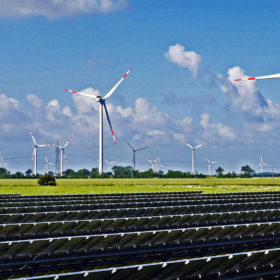
India to lead new energy wave
A new report from the Institute for Energy Economics and Financial Analysis (IEEFA) tracks key trends at major companies across India’s power sector value chain. It finds the nation is poised to lead the clean energy wave, with investors committing in response to the bold policies that are enabling the transition.
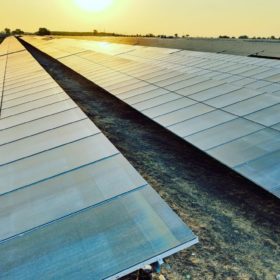
Tata Power Renewables commissions 120 MW solar project in Gujarat
Tata Power Renewables has commissioned a new 120 MW solar project in just five months. The installation uses 381,000 thin-film glass-on-glass modules with peak outputs of 440 W to 460 W.

Ayana Renewable, Greenstat Hydrogen to launch green hydrogen pilot in Karnataka
Ayana Renewable Power and Greenstat Hydrogen India have signed an agreement to jointly develop green hydrogen projects in India. The first one will be launched in Karnataka.
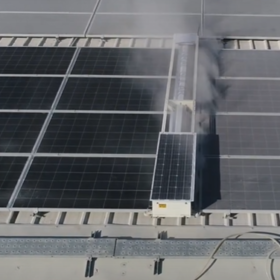
Self-powered, dry-cleaning robot for solar panels
Enray Solutions has developed an autonomous, water-free cleaning robot for ground-mount solar installations that draws its power from an on-board PV panel and battery. The robot is designed to withstand the harsh environmental conditions of all kinds of terrain.
ReNew Power signs PPAs for 2 GW
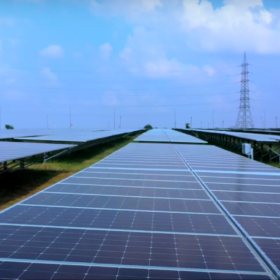
NASDAQ-listed ReNew Power has signed power purchase agreements for 1.5 GW of new utility-scale PV capacity in Rajasthan. It will also build around 0.5 GW of renewables for corporate customers.

Shell to acquire Sprng Energy
Shell has signed the agreement to acquire Solenergi Power, an Actis company owning 100% of Indian developer Sprng Energy. The transaction, valued at $1.55 billion, is expected to close later this year.