Emiliano Bellini

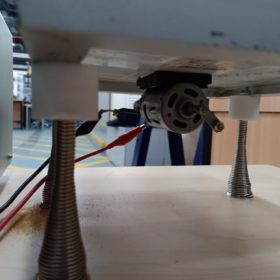
Vibration tech for self-cleaning solar panels
Scientists in the U.K. have developed a system which makes panels vibrate to provide cleaning. The academics have conceded, however, they are yet to calculate the ‘sweet spot’ of mechanical stress to be applied.

Solar inverters vs. cyberattacks
A U.S. research group is now developing new inverters to protect solar installations from cyberattacks. The researchers also aim to create new cybersecurity standards. Professor Alan Mantooth, the group’s research coordinator, said that inverters can be shut down if they are hacked, or contribute to grid instability and result in the overcharging of batteries, while potentially creating problems that we still don’t know how to address.
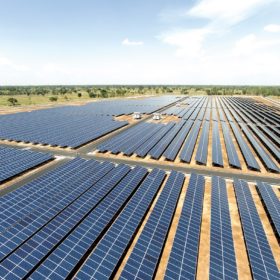
Global solar EPC market dominated by US, German, Indian contractors
Although the Wiki-Solar website ranking only provides a snapshot of PV project engineering, procurement and construction contracts outside of China, it is nevertheless a useful indicator of the changing global solar market landscape. Of the top 11 companies, four are based in India, three in Germany, and two in the United States. But last year’s largest contractor, U.S.-based First Solar, might lose its leading position this year, as it has largely discontinued its EPC activities.
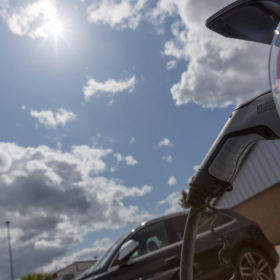
How much money can you make with PV-assisted EV charging stations?
A French-Turkish research team has created an economic model to optimize scheduling for solar-powered EV charging units. The proposed model suggests that such projects might be more profitable today than at the end of the decade, depending on a wide range of variables.
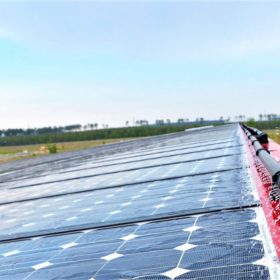
Cooling down PV panels with water
France’s Sunbooster has developed a technology to cool down solar modules when their ambient temperature exceeds 25 degrees Celsius. The solution features a set of pipes that spread a thin film of water onto the glass surface of the panels in rooftop PV systems and ground-mounted plants. The cooling systems collect the water from rainwater tanks and then recycle, filter and store it again. The company claims the technology can facilitate an annual increase in power generation of between 8% and 12%.

Covid-19 and dependence on China’s PV supply chain
The Asian Development Bank says developing countries in Asia and the Pacific should consider developing their own solar industry supply chains as the Covid-19 pandemic has exposed their over-reliance on China to carry through the energy transition.

IIT Bombay group suggests method of detecting early-stage discoloration in EVA encapsulants
A new, non-destructive technique has been proposed by researchers who say identifying early-stage discoloration in EVA encapsulants can help detect degradation in solar panels before power output is affected. The IIT Bombay group used an ultraviolet accelerated aging test during 34 days on three encapsulant samples.

Cheaper flow batteries with new membrane
US scientists claim to have discovered a membrane which could lead to cheaper large scale flow batteries. The material is an ion-selective, aqueous-compatible polymer with intrinsic microporosity known as AquaPIM and is said to have tunable thickness and high conductivity in aqueous electrolytes.
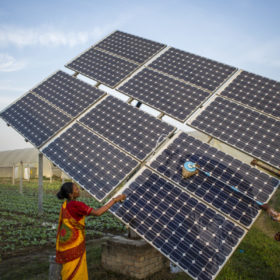
Solar will turn vicious water-energy-climate cycle into virtuous loop
The International Water Management Institute is promoting the Solar Irrigation for Agricultural Resilience (SoLAR) initiative to expand the use of solar irrigation systems throughout Bangladesh, India, Nepal, and Pakistan. Proponents of solar irrigation pumps say that they can have a strong positive impact on groundwater.
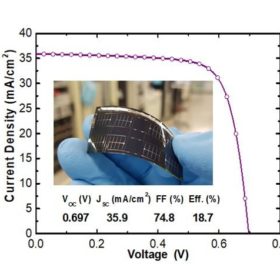
Korean researchers announce flexible CIGS solar cell with 20.4% efficiency
The thin-film cell was manufactured through a low-temperature process and doping with alkali elements.