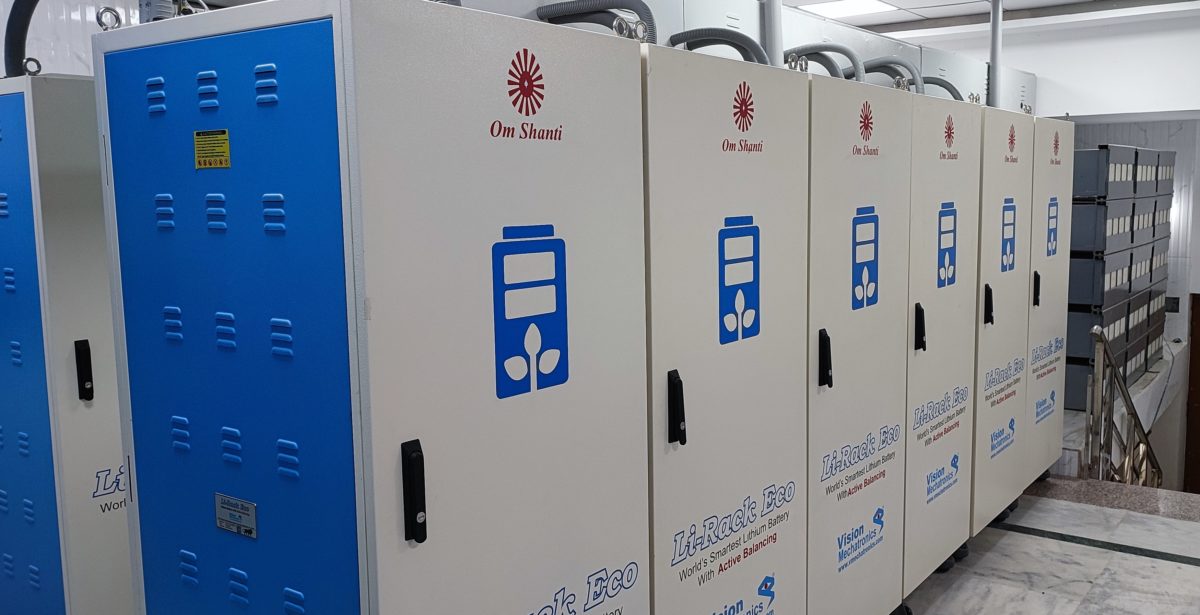





A new report by the India Energy Storage Alliance (IESA) and Customised Energy Solutions (CES) projects India’s behind-the-meter (BTM) stationary energy storage market to grow from 32 GWh in annual demand in 2025 to over 39 GWh by 2033.
The BTM systems include onsite energy generation and storage located on the customer’s side of the utility meter, such as rooftop solar panels, battery storage, as well as batteries for backup applications installed with UPS systems, inverters, and telecom towers. These systems enable direct use of generated or stored energy without passing through the grid.
The report highlights that India’s stationary storage market is at a tipping point. As the cost of lithium-ion batteries and solar-plus-storage systems continues to tumble, more businesses and consumers across India are turning to on-site energy storage to manage rising grid tariffs and ensure reliable power. In 2024, the levelized cost of energy from a rooftop solar system with storage hovered around 6-7 per kWh, already approaching parity with average commercial grid tariffs in key states like Maharashtra, Tamil Nadu, and Karnataka.
CES analysts predict that by 2026, solar-plus-storage will be cost-competitive for more commercial users nationwide, with industrial users expected to follow closely behind.
“Lower technology costs, progressive policies, and the urgent need for reliable power are converging to make BTM storage an integral part of India’s energy ecosystem,” said Debmalya Sen, president, India Energy Storage Alliance. “The projected growth to 39 GWh by 2033 reflects not just surging demand, but a paradigm shift in how businesses and consumers interact with energy. The next decade will be defined by smart storage and domestic innovation.”
The CES report reveals that while lead acid batteries still dominate the BTM landscape, holding more than 85% of the market in 2025, lithium-ion technology is rapidly gaining ground. In the telecom sector alone, lithium-ion batteries now account for an impressive 77% of new installations. The UPS and rooftop solar segments are also seeing a good momentum in lithium battery adoption.
Domestic manufacturing of lithium-ion battery cells is also taking off. Major players such as Reliance Industries, Ola Electric, Tata Group, Exide and others are investing billions to build up to 95 GWh of battery manufacturing capacity, supported by the government’s Production Linked Incentive (PLI) scheme.
The report further notes that while central and state policies, such as net metering, time-of-day tariffs, and, are expected to positively impact demand, the traditional reliance on inverter backup and microgrids may diminish in regions where grid reliability is on the rise. Nevertheless, persistent outages in certain states, coupled with the ongoing need for cost management and resilience, ensure continued robust demand for advanced storage solutions. The market also sees significant new players entering lithium battery manufacturing, with more than 30 notable pack assemblers now operating across India’s major industrial regions.
Comprehensive in its scope, the report not only covers rooftop solar and telecom towers but also railways, rural microgrids, streetlights, and decentralised installations, providing segment-by-segment forecasts and technology trends through 2033.
This content is protected by copyright and may not be reused. If you want to cooperate with us and would like to reuse some of our content, please contact: editors@pv-magazine.com.






By submitting this form you agree to pv magazine using your data for the purposes of publishing your comment.
Your personal data will only be disclosed or otherwise transmitted to third parties for the purposes of spam filtering or if this is necessary for technical maintenance of the website. Any other transfer to third parties will not take place unless this is justified on the basis of applicable data protection regulations or if pv magazine is legally obliged to do so.
You may revoke this consent at any time with effect for the future, in which case your personal data will be deleted immediately. Otherwise, your data will be deleted if pv magazine has processed your request or the purpose of data storage is fulfilled.
Further information on data privacy can be found in our Data Protection Policy.