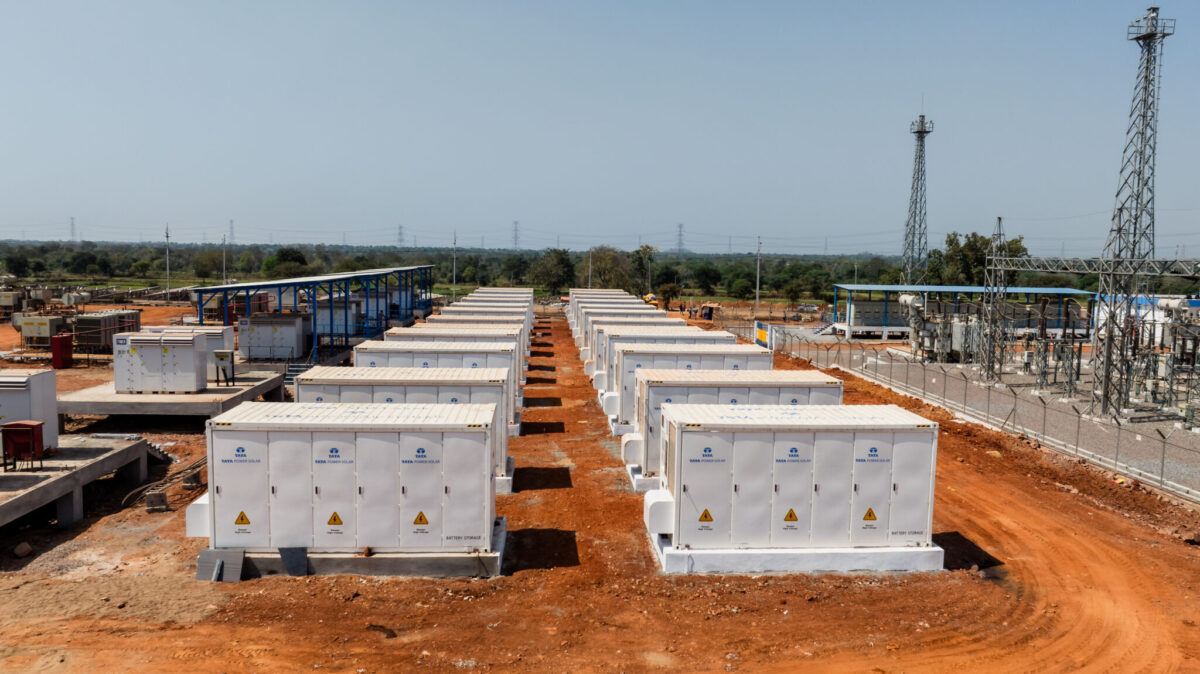





A new whitepaper projects India’s cumulative installed stationary energy storage capacity to soar to 346 GWh by 2033, from currently less than 1 GWh. The report says the market is witnessing explosive growth, with a record 92 GWh of battery energy storage system (BESS) projects in the pipeline now.
The whitepaper, prepared by Indian Energy Storage Alliance (IESA) in partnership with Customized Energy Solutions (CES), was unveiled at the Stationary Energy Storage India (SESI) 2026 conference.
“India’s power system is experiencing unprecedented ramping and flexibility requirements, with grid demand swings reaching up to 90 GW. In this context, large-scale energy storage is no longer optional; it is essential for a resilient and reliable grid,” S.C. Saxena, chairman & managing director, GRID India, said at the whitepaper launch. “Thanks to policy support and falling costs, battery and pumped hydro storage are being rapidly integrated across the country. As prices drop and technology advances, energy storage will be at the heart of our renewable energy transition, ensuring round-the-clock power and unlocking new value streams for the sector.”
The new analysis highlights how India, propelled by ambitious policy targets and regulatory reforms, is quickly becoming a frontrunner in the deployment of stationary energy storage. Over the past year alone, the sector has seen launch of 69 new BESS tenders totalling 102 GWh, a 35% increase over 2024 and nearly double the annual tender volume. The expanding project pipeline reflects robust investor interest and a rapidly maturing market.
Looking ahead, the report projects that installed stationary storage capacity will surge to 346 GWh by 2033 under the base scenario, rising to 544 GWh if policy momentum continues. Pumped hydro energy storage (PHES) is also gaining steam, with cumulative capacity expected to climb from 7 GW in 2025 to 107 GW by 2033.
Debmalya Sen, President of IESA, remarked, “This white paper is both a milestone and a call to action. It provides the strategic clarity needed for India to realise its vision of 500 GW of non-fossil generation by 2030, with energy storage as the backbone of a flexible and reliable grid.”
The white paper attributes this acceleration to a combination of forward-thinking initiatives, including the rollout of Energy Storage Obligations (ESO), Viability Gap Funding (VGF), and the formal recognition of storage in the Electricity Amendment Rules 2025. Additional incentives, such as 100 per cent ISTS charge waivers, are further strengthening the sector’s investment appeal and bankability.
This content is protected by copyright and may not be reused. If you want to cooperate with us and would like to reuse some of our content, please contact: editors@pv-magazine.com.




By submitting this form you agree to pv magazine using your data for the purposes of publishing your comment.
Your personal data will only be disclosed or otherwise transmitted to third parties for the purposes of spam filtering or if this is necessary for technical maintenance of the website. Any other transfer to third parties will not take place unless this is justified on the basis of applicable data protection regulations or if pv magazine is legally obliged to do so.
You may revoke this consent at any time with effect for the future, in which case your personal data will be deleted immediately. Otherwise, your data will be deleted if pv magazine has processed your request or the purpose of data storage is fulfilled.
Further information on data privacy can be found in our Data Protection Policy.