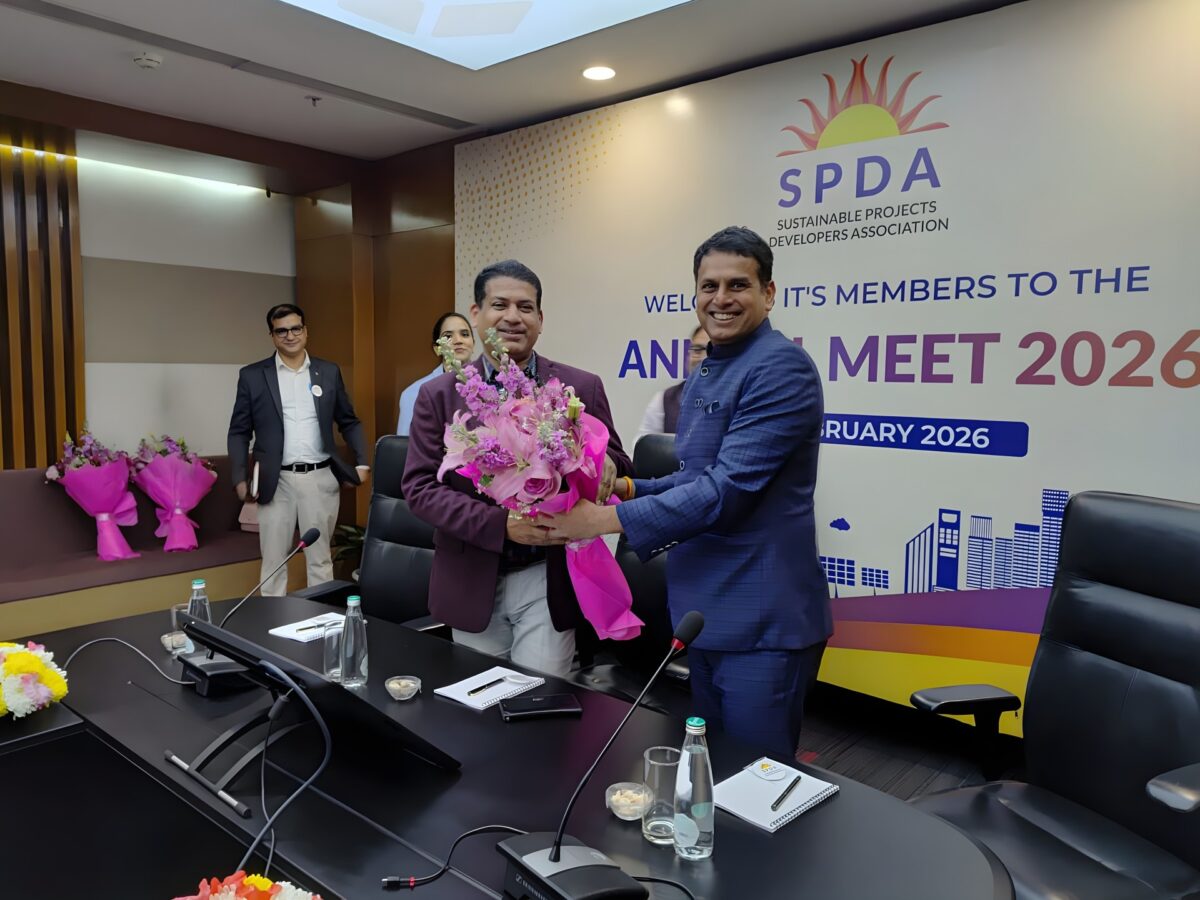





“Renewable energy growth in India is expected to become increasingly multi-dimensional as the country works toward becoming a developed nation by 2047,” said Santosh Kumar Sarangi, Secretary to the Government of India, Ministry of New and Renewable Energy (MNRE).
Speaking at the annual meeting of the Sustainable Projects Developers Association (SPDA) in New Delhi, Sarangi said that extending beyond utility-scale projects to distributed renewable energy, green open access and emerging prosumer models enabled by digital platforms and the India Energy Stack would play a pivotal role in this journey.
As India advances toward its vision of becoming a developed nation by 2047, sustaining economic growth above 7.5% will require significant expansion in manufacturing and electricity-intensive services such as AI, data centres and IoT. In this journey, reliable and clean energy will be indispensable.
“The demand profile is also changing,” said Sarangi. “Plain vanilla solar and wind may not meet DISCOM needs. Hybrid and storage-integrated solutions aligned with demand curves are gaining traction, as seen in recent SECI tenders.”
He added that the transition will require DISCOMs to reorient toward Electricity-as-a-Service (EaaS) something similar to that of SaaS and infrastructure-based models, leveraging digital twin technologies, satellite mapping and smart asset monitoring to improve efficiency and optimise costs. Transmission planning will remain critical, particularly as renewable capacity is concentrated in select states while load centres are dispersed across the country.
As per a JMK Research report, India installed around 37.8 GW of solar capacity in CY2025. This comprised about 28.6 GW of new utility-scale solar, a 54.6% increase from 2024, and 7.9 GW of rooftop solar, up 72% year on year. Off-grid additions stood at 1.35 GW, compared to 1.48 GW in 2024.
“Renewable installations are expected to remain robust, driven increasingly by C&I demand, distributed energy and emerging sectors,” said Sarangi, adding that India also holds significant potential in renewable manufacturing and exports.
“The future of renewable energy in India is promising and dynamic, requiring continued adaptability, innovation and strong collaboration between policymakers and industry stakeholders.”
Speaking on the occasion, Vineet Mittal, chairman, SPDA, and chairman, Avaada Group, highlighted the sector’s execution strength and priorities ahead.
Mittal said, “India’s renewable energy sector has demonstrated strong execution capability, moving from projects measured in single-digit megawatts to consistently delivering capacity additions approaching 50 GW annually.
This growth reflects policy vision, investor confidence and the strength of Indian developers. The sector now supports nearly a million jobs and has evolved from being largely import-dependent to building domestic manufacturing capacity in modules and cells. The next phase must focus on deeper localisation across the value chain — including critical balance-of-system components and strengthen the supply chain resilience, industrial depth and long-term energy security.
Mittal highlighted that as India advances towards the 500 GW non-fossil fuel milestone, sustained demand creation, timely PPA signings and large-scale deployment of hybrid and storage-backed renewable solutions will be essential.
“With emerging opportunities in data centres, green hydrogen and advanced manufacturing, renewable energy is positioned not only as a climate solution but also as a strategic economic driver. With consistent policy support and continued government–industry collaboration, India can accelerate its transition while generating employment, enhancing competitiveness and reinforcing its position as a global clean energy leader,” he added.
The Annual Meet witnessed participation from across the entire renewable energy sector value chain including Purvah Green, Ocior, Avaada Energy, ACME, Waaree, Serentica, Azure, Aditya Birla, ESSAR, Sembcorp, Sunsure, RaysPower, and Jindal India. During the event, SPDA also elected Sandeep Kashyap, CEO, Purvah Green Power- RPSG group, as President of SPDA for a period of one year.
SPDA represents around 50 member companies across solar, wind, hybrid, battery energy storage systems (BESS), pumped storage, green hydrogen and green ammonia segments. It has facilitated key interventions over the past year, including that of long-awaited resolution on the issue of Great Indian Bustards, reduction in Renewable Energy Development & Facilitation Charges, removal of blacklisting clauses from bidding guidelines for renewable projects, and improvements in security and law and order conditions related to project development.
This content is protected by copyright and may not be reused. If you want to cooperate with us and would like to reuse some of our content, please contact: editors@pv-magazine.com.





By submitting this form you agree to pv magazine using your data for the purposes of publishing your comment.
Your personal data will only be disclosed or otherwise transmitted to third parties for the purposes of spam filtering or if this is necessary for technical maintenance of the website. Any other transfer to third parties will not take place unless this is justified on the basis of applicable data protection regulations or if pv magazine is legally obliged to do so.
You may revoke this consent at any time with effect for the future, in which case your personal data will be deleted immediately. Otherwise, your data will be deleted if pv magazine has processed your request or the purpose of data storage is fulfilled.
Further information on data privacy can be found in our Data Protection Policy.