




From pv magazine Brazil
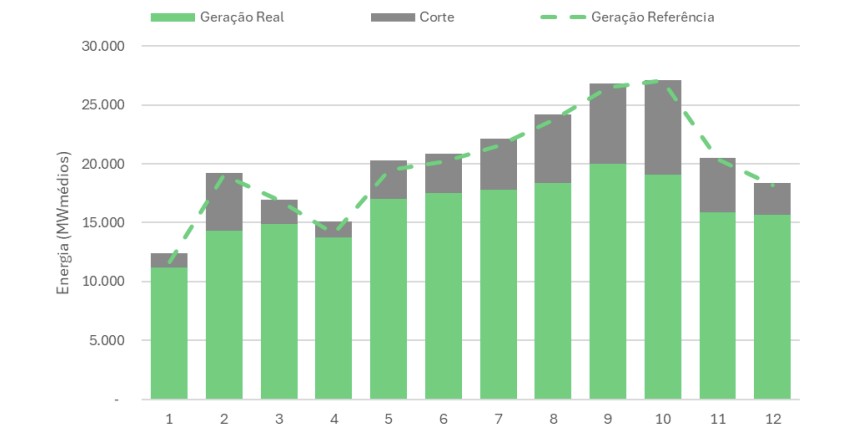
Brazil failed to use roughly 20% of the solar and wind electricity it generated in 2025, resulting in an estimated loss of BRL 6.5 billion, according to Volt Robotics’ Annual Curtailment Report.
Volt Robotics said the scale of curtailment reflects an unprecedented period of renewable oversupply combined with operational constraints in Brazil’s national electricity system.
Average generation cuts reached 4,021 MW over the year, equivalent to the monthly output of a large hydroelectric plant. On at least 16 days in 2025, system operation approached the lower technical safety limit, a sharp increase from 2024, when only one comparable event was recorded.
Volt Robotics said the 2025 events were driven by excess electricity supply rather than scarcity, marking a structural shift in system risk dynamics.
Curtailment intensified between August and October, when historically high levels of generation coincided with transmission constraints and weaker demand. The report attributes the peak losses to a combination of operational limitations, grid congestion, and insufficient flexibility to absorb surplus power.
Sunday mornings emerged as the most frequent stress point for the grid. Volt Robotics said reduced economic activity during weekends lowers electricity demand, while solar output peaks and is often reinforced by strong wind generation. This recurring mismatch leads to network overloads, forced generation cuts, and system operation near the lower safety threshold.
The report also highlights the risk of system instability caused by excess renewable generation. During the 16 critical days, Brazil’s National System Operator classified conditions as severe and implemented emergency measures, supported by the National Electric Energy Agency, including extraordinary generation curtailments.
Volt Robotics warned that without structural adjustments, surplus clean energy itself can become a source of operational risk.
The economic impact extends beyond immediate revenue losses. Frequent curtailment increases perceived investment risk, raises financing costs, and weakens Brazil’s appeal for new renewable energy projects, the report said. Both regulated and free-market projects were affected, with exposure to contractual penalties and the Settlement Price of Differences.
Regionally, Minas Gerais, Ceará, and Rio Grande do Norte recorded the highest levels of curtailed energy, forming what Volt Robotics described as Brazil’s “curtailment triangle.” Southern states experienced significantly lower losses.
Volt Robotics said the situation reflects a structural mismatch between rapid renewable capacity expansion, rising distributed generation, transmission bottlenecks, and tariff structures that do not adequately signal when electricity consumption is most valuable.
The report recommends the introduction of more dynamic time-of-use tariffs, stronger demand-side participation, and regulatory reforms to reduce curtailment and maintain the stability of Brazil’s electricity system.
This content is protected by copyright and may not be reused. If you want to cooperate with us and would like to reuse some of our content, please contact: editors@pv-magazine.com.






By submitting this form you agree to pv magazine using your data for the purposes of publishing your comment.
Your personal data will only be disclosed or otherwise transmitted to third parties for the purposes of spam filtering or if this is necessary for technical maintenance of the website. Any other transfer to third parties will not take place unless this is justified on the basis of applicable data protection regulations or if pv magazine is legally obliged to do so.
You may revoke this consent at any time with effect for the future, in which case your personal data will be deleted immediately. Otherwise, your data will be deleted if pv magazine has processed your request or the purpose of data storage is fulfilled.
Further information on data privacy can be found in our Data Protection Policy.