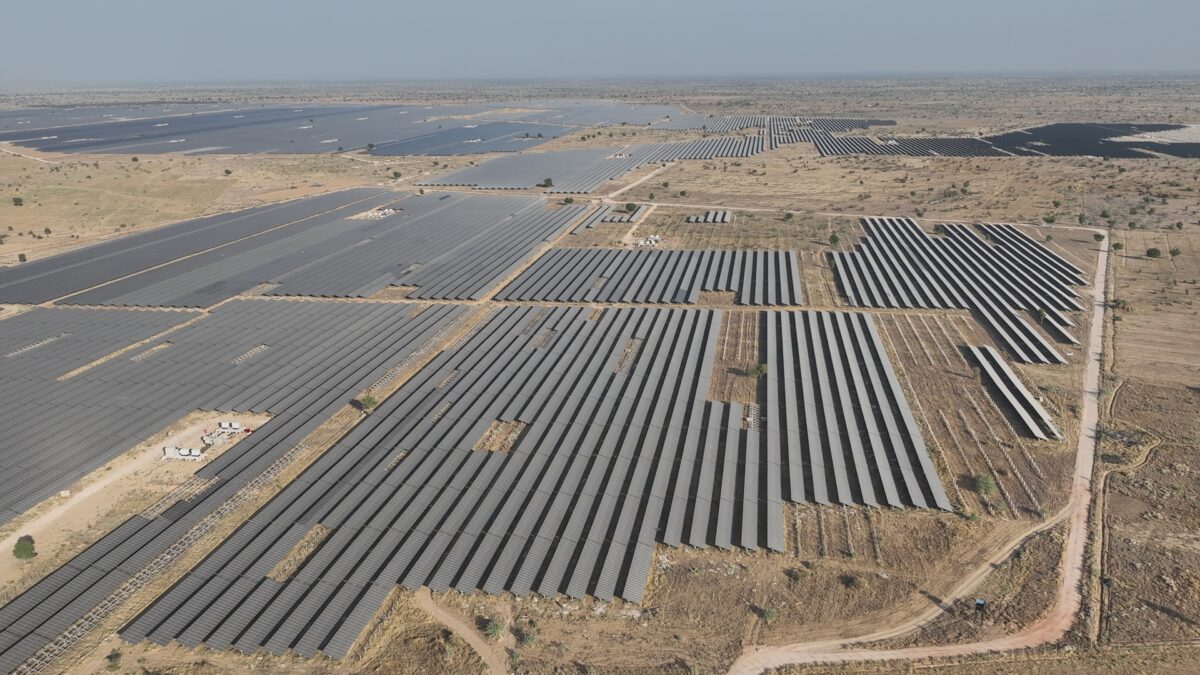





Over the past decade, India’s renewable energy (RE) journey has been one of scale, speed, and structural ambition. From barely crossing 40 GW of non-hydro renewable capacity in the mid-2010s, the country has surged past the 203 GW mark by the November 2025, driven largely by rapid solar and wind deployment. Utility-scale renewables have transformed India into one of the world’s lowest-cost RE markets. Importantly, 2025 continued this expansionary trend, reinforcing India’s position as a global clean energy leader. As the year draws to a close, it is crucial to examine both the advances made and the challenges that persisted across the sector.
RE Sector Developments
With record 40+ GW solar and wind installations (solar: 34.9+ GW, wind: 5.8+GW), 2025 has marked yet another high point in Indian annual renewable capacity additions. The capacity additions have been driven by strong project momentum across all solar segments i.e. rooftop, open access and Discom PPA.
This momentum is supported by a concurrent scaling up of domestic solar manufacturing. According to JMK Research analysis, Module and cell manufacturing capacity crossed the 175 GW and 30 GW mark respectively, with multiple facilities getting commissioned every month. While true upstream capabilities (polysilicon and wafers) remain limited, Indian solar module demand has almost completely shifted to domestic sources.
In 2025, majority of the grid-scale RE tendering has shifted to projects having storage and hybrid components, with their tariff discovery continuing its downward trajectory.
• Standalone battery energy storage system (BESS) tenders supported by viability gap funding (VGF) picked up pace and achieved record-low tariffs (INR 1.48 lakh/MW/month in a November 2025 auction), bringing storage closer to commercial viability for grid applications.
• At INR 49.75 per Kg, SECI’s green ammonia tender auction achieved an almost price parity with its grey counterpart in an August 2025, thereby reinforcing confidence in India’s long-term decarbonization pathway.
Persisting Challenges
Despite record tendering activity, a persistent backlog of unsigned Power Purchase Agreements (PPAs) and Power Sale Agreements (PSAs) continued to plague the sector. As of September 2025, approximately 44 GW of awarded capacity remained stranded with unsigned PSAs, underlining the ongoing project realization challenges such as evolving offtaker preferences, grid infrastructure delays, DISCOM reluctance etc. This not only increases developer risk but also slows down financial closure and physical execution, undermining the momentum created by headline tender announcements.
Grid integration challenges became more pronounced in 2025, with high-renewable states such as Rajasthan, Gujarat, and Tamil Nadu reporting curtailment levels ranging from 10% to 30% due to transmission unavailability. Curtailment during high-generation periods and delays in commissioning inter-state transmission systems (ISTS) affected project realizations and plant load factors. While large-scale transmission programs are underway, the mismatch between generation build-out and evacuation readiness remains a structural weakness that directly impacts investor confidence.
Supply chain risks have resurfaced in 2025, as China tightened export controls around critical minerals and rare earth elements essential for wind turbines, power electronics, and storage technologies. At the same time, India’s upstream solar manufacturing capabilities, particularly in polysilicon and wafer production is still largely inadequate. Consequently, the entire solar sector remains partially exposed to external shocks and price volatility, even as downstream manufacturing scales up.
Policy revisions in July 2025 by the state regulators to banking and tariff order provisions in Maharashtra (one of India’s leading RE states) created confusion for commercial and industrial (C&I) consumers and open access developers. Although the order has since been stayed by the High Court, such policy flip-flops erode trust, disrupt financial models, and highlight the continuing divergence between central renewable ambitions and state-level execution realities.
Way Forward
India’s renewable energy story in 2025 remains fundamentally positive. Capacity is scaling, costs are falling, and the ecosystem is deepening across manufacturing, storage, and new green vectors such as hydrogen and ammonia. At the same time, the year underscored that sustaining the next phase of growth will hinge on grid preparedness, policy certainty, robust power contracting mechanisms, and faster execution.
Looking ahead to 2026, India’s renewable energy growth trajectory is expected to broadly remain intact. A significant volume of solar capacity is likely to be commissioned before the June 2026 deadline for the implementation of the Approved List of Cells and Manufacturers (ALCM), boosting installations in the first half of the year. However, post this deadline, capacity additions could moderate unless the government provides clarity or an extension to the ALCM timeline. Overall, renewable energy installations in 2026 are expected to be similar to 2025. With clear and precise long term policy reforms and coordinated action across all energy stakeholders, India can meet and potentially exceed its renewable energy target of 500 GW RE by 2030.
The views and opinions expressed in this article are the author’s own, and do not necessarily reflect those held by pv magazine.
This content is protected by copyright and may not be reused. If you want to cooperate with us and would like to reuse some of our content, please contact: editors@pv-magazine.com.



1 comment
By submitting this form you agree to pv magazine using your data for the purposes of publishing your comment.
Your personal data will only be disclosed or otherwise transmitted to third parties for the purposes of spam filtering or if this is necessary for technical maintenance of the website. Any other transfer to third parties will not take place unless this is justified on the basis of applicable data protection regulations or if pv magazine is legally obliged to do so.
You may revoke this consent at any time with effect for the future, in which case your personal data will be deleted immediately. Otherwise, your data will be deleted if pv magazine has processed your request or the purpose of data storage is fulfilled.
Further information on data privacy can be found in our Data Protection Policy.