





India can secure reliable, round-the-clock clean power at costs competitive with new thermal plants by 2030 under realistic market conditions, with the possibility of achieving cost parity as early as 2025 under more favourable circumstances, a new report found.
The study, Budgeting for Net Zero: Powering India’s Reliable Clean Energy Future by the International Institute for Sustainable Development (IISD) and the Center for Study of Science, Technology and Policy, finds that firm and dispatchable renewable energy (FDRE)—hybrid projects combining solar, wind, and battery storage—can match or undercut the cost of new thermal power plants when developers are able to monetize both a portion of surplus electricity generated by oversized renewable sources and additional storage capacity.
FDRE projects install slightly more renewable and storage capacity than required for their contracted supply in order to meet the specific demand profile. This oversizing can lead FDRE projects to generate excess electricity. To recover value from this uncontracted generation, developers sell the surplus power in the day-ahead market (DAM) or the real-time market.
Selling this surplus power plays a critical role in lowering overall costs. FDRE—one of several tender types designed to provide firm clean energy—is already much cheaper than new coal when the full social costs of thermal power plants are considered.
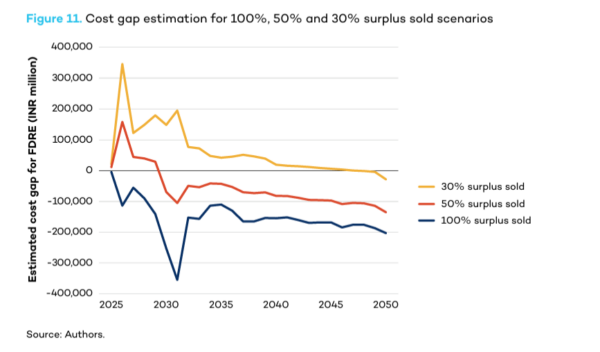
Even without accounting for these social costs, the analysis shows that FDRE becomes cost-competitive with new coal-fired thermal plants in 2025 when developers sell 100% of the excess generation (beyond guaranteed generation) in the open electricity market. If 50% of non-contracted excess generation is sold, FDRE reaches cost parity by 2030. And when only 30% of surplus power is monetized, FDRE reaches cost parity by 2047.
“Firm and dispatchable renewables are not just a clean alternative—they are an increasingly competitive source of reliable power. With thoughtful tender design and market reforms, India can tap into FDRE to meet rising electricity demand, cut long-term costs, and build a power system that is both resilient and future-ready,” said Sunil Mani, policy advisor at IISD.
The study examines when and under what conditions FDRE can compete with new thermal, whether government support is needed to accelerate deployment, and the macroeconomic impacts of scaling FDRE. It also evaluates how tender design, developer strategies, and electricity market reforms influence FDRE’s affordability.
FDRE marks an important shift in India’s clean energy procurement. Instead of simply adding variable renewable energy to the grid, FDRE tenders require developers to supply clean electricity at specific, often peak hours aligned with distribution companies’ (discoms’) demand patterns. This is becoming increasingly relevant as India’s power needs rise and discoms face higher costs from managing variability through short-term markets and limited access to flexible supply. FDRE offers one pathway to scale renewables while maintaining reliability and cost predictability for both discoms and consumers.
Although early FDRE tenders have faced challenges—such as uncertainty around the optimal renewable–storage mix and the monetization of surplus power—9.7 GW of FDRE capacity is already under construction, and bid prices closely match the cost projections in the study.
The report stresses that FDRE is not meant to replace all other clean energy solutions. Because FDRE guarantees firm delivery, it is naturally more expensive than standalone solar, wind, or storage when round-the-clock supply is not required. The authors of the report highlight that a balanced approach—deploying FDRE where demand profiles justify it and expanding lower-cost clean energy and storage elsewhere—will deliver the most efficient outcomes for India’s evolving power system.
“FDRE can play an important role alongside standalone renewables, storage, and smarter grid management to support India’s clean energy transition,” says Dr Anasuya Gangopadhyay, senior associate in the Climate Change Mitigation team at CSTEP.
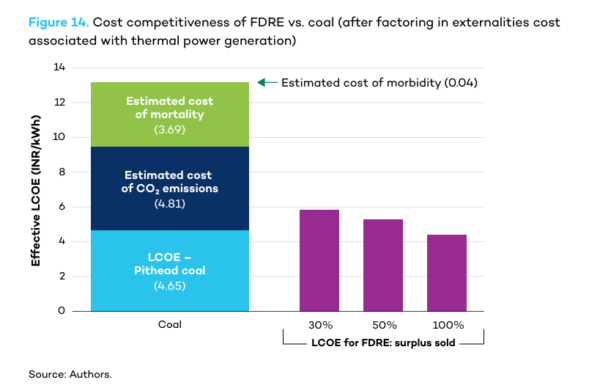
The report also highlights that comparing FDRE and coal solely on energy costs ignores coal’s full societal costs. When air pollution and climate damages are included, the effective cost of new pithead coal rises from INR 4.65/kWh to INR 13.19/kWh, making FDRE immediately cheaper in all scenarios.
In addition, FDRE provides energy security advantages: it reduces exposure to fossil fuel price volatility and can be deployed in 2–2.5 years, compared to 5–7 years for new coal plants.
This content is protected by copyright and may not be reused. If you want to cooperate with us and would like to reuse some of our content, please contact: editors@pv-magazine.com.




By submitting this form you agree to pv magazine using your data for the purposes of publishing your comment.
Your personal data will only be disclosed or otherwise transmitted to third parties for the purposes of spam filtering or if this is necessary for technical maintenance of the website. Any other transfer to third parties will not take place unless this is justified on the basis of applicable data protection regulations or if pv magazine is legally obliged to do so.
You may revoke this consent at any time with effect for the future, in which case your personal data will be deleted immediately. Otherwise, your data will be deleted if pv magazine has processed your request or the purpose of data storage is fulfilled.
Further information on data privacy can be found in our Data Protection Policy.