Solar industry grapples with oversupply and uncertainty
The solar industry stands at a critical juncture. Oversupply, regulatory hurdles, and technological advancements are all reshaping the landscape. Manufacturers must adapt swiftly, balancing production with demand while navigating the complexities of global trade.

BirdBlocker unveils bird-proofing solutions for rooftop PV at Intersolar
Dutch company offering bird-proofing solution for solar installations expands its range with a trio of launches – with high hopes that its business can take flight on commercial rooftops.
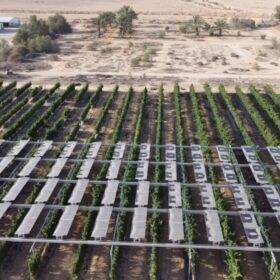
Israeli startup launches agrivoltaic pilot in desert with double-axis sun tracking
Agri-Light has launched its first pilot agrivoltaic project, using a two-axis solar installation on a rail system to move solar panels horizontally above a vineyard in the Negev Desert. The results are due this summer, and the company plans to build commercial projects in Israel and Spain next year.

IEA-PVPS releases fact sheet on environmental life cycle assessment of PV Systems
The updated IEA PVPS Task 12 Fact Sheet provides a comprehensive assessment of the environmental impacts associated with PV systems. It highlights the significant advancements made in PV technology, emphasizing improved efficiencies and reduced environmental footprints.

Spontaneous glass breakage on solar panels on the rise
The National Renewable Energy Laboratory noted an increase in spontaneous glass breakage in solar panels. The PV Module Index from the Renewable Energy Test Center investigates this and other glass-related trends in solar manufacturing.
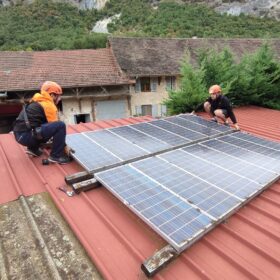
Solar modules deployed in France in 1992 still provide 75.9% of original output power
New testing conducted at France’s oldest PV system have shown that its solar modules can still provide performance values in line with what the manufacturers promised.
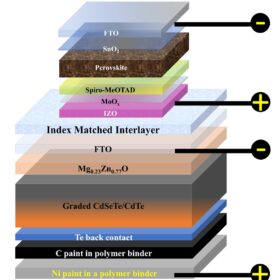
Perovskite-cadmium telluride tandem solar cell based on special electrode achieves 24.2% efficiency
An Indian-US research team has fabricated a four-terminal perovskite-cadmium telluride tandem solar cell by utilizing a highly conductive and sputtered transparent electrode to increase the current density of the bottom cell. The tandem device combines a 18.3%-efficient top perovskite cell and a 19.53%-efficient cadmium telluride bottom device.
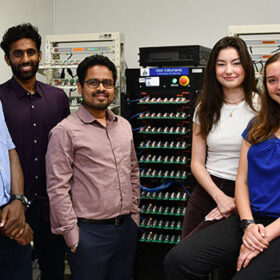
Bringing lithium-sulfur batteries closer to commercialization
Researchers at the University of South Carolina have successfully transitioned their highly-durable lithium-sulfur battery technology from coin to pouch cells and reported competent energy densities.
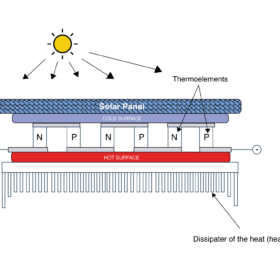
Scientists claim PV systems combined with thermoelectric cooling may achieve 6-year payback time
Scientists in South Africa have modeled a photovoltaic system connected to a thermoelectric cooling device and have found it may produce around 9.2% more electricity than conventional PV system without cooling. The research team claims the proposed system guarantees a minimum cost saving of 10.56%.

The role of renewable energy in achieving India’s net zero goals
The road to net-zero emissions in India doesn’t require herculean efforts. We can get there by wholeheartedly adopting renewables, investing in innovation and technology, and promoting public-private partnerships to build a better, cleaner, and more sustainable India for generations to come.