How to combine photovoltaics with rainwater harvesting
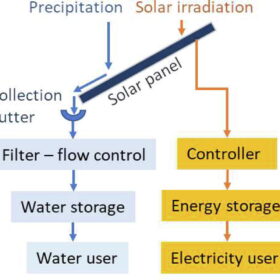
Scientists have developed a system that harvests rainwater running off PV panels for household use or hydrogen production. Their analysis showed that, in the southern Sahel, the system can meet both the energy and water requirements for electrolysis, with surplus rainwater covering up to 50% of a household’s daily water demand.

Jindal Poly Films acquires Enerlite Solar Films
Jindal Poly Films Ltd (JPL) has announced the acquisition of Enerlite Solar Films India, a manufacturer of encapsulation films used in PV modules.

Fraunhofer ISE streamlines use of epitaxial wafers in TOPCon solar cell manufacturing
Researchers at the German research institute have demonstrated that the so-called EpiWafers could be used directly for solar cell fabrication without needing a pre-gettering step. Their experiments provide a proof of principle* for epitaxially grown silicon wafers from German wafer manufacturer NexWafe GmbH.

The Hydrogen Stream: BPCL commissions 5MW green hydrogen plant at Bina refinery
Bharat Petroleum Corp. Ltd (BPCL) has commissioned its first — and one of India’s largest — green hydrogen plant at the Bina Refinery in Madhya Pradesh.

US solar cell production could double in less than two years
US solar cell production is set to double in under two years, driven by growth in domestic content. Anza shares second-quarter 2025 insights into the solar supply chain amid uncertainty.

Longi expresses interest in solar manufacturing in Algeria
A delegation from Chinese module maker Longi met with officials from Algeria’s Ministry of Energy and Mining last week to discuss cooperation that would support Algeria’s domestic solar market, including a solar manufacturing facility.

Chemitek Solar launches new antistatic soiling mitigation coating
The Portuguese company said its new anti-soiling solution lasts for at least a year. It can be applied during routine cleaning operations by mixing it directly in the cleaning water.
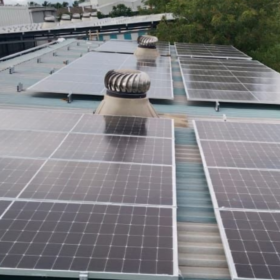
RenewSys awarded EcoVadis Platinum rating for sustainability
RenewSys has become India’s first and only solar PV manufacturer to achieve EcoVadis Platinum rating, joining global top 1% in sustainability.
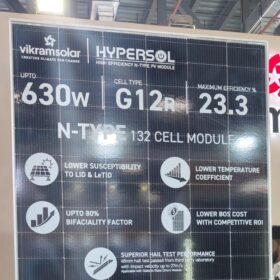
Vikram Solar launches G12R n-type bifacial modules
Vikram Solar Ltd has launched its HYPERSOL series n-type bifacial modules with power output from 605 Wp to 630 Wp and efficiency between 22.38% and 23.30%.
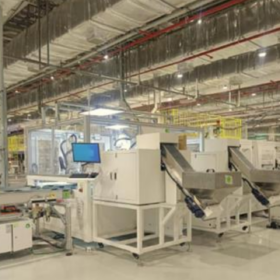
Reliance Industries Ltd commissions gigawatt-scale HJT solar module line
Reliance Industries Ltd has started production from the first phase of the planned 10 GW solar module facility. The fully automated line produces HJT panels with up to 720 Wp output.