‘It’s not a matter of sodium versus lithium, we need both’
A US research team has developed all-solid-state sodium batteries that retain performance down to subzero temperatures. The systems utilize a special chloride-based solid-electrolyte-coated cathode.
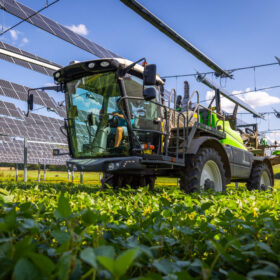
France agrivoltaics trials show early crop and livestock gains
Data from agrivoltaic canopy trials in France, developed by energy producer TSE and the French National Research Institute for Agriculture, Food and the Environment (INRAE), indicate measurable temperature, water-balance, and yield effects that reinforce the role of managed agrivoltaics in farm-level climate adaptation.
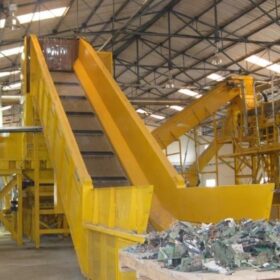
Industry body IESA submits recommendations to strengthen battery recycling ecosystem
Industry body India Energy Storage Alliance (IESA) has called for clearly defined roles and responsibilities under the Battery Waste Management Rules, the adoption of global standards, recycled content targets aligned with emerging battery chemistries and domestic manufacturing, and support for eco-design to enable easier recycling.
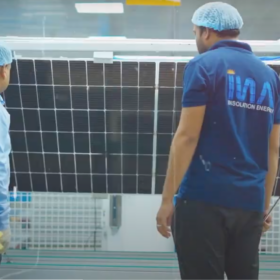
Insolation Energy reports 25.6% year-on-year growth in H1 revenue
Insolation Energy Ltd, a Rajasthan based solar panel manufacturer, has reported consolidated revenue of INR 776.7 crore for the half year ended September 30, 2025 (H1 FY 2026), a 25.6% increase year-on-year. Profit after tax (net profit) surged 23.5% to INR 80.1 crore.
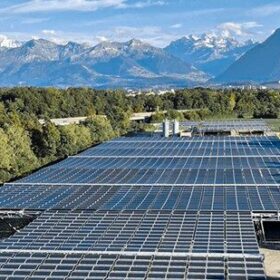
World’s largest foldable rooftop PV system comes online in Switzerland
A wastewater treatment plant in the canton of Bern has been inaugurated with what dhp Technology claims is the world’s largest foldable rooftop solar installation to date. The 3.6 MW array spans several treatment basins, allowing the existing site to serve dual purposes: wastewater treatment at ground level and solar power generation overhead.
Sinovoltaics updates solar module manufacturer financial stability ranking
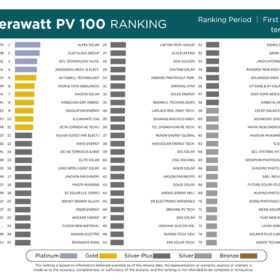
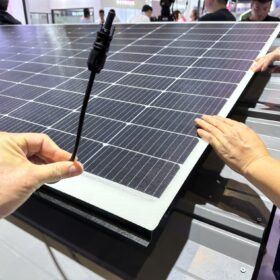
The quality assurance provider reported India-based Insolation Energy, Waaree Renewable Technologies, and Solex Energy retained the top three positions in its Altmann-Z score-based quarterly ranking. Its analysts noted the number of companies with healthier scores increased from 9 to 11.
PVV Infra to set up 1 GW n-type TOPCon solar cell manufacturing facility in Visakhapatnam
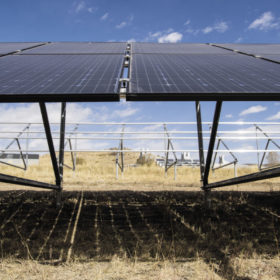
PVV Infra Ltd has signed a Memorandum of Understanding (MoU) with the Andhra Pradesh Economic Development Board (APEDB) to invest around INR 650 crore in establishing a 1 GW n-type TOPCon solar cell manufacturing facility in Visakhapatnam.

India’s evolving battery landscape: An interview with Trina Solar’s Leo Zhao
Leo Zhao, Head of Energy Storage, Trina Solar Asia Pacific, speaks to pv magazine about why India is a strategic market for utility-scale energy storage, the latest trends and technology adoption, and Trina Solar’s plans for the market.
Saatvik Solar secures INR 177.5 crore PV module order
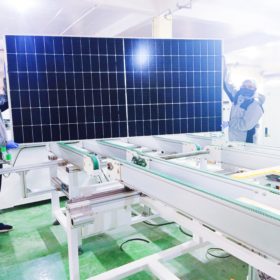
Saatvik Solar, an arm of Saatvik Green Energy, has secured new domestic orders aggregating to INR 177.50 crore for the supply of high-efficiency solar PV modules.
Waaree Energies begins solar module production at Samakhiali and Chikli facilities in Gujarat
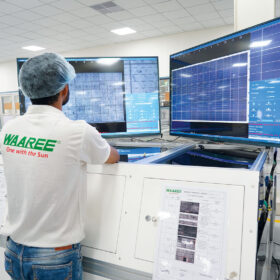
Waaree Energies has commenced operations at its 1.5 GW solar module manufacturing facility in Samakhiali–Kutch, Gujarat. This follows the commissioning of its 2.1 GW facility in Chikli.