Trump orders pause to IRA funding
An executive order released by the White House states, “All agencies shall immediately pause the disbursement of funds appropriated through the Inflation Reduction Act of 2022”.
TOPCon IP battle intensifies with Qcells launching infringement notices
Qcells has launched an intellectual property (IP) dispute over alleged unauthorized use of its patented laser-enhanced contact opening (LECO) tech in tunnel oxide passivated contact (TOPCon) solar cells. The case underscores rising tensions in the PV industry over TOPCon patents.
Avaada Group closes $1 billion financing for its diverse projects for Q3 FY 2025
Avaada Group has completed INR 8,500 crore ($1 billion) in financing/refinancing for its large-scale solar projects, agrivoltaic projects under the PM-KUSUM scheme, commercial and industrial (C&I) projects and solar module manufacturing facilities.
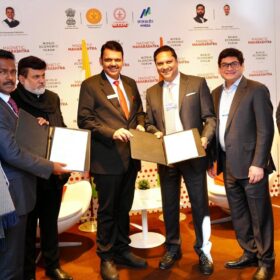
Blue Energy to set up EV truck, battery manufacturing facility in Maharashtra
Blue Energy Motors has signed an agreement with the Government of Maharashtra to set up a manufacturing facility designed to produce 30,000 EV trucks annually. The facility will also house a battery pack line.
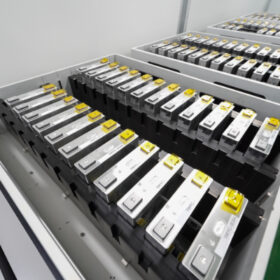
S&P Global: Annual battery cell production passes 10 billion, lower prices to stimulate demand
While oversupply remains a feature of the lithium-ion battery production landscape, large production volumes are accelerating innovation and enhancing energy storage competitiveness. S&P Global analysis reveals that balance is likely to return to the global market in the coming years as stationary energy storage and EV adoption continues to accelerate.
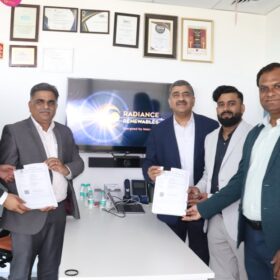
Waaree Energies supplies 132.5 MWp of solar modules to Radiance Renewables
Waaree Energies manufactured and supplied 132.5 MWp of n-type TOPCon solar modules for a commercial and industrial project by Radiance Renewables.
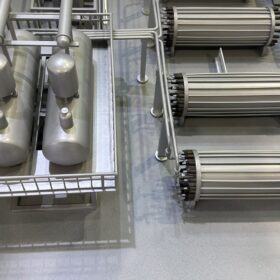
The Hydrogen Stream: SECI awards LoAs for electrolyser production-linked incentives
Solar Energy Corp. of India Ltd (SECI) has issued Letters of Award for incentives to set up electrolyzer manufacturing capacities under tranche II of the Strategic Interventions for Green Hydrogen Transition (SIGHT) Scheme.

Five solar businesses added to forced labor list, banned from U.S. entry
Under the Uyghur Forced Labor Prevention Act (UFLPA), five businesses in China were added to an entity list, making them ineligible to provide products and services in the United States.
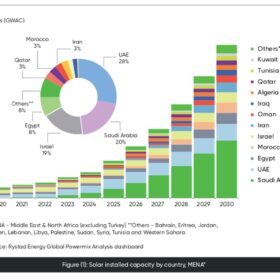
MENA region hits 24 GW (AC) of total solar capacity
The Middle East Solar Industry Association’s (MESIA) latest report says solar capacity in the Middle East and North Africa (MENA) region grew by 25% in 2024, with local manufacturing and energy storage also accelerating.
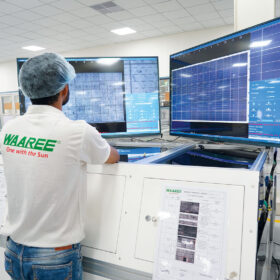
Waaree Energies secures 180 MW solar module order
Waaree Energies has secured a Letter of Award from a domestic renewable power producer to supply 180 MWp of solar modules.