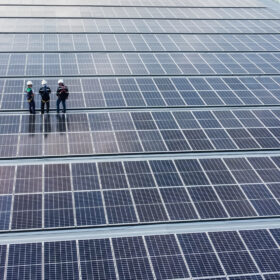
Most module makers willing to kickstart cell production—Loom Solar founder
As importing solar cells becomes costlier and time-consuming in the Covid-19 scenario, most of the module manufacturers in India are eyeing solar cell production—says Loom Solar co-founder and director Amol Anand in an interview with pv magazine.

The long read: Understanding LeTID
Light- and elevated temperature-induced degradation (LeTID) of PV cells can have far-reaching impacts on the efficiency of modules. Alison Ciesla and Brett Hallam of the University of New South Wales argue that accelerated testing, such as that included in the forthcoming IEC standards, is critical for LeTID identification and quantification in order to manage these impacts.

Solar canopies can put PV panels in some new and interesting places
A major advantage of this design is the ability to string cables over a longer distance without the support needed in traditional racking approaches.

Harvesting atmospheric water to cool down PV panels
Scientists from Saudi Arabia have proposed a new PV panel cooling technique which employs an atmospheric water harvester. The device uses waste heat from the PV panel to collect atmospheric water at night and then releases it during the day to cool down the module. The researchers claim the device may also be improved to produce liquid water, which could be used for the cleaning of the modules.

Alpex Solar reopens its module fab in Noida
The New Delhi headquartered company has its own state-of-the-art, automatic module manufacturing facility with a capacity of 350 MW per annum in Greater Noida, Gautam Budh Nagar district of Uttar Pradesh.

A flexible perovskite solar cell with 11.8% efficiency
U.S. researchers have created an inorganic mixed halide perovskite solar cell which they claim shows no thermal degradation even at 200 degrees Celsius for three days. The device can be used in tandem junction cells and is designed for use in real-life environments with high solar irradiation.
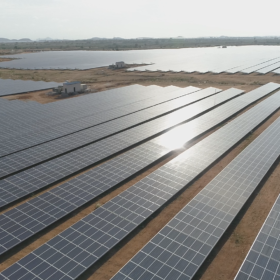
MicroSun Solar resumes module manufacturing operations
The Bengaluru-based solar module manufacturer, which has a state-of-the-art facility with capacity of 150 MW per annum, had closed the operation of its units since March 24 after the government announced lockdown to contain Covid-19 spread.

Solar industry gets more time to submit responses for safeguard duty review
The Directorate General of Trade Remedies (DGTR) has granted an extension till May 11 for the solar manufacturers and importers to file their responses as it probes the need for continuing with the imposition of safeguard duty on solar cells, whether or not assembled into modules.
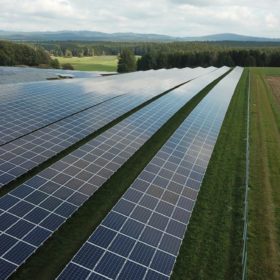
LCOE from large scale PV fell 4% to $50 per megawatt-hour in six months
Analysts at Bloomberg New Energy Finance say the lowest-cost projects financed in Australia, China, Chile and the UAE in the last six months hit a levelized cost of energy of just $23-29/MWh and the best solar and wind projects will produce electricity for less than $20/MWh by 2030.

SunSource orders 105 MW of Trina Solar modules with 500W+ output
Trina Solar’s new Vertex series of bifacial modules have a conversion efficiency of up to 21% and can deliver more than 500W of power from the front surface.