IREDA to launch call for applications under the production-linked solar incentive scheme soon
Indian Renewable Energy Development Agency Ltd (IREDA), the implementing agency for the Production Linked Incentive (PLI) Scheme, would soon issue the selection document for solar manufacturers who wish to apply for state cash to set up production lines in India.

Industry reacts to production-linked solar incentive scheme
Solar manufacturers have welcomed the bidding criteria which apply to the incentives offered for setting up gigawatt scale, high-efficiency PV production lines but would like a bigger budget, to finance significant capacity build-up.
Government to finance 100 MW Bangladeshi solar plant
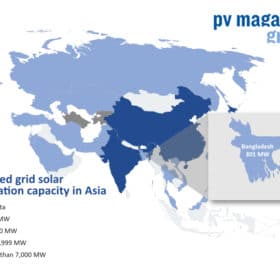
The federal government will provide INR968 crore of soft loans for a INR1307 crore, 100 MW solar park near the Jamuna river in Bangladesh’s Jamalpur district, where a second park of a similar size is being planned by Dhaka and a Chinese partner.
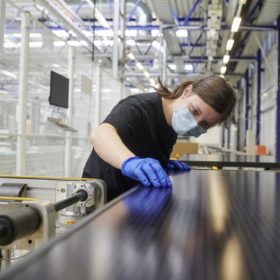
Meyer Burger unveils 400 W heterojunction solar module
The solar module will be available in three versions – white, black, and glass-glass. The products have an output of up to 400 W, but when the bifacial effect is optimally used, the output of the glass-glass module can reach up to 430 W. Both the white and black modules weigh less than 20 kg.

India installed 3.2 GW of solar in 2020
In large-scale solar, Adani was the largest developer by capacity, and Sterling & Wilson the preferred EPC partner. Tata Power Solar led in rooftop solar installations.
Goldi Solar supplies 24+ MW modules to a textile client
The Surat-based solar manufacturer has completed the supply of an aggregate 71,690 quantity of 335Wp polycrystalline solar panels to a textile company LS Mills.
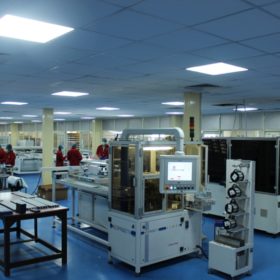
Gautam Solar doubles capacity with new production line
Gautam Mohanka, managing director of New Delhi-headquartered Gautam Solar, told pv magazine its Haridwar module factory, now scaled up to 250 MW, is producing panels with a power output of up to 400 W, using mono PERC and polycrystalline cells.
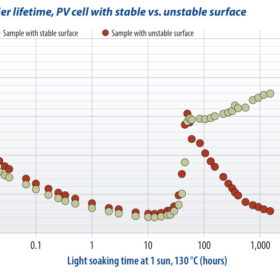
The long read: A deeper understanding of LeTID
Australia’s University of New South Wales (UNSW) has built a reputation for strong collaboration with the PV industry, from cell passivation through to the causes of degradation. Malcolm Abbott, a senior research fellow, directs one of the UNSW teams that is continuing its work into light and elevated temperature-induced degradation (LeTID). He recently spoke with pv magazine to provide an update.
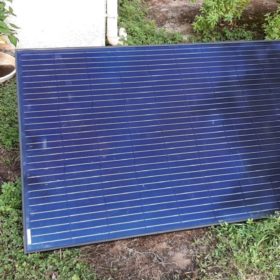
Solar kit for gardens and balconies, from France
French start-up Ekwateur is offering a solar kit consisting of a 330 W panel, a micro-inverter, a metallic structure, a monitoring sensor, and a few cables.
MNRE spells out the rules for its production-linked incentive scheme
Solar manufacturers who wish to apply for state cash to set up production lines must meet minimum requirements for manufacturing scale and module efficiency, and must produce at least solar cells and modules to be shortlisted. They will then bid for the amount of incentives they want over a five-year period, with extra weight given to applicants who will manufacture more of the supply chain, from polysilicon downwards.