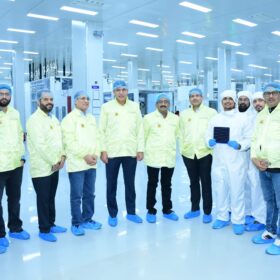
Fujiyama Power Systems commissions 1 GW solar cell manufacturing plant at Dadri, Uttar Pradesh
Fujiyama Power Systems Ltd has commenced production at its 1 GW solar cell manufacturing plant in Dadri, Uttar Pradesh. The newly commissioned facility will cater entirely to captive consumption, strengthening the company’s backward integration and supply-chain security.
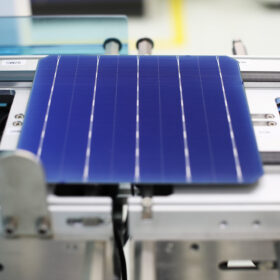
More PV manufacturers expected to adopt copper metallization in 2026
Rising silver prices are pushing PV manufacturers toward copper-based metallization, with DK Electronic Materials targeting 2026 for large-scale deployment of high-copper paste solutions, while Fraunhofer ISE warns efficiency trade-offs remain unacceptable.
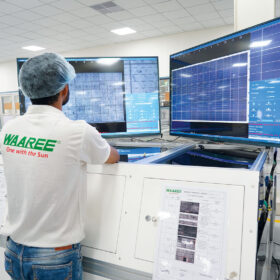
Waaree Energies posts record quarterly results
Waaree Energies Ltd reported revenue from operations of INR 7,565.05 crore in the third quarter of fiscal year 2026, marking a year-on-year increase of 118.81%. Profit after tax (PAT), after accounting for exceptional items, surged 118.35% YoY to INR 1,106.79 crore.

European PV market faces potential 2026 price shock from China export tax
China’s PV manufacturing sector is operating at full capacity ahead of an April 1 export tax change, contributing to module price increases of 20% to 30% in parts of the supply chain and raising risks for price-sensitive European commercial and utility-scale projects in early 2026.
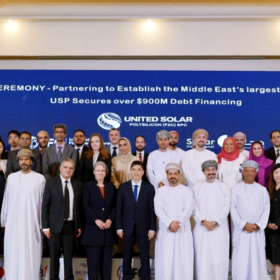
Omani polysilicon factory reaches financial close
United Solar Holding has secured more than $900 million to complete the financing required for its 100,000 MT polysilicon manufacturing facility in Oman. Production is expected to begin during the first quarter of this year.
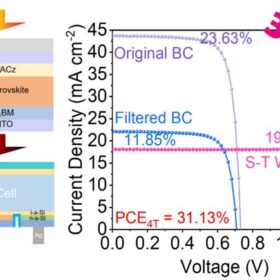
Chinese scientists build 31.13%-efficient perovskite-silicon tandem solar cell via 2D seeding agent
Researchers in China developed a novel two dimensional (2D) seeding agent to regulate crystallization in a 1.80-eV wide-bandgap perovskite film. A perovskite-silicon tandem device made with the resulting optimized subcell achieved an efficiency of 31.13%, outperforming a control device.
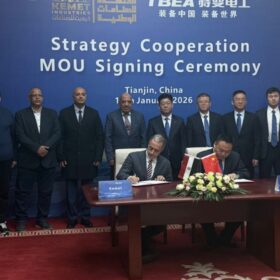
GCL, Cornex, TBEA to build solar manufacturing complex in Egypt
Egypt’s Kemet has signed three agreements with Chinese companies over the last week, covering plans for a 5 GW solar cell complex, a 5 GWh battery energy storage factory and Egypt’s first solar inverter factory.

Australia betting on new ‘strategic reserve’ to loosen China’s grip on critical minerals
The federal government has unveiled new details of its plan to create a $1.2 billion critical mineral reserve. Three minerals will initially be the focus: antimony, gallium and rare earths (a group of 17 different elements).
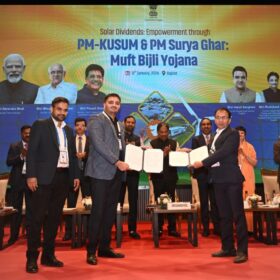
Kosol Energie signs MoU for INR 90,000 crore investment in Gujarat
Kosol Energie has signed a memorandum of understanding (MoU) with the Government of Gujarat to invest INR 90,000 crore in the State. The company said the proposed investment will support the development of advanced solar module manufacturing facilities, next-generation R&D centers, large-scale renewable energy parks, and integrated green energy ecosystems.

LNK Energy announces INR 10,000 crore investment across solar manufacturing, green fuels and renewable power generation
The newly launched LNK Energy plans INR 10,000 crore investment to build an integrated clean energy platform spanning solar manufacturing, green fuels and renewable power generation. The company will start with a 6 GW solar cell and module facility with integrated ingot and wafer production in Maharashtra, with plans to expand into related component manufacturing, green hydrogen and renewable power generation.