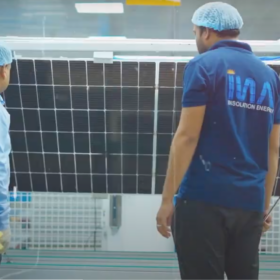
Insolation Green Energy secures INR 516.05 crore solar module orders
The solar module deliveries are scheduled for the financial years 2025–26 and 2026–27.

NLC India seeks to procure 579.74 MWp PV modules for Rajasthan solar project
NLC India has launched a tender for procurement of 579.74 MWp PV modules for its upcoming 810 MW solar power project in the RVUN Solar Park at Pugal, Bikaner, Rajasthan.

India’s decisive leap beyond gigawatts post-COP30
India’s renewable energy journey has long been narrated through the lens of capacity: gigawatts added, modules produced, plants commissioned. While these indicators are important, genuine leadership will arise from our ability to embed advanced materials, high-efficiency solar cell architectures like TOPCon, N-Type and rear-contact technologies, robotics-driven precision manufacturing, and AI-enabled predictive monitoring into our value chains.

Huasun unveils 770 W, 2,000 V heterojunction solar module
The Chinese manufacturer said the higher-voltage design of the new module reduces cable, combiner, pile-foundation, and land-use requirements, delivering balance-of-system savings of up to CNY 0.15 ($0.012)/W in western China. The module offers a power output of 730 W to 770 W and a conversion efficiency of up to 24.8%.
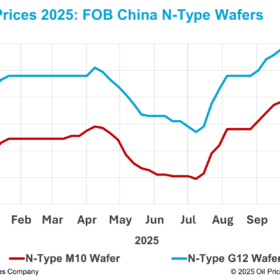
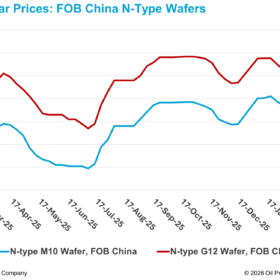
N-type wafer prices extend four-week slide amid weak demand, rising inventory concerns
In a new weekly update for pv magazine, OPIS, a Dow Jones company, provides a quick look at the main price trends in the global PV industry.
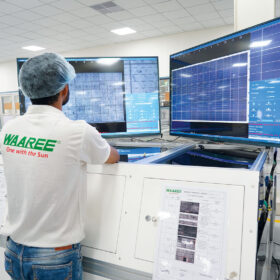
Waaree Energies secures 350 MW solar module order from AMPIN Energy Transition
Waaree Energies will supply 350 MW of TOPCon G12R modules to power AMPIN’s flagship solar projects across India. The delivery of the modules is scheduled to be completed by March 2026
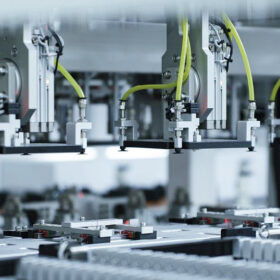
JinkoSolar achieves world record efficiency of 27.79% for TOPCon solar cell
The Chinese manufacturer says Germany’s Institute for Solar Energy Research Hamelin (ISFH) has independently verified the result.
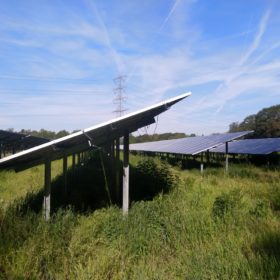
Premier Energies raises stake to 80% in aluminium frames JV
Premier Energies now holds 80% of Premier-Green Aluminium, the JV company formed for manufacturing aluminium frames for solar PV modules, with Nuevosol Energy holding the remaining 20%.

European solar manufacturing ‘considerably behind’ NZIA targets, says EU observatory
A report from the Clean Energy Technology Observatory finds that while the EU is a technology leader in PV inverters, trackers and mounting structures, its manufacturing capacity in solar ingots, wafers, cells and modules falls far behind targets set by the Net Zero Industry Act.

India could attract $4.1 trillion in green investments by 2047: CEEW
Around 92% of the required investments—about $3.79 trillion—would flow into the energy transition, spanning renewable energy, storage, clean mobility, and green hydrogen.