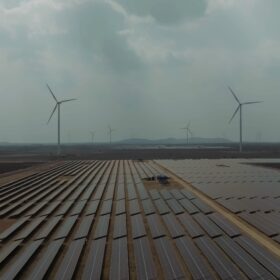
CleanMax secures $575 million for 1 GW renewable energy projects in India
Clean Max Enviro Energy Solutions, a renewable energy solutions provider for the commercial and industrial sector, has raised $575 million to support the development of around 1 GW of solar and wind projects across the Indian states of Rajasthan and Karnataka.
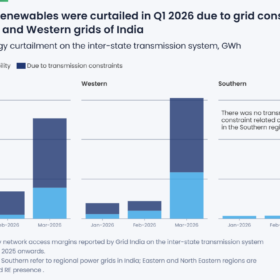
India curtailed 300 GWh of renewable energy in Q1 2026 due to transmission constraints, says Ember
With the right regulatory changes, battery energy storage systems offer a credible near-term solution to the country’s rising grid gaps.

Oman power company signs 2.7 GW PPA for continuous wind-solar-storage project
The gigawatt-scale solar, wind and battery project developed by O-Green Energy expected to provide round-the-clock power. It is part of a push from Nama Power and Water Procurement to secure 7 GW solar, 3 GW battery storage capacity by 2030.
BII, CIP launch $300 million platform to support renewables project development in India
British International Investment (BII) has launched a $300 million platform to accelerate renewable power projects in India, with $150 million each from BII and Danish fund manager Copenhagen Infrastructure Partners (CIP).

Hybrid energy systems: Combining solar, wind & storage for maximum efficiency
Hybrid energy systems are set to play a crucial role in shaping the future of energy infrastructure. With advancements in smart grid technologies, artificial intelligence, and predictive analytics, these systems will become even more efficient and adaptive. They offer a scalable and sustainable solution to meet rising energy demands while reducing carbon emissions and enhancing energy security.
ACME Solar FY26 profit jumps 98.4% to INR 498 crore
ACME Solar Holdings has reported a 98.4% year-on-year increase in profit after tax (PAT) to INR 498 crore for fiscal year 2026. The company posted total revenue of INR 2,507 crore for FY 2026, up 59% year on year.
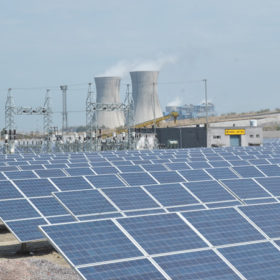
India’s top state-run energy firms invest INR 2.33 trillion in fossil fuels vs INR 0.30 trillion in clean energy in FY 2025
While a significant share of state-run energy firms’ current fossil fuel capital expenditure is tied to ongoing projects, new and incremental investments can be progressively rebalanced toward clean energy, says Deepak Sharma, a consultant at the International Institute for Sustainable Development.
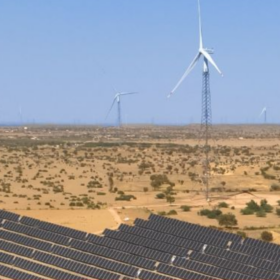
AMPIN Energy Transition commissions 500 MWp wind-solar hybrid project in Rajasthan
AMPIN Energy Transition has commissioned 500 MWp of interstate transmission system (ISTS)-connected wind-solar hybrid capacity in the Indian state of Rajasthan, marking its first integrated hybrid project supplying power to distribution companies (DISCOMs) and corporate customers.
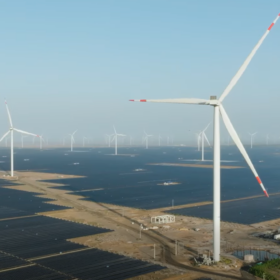
Adani Green’s operational RE capacity grows 35% YoY to 19.3 GW
The company reported revenue from power supply of INR 11,602 crore in FY 2026, marking a 22% year-on-year increase. EBITDA from power supply rose 23% YoY to INR 10,865 crore—almost twice the annual EBITDA for FY23.
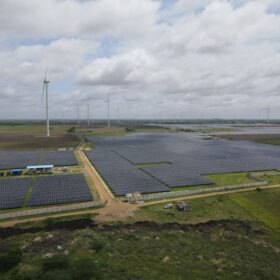
CleanMax to supply hybrid renewable power to Shell’s LNG terminal and technology centre in India
CleanMax’s 16.83 MW wind–solar hybrid project in Gujarat will supply renewable power to Shell’s LNG terminal at Hazira, Surat. Its 13.2 MW wind–solar hybrid project in Karnataka will power Shell’s Technology Centre in Bengaluru.