Uma Gupta

India’s solar module production capacity to reach 215–220 GWp by FY28: CareEdge Ratings
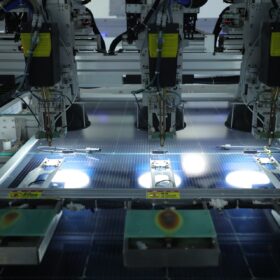
India’s solar module manufacturing capacity is expected to reach 215–220 GWp by FY28, driven by strong policy support, growing domestic demand, and export opportunities, according to a new report by CareEdge Ratings. The country’s solar cell manufacturing capacity is also projected to rise sharply to around 100 GWp by FY28.
Jharkhand can emerge as a front-runner in India’s low-carbon transition
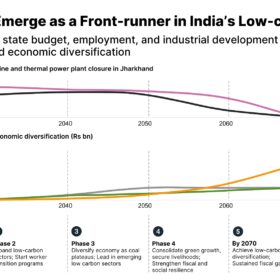
Jharkhand’s vast renewable energy potential, combined with its industrial base and critical mineral reserves, positions the state to emerge as a hub for low-carbon manufacturing, ranging from EVs, solar panels and battery energy storage systems (BESS) to green hydrogen production.

“Next year, the solar tracker market will be much larger”: GameChange Solar CEO
Vikas Bansal, President and CEO – International, GameChange Solar, expects that 55–60% of India’s new utility-scale solar capacity additions in FY 2027 will use trackers — a significant jump from the current 30–35% adoption rate.

Loom Solar showcases 730 Wp modules at REI 2025, announces 1.2 GW module factory in Uttar Pradesh
Loom Solar showcased its TOPCon and HJT PV modules up to 730 Wp, battery energy storage systems ranging from 1 kWh to 5 MWh, and made-in-India PV inverters from 3 kW to 50 kW. The company also announced plans to set up a 1.2 GW module factory in Uttar Pradesh.
The impact of dust on PV systems in arid coastal environments
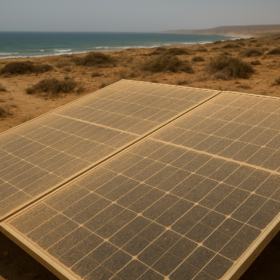
A Saudi–Egyptian research team investigated the effects of four types of dust on photovoltaic panels in arid coastal environments, finding that power losses can reach up to 48%.
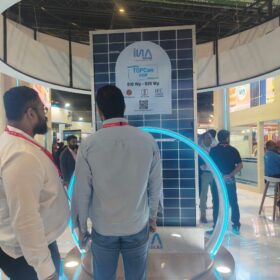
INA Solar to begin G12R TOPCon cell production by September next year
Deepak Jain, Chief Technical Officer (CTO) of Insolation Energy (INA Solar), told pv magazine that they are eyeing major capacities in TOPCon G12R cell production and backward integration into ingot and wafer manufacturing. The company will begin commercial production of G12R solar cells by September next year, with an initial capacity of 4.5 GW in its Phase 1 rollout.
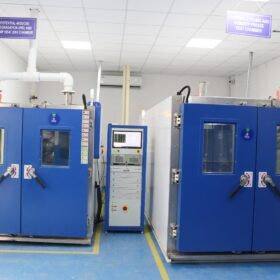
Jakson Solar inaugurates advanced in-house reliability testing lab
The state-of-the-art facility is equipped with high-precision testing equipment specifically designed to continuously test and evaluate solar PV modules and their components. The modules are subjected to extreme climatic conditions, simulating the stresses they will endure over their operational life.
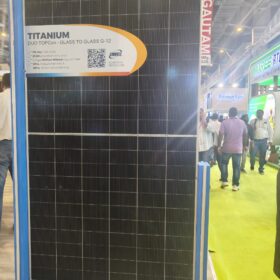
Emmvee unveils 715 Wp G12 n-type glass-glass TOPCon module
Emmvee has unveiled Titanium Duo G12 n-type bifacial (glass-glass) TOPCon module with power output of 715 Wp and an efficiency of 23.18%.

Waaree unveils 350 kW three-phase inverter for utility-scale solar projects
Waaree Energies has showcased its 350 kW three-phase string inverter for utility-scale solar projects. The inverter has six MPPT inputs, which allow total 30 strings of modules.

How to make India’s energy sector more cyber resilient
Amid looming threats from interconnected environments, emerging technologies, and siloed security practices, the energy sector needs a single source of truth. An exposure management platform delivers this, bringing IT and OT security into a unified ecosystem. It proactively identifies risks and stops them before they spiral out of control and stop operations.