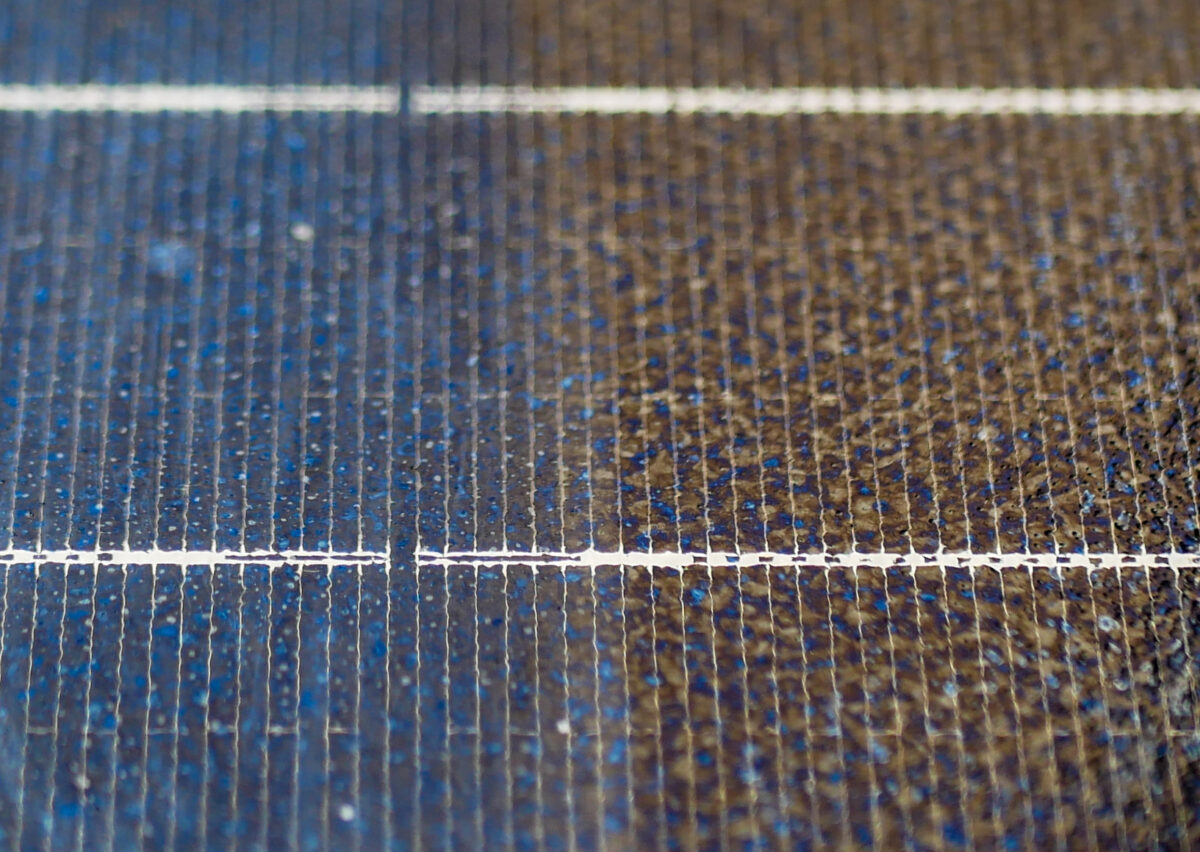





Researchers from Germany’s Fraunhofer Center for Silicon Photovoltaics (CSP) have evaluated the impact of several PV cleaning products on module glass surfaces and have found that certain commercially available cleaning agents for photovoltaic modules can significantly damage anti-reflective glass coatings and reduce energy yield.
The researchers tested five commercially available cleaning agents alongside pure deionized (DI) water, which served as a reference. The aim was to determine whether chemical cleaners used during PV maintenance could degrade the anti-reflective coating (ARC) commonly applied to solar module glass.
“The tested cleaners are market-leading products, which are freely available on the European market. Only one of the cleaners is special-purpose cleaner while all others are promoted as all-purpose PV cleaners,” Fraunhofer CSP researcher, Marko Turek, told pv magazine, without provided further details.
Experimental setup
The scientists exposed the module glass to the cleaning agent for 24 hours at 55 C. “This corresponds to a total wetting time over the lifetime of PV modules, assuming frequent cleaning, while a module temperature of 55 C is also not unusual in direct sunlight,” Turek explained. “Nevertheless, our aim was not to replicate one of many possible application scenarios, but to benchmark the cleaners against one another under reproducible and controlled conditions.”
After the exposure the team quantified the optical performance of the glass by optical measurements, in particular regarding its optical transmission. “We found that some products had a larger impact than others, and that there’s quite a large spread among the five cleaners that we investigated,” Turek said. “The change in optical performance would directly translate into a power loss for PV modules. If the ARC is degraded and the anti-reflective functionality is lost, the module will produce less power.”
“We did not do any chemical analysis of the cleaners themselves,” Turek went on to say. “Our main objective was not some kind of reverse engineering but rather to provide an objective screening test. And for us, the point was to raise awareness that PV system owners really should, before using a cleaner, check that the cleaner does not do any harm to their modules.”
Degradation
Three of the five tested cleaning agents caused measurable degradation of the anti-reflective coating, leading to optical losses that translated into reduced PV performance. In the most severe cases, the researchers calculated performance losses of up to 5.6%. This number refers to the current loss of the solar module compared to a module with undamaged glass coating.
By contrast, two of the tested cleaning agents produced no significant degradation similarly to the DI-water reference. Microscopy images confirmed the underlying cause: ARC-coated glass exposed to the damaging cleaners displayed visible surface degradation, while samples treated with the non-damaging agents retained largely intact coatings.
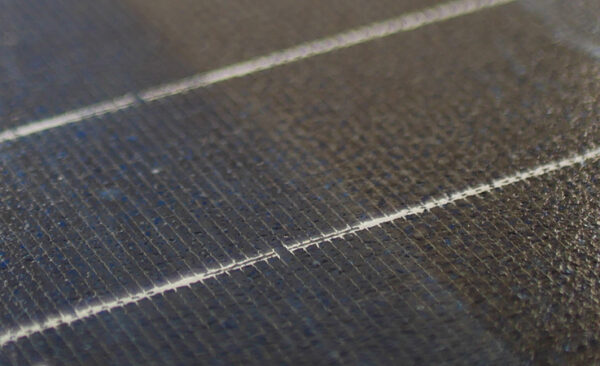
Image: Fraunhofer CSP
“We saw the anti-reflective coating really being damaged,” Turek explained. “With the three cleaners that had a strong impact, there are parts where it’s still there and there are other parts where it has been removed. Whereas for the other two cleaners, it still looks very uniform. The change is visible to human eye. Its color appearance is a bit non-uniform, so you see like a rainbow color there.”
“We have even found that some aggressive PV cleaner products are marketed as certified or tested as material compatible. This is because cleaning products are assessed under very different conditions, and in some cases standards that are unsuitable or misapplied are used. All of this has prompted us to conduct more in-depth investigations into the effects of cleaning agents. We can also support partners from industry – both manufacturers of module components and cleaning agents – with corresponding analyses. In particular, we can assist investors and park operators in selecting suitable cleaning agents,” Turek pointed out.
Prospects
The researchers explained that the damage on ARC is permanent and likely caused by a chemical reaction, as no mechanical stress has been detected during the experiments. “There currently companies they can repair or retrofit the module with another ARC,” the scientist said. “But as I’m aware, it’s not like done on a regular basis. So it’s not like that every PV park gets a retrofit every five years. It’s more like an idea or an active process of development where from a technological point of view, it could work. I’m not sure if it works from a commercial point of view.”
He also explained that cleaning agents are used in solar parks to mitigate the mechanical stress produced by robots or mechanical brushes. “PV plant operators that want to reduce scratching and abrasion effects should use chemical cleaning agents, but that makes only sense if the like damage you avoid from the brushing is not imposed then by the cleaning agent, because then you don’t win anything,” he stated.
In the next step, the Fraunhofer CSP researchers want to investigate the relationship between actual cleaning performance and possible damage to the ARC. This research will be based on their expertise in analyzing the microstructure of materials. The aim of an in-depth investigation of the interaction between chemical and mechanical effects is to derive recommendations for industry.
This content is protected by copyright and may not be reused. If you want to cooperate with us and would like to reuse some of our content, please contact: editors@pv-magazine.com.




By submitting this form you agree to pv magazine using your data for the purposes of publishing your comment.
Your personal data will only be disclosed or otherwise transmitted to third parties for the purposes of spam filtering or if this is necessary for technical maintenance of the website. Any other transfer to third parties will not take place unless this is justified on the basis of applicable data protection regulations or if pv magazine is legally obliged to do so.
You may revoke this consent at any time with effect for the future, in which case your personal data will be deleted immediately. Otherwise, your data will be deleted if pv magazine has processed your request or the purpose of data storage is fulfilled.
Further information on data privacy can be found in our Data Protection Policy.