




The decline in India’s solar module exports to the US, due to tariff measures introduced by the Donald Trump administration, presents an opportunity to boost India’s energy security by accelerating domestic solar power deployment, suggests a new analysis by Bengaluru-based think tank Climate Risk Horizons.
The report says increased solar deployment and stricter enforcement of renewable purchase obligations across states and industries can help Indian manufacturers get over a volatile period and position themselves to compete better in a global market.
Solar module production in India has grown strongly, making the nation a net exporter, with the US as the major buyer. From FY 2022 to FY 2024, India’s PV module exports to the US rose nearly tenfold.
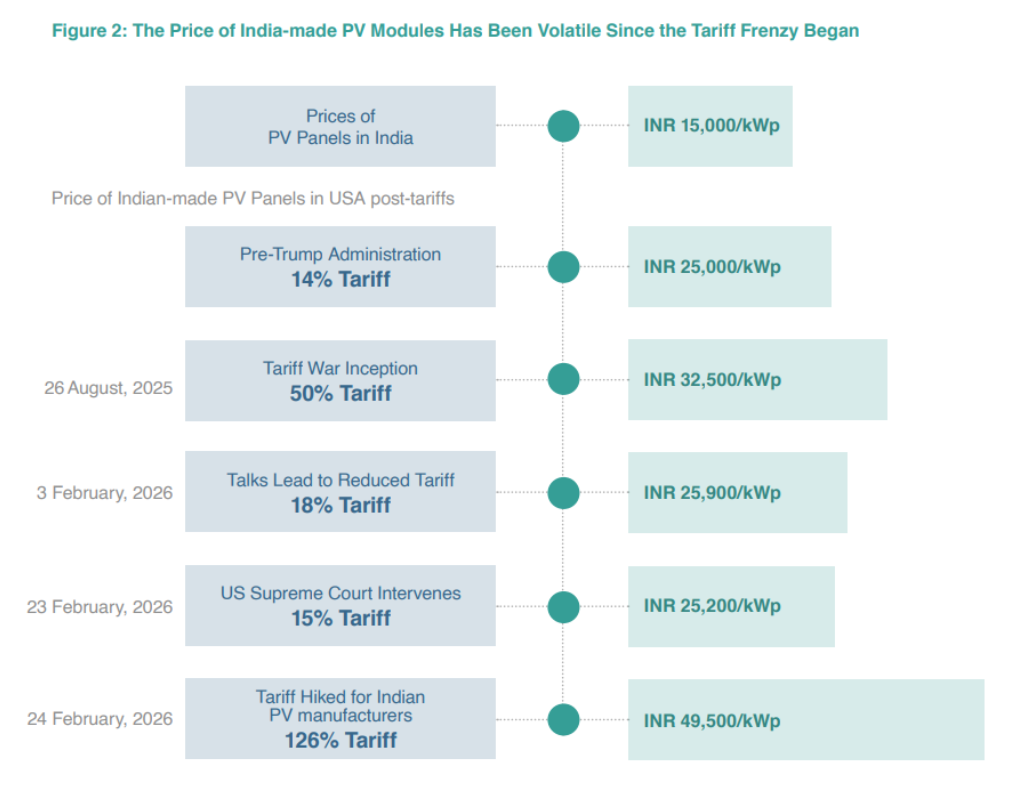
However, the trade tariffs imposed by the Trump administration in 2025 have since reduced India’s solar exports drastically. From August to September 2025, India’s solar module exports dropped from about $134 million to roughly $80 million, after a blanket 50% tariff was imposed on all export goods. Module costs in the US increased 31%, squeezing profit margins that typically range between 40–60% in developed markets.
Since the beginning of February 2026, the tariff rates have changed every few days. As of early March, Indian-made solar modules incur a 126% tariff in the US.
In a time of volatile geopolitics and policy by tweet, this tariff war reflects the risk of over reliance on, and concentration of, export markets. To strengthen the export resilience of its solar sector, India must look for new export markets in other developed countries, such as the EU, which primarily imports solar modules from China. While ramping up exports to the EU could take time, the report suggests that India must quickly leverage favourable factors like reduced GST rates on solar, latent industrial demand for renewable electricity and the need to cut energy imports to scale up domestic solar manufacturing.
“Enforcing the Renewable Purchase Obligation (RPOs) for India’s heavy industry is a tool that has been neglected too long. Heavy industries are required to source about 30% of their electricity consumption from renewable sources but almost none of them meet this target,” Vishnu Teja, author of the report. “If India’s top companies across cement, aluminium, steel, and fertiliser industries were to meet their RPOs, that alone would translate to about 19 billion units (BU) of annual renewable electricity demand. We estimate that 10 GW of solar PV would be needed to meet the 30% RPO and 50 GW to ensure that all electricity used by these companies comes from RE. This would boost demand for domestically-produced panels and lower industrial energy costs at the same time.”
GST 2.0, introduced in September 2025, reduced the GST for solar panels from 12% to 5%, with the government estimating a capital cost reduction of INR 20–25 lakh per MW, acting as an incentive for solar developers.
While India’s module manufacturing capacity can meet current domestic demand, the combined manufacturing capacity of components such as wafers, ingots, and polysilicon does not exceed 3 GW. India relies on China’s export—which controls more than 90% of the market in each of these verticals—for the same. An increase in demand for domestic renewable electricity can push the Indian manufacturers towards vertical integration.
“Recent volatility in the energy markets, whether reflected in tariffs on India’s solar exports or restrictions on oil imports, reinforce the need for greater energy security,” said Ashish Fernandes, Director of Climate Risk Horizons. “The good news is that solar is cheap and getting cheaper. Increasing domestic RE deployment will reduce India’s dependency on imported coal and, eventually, oil and gas as well. In 2024, India imported 30% of its annual coal for electricity at a cost of USD 21 Billion. By strengthening domestic RE capacity, India can not only secure greater energy independence but also conserve foreign exchange.”
This content is protected by copyright and may not be reused. If you want to cooperate with us and would like to reuse some of our content, please contact: editors@pv-magazine.com.






By submitting this form you agree to pv magazine using your data for the purposes of publishing your comment.
Your personal data will only be disclosed or otherwise transmitted to third parties for the purposes of spam filtering or if this is necessary for technical maintenance of the website. Any other transfer to third parties will not take place unless this is justified on the basis of applicable data protection regulations or if pv magazine is legally obliged to do so.
You may revoke this consent at any time with effect for the future, in which case your personal data will be deleted immediately. Otherwise, your data will be deleted if pv magazine has processed your request or the purpose of data storage is fulfilled.
Further information on data privacy can be found in our Data Protection Policy.