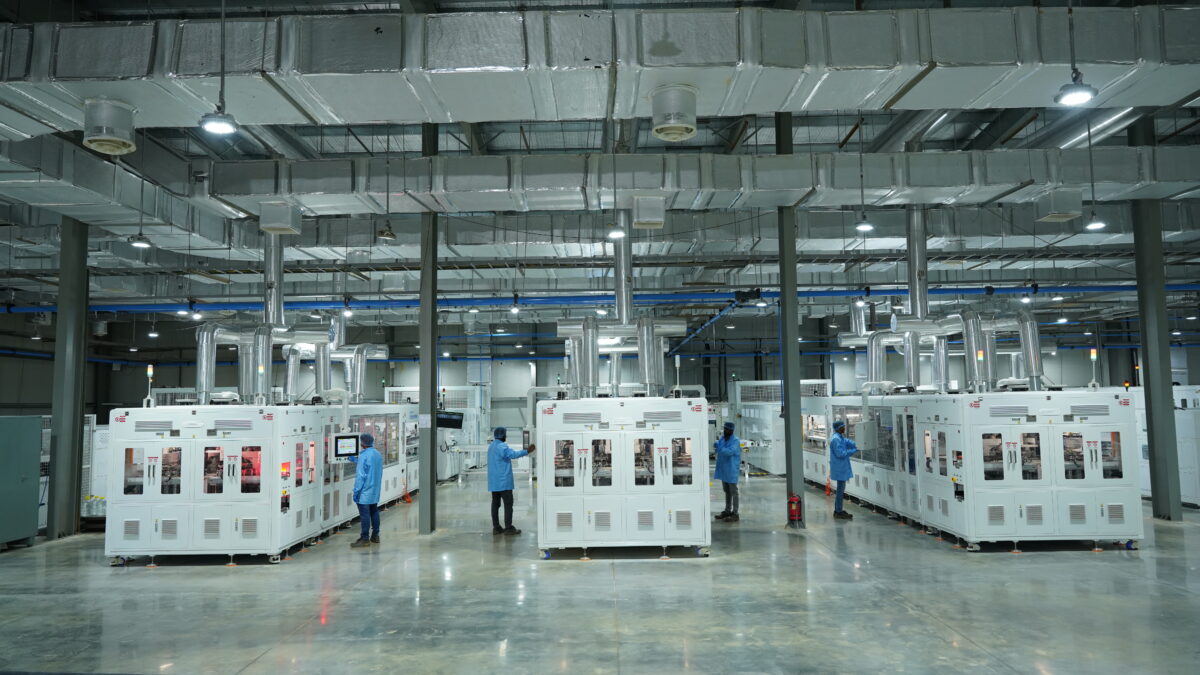





India’s solar manufacturers could face a period of export volatility following the United States’ preliminary decision to impose countervailing duties on solar cell and module imports from India, even as leading manufacturers emphasise limited impact owing to their diversified supply chains and expanding overseas manufacturing footprint.
Solar imports from India are subject to a preliminary countervailing duty rate of 125.87%, as proposed by the US Commerce Department recently.
According to Sehul Bhatt, director, Crisil Intelligence, the proposed duties will have a negative impact on export-focused manufacturers. India exported cells and modules worth INR 340 billion to the US between April 2023 and November 2025. This was supported by lower cost of Indian modules compared with those made in the US, both using imported cells—an advantage the duties will erode.
Bhatt highlighted three factors at play here: First, the US accounts for more than 95% of India’s solar cell and module exports, as seen over the past three quarters. Second, modules imported from India will now become at least 30% costlier than US-made modules (also using imported cells) and, thereby, unviable from a cost perspective. Third, the announcement comes at a time when Indian players have planned healthy capacity expansion over the next three years.
Given the tariff uncertainty over the past year or so, a few Indian companies have strategised expansion outside India, which cushions them from this increased duty.
Overall, Bhatt believe the duties will create volatile trade patterns for exports from India till finalization of rates, scheduled in July 2026, forcing the companies to navigate limited market opportunities amid supply addition.
Ankit Jain, Vice President and Co-Group Head – Corporate Ratings at ICRA Ltd, said the proposed countervailing duties and the growing regulatory uncertainty in the USA are likely to dampen export volumes from India, which were around 3 GW for the last calendar year, potentially exerting pricing pressures on domestic OEMs and thus impacting the profitability of solar module manufacturers.
“These volumes if redirected back in India can result in pricing pressure in the Indian market, which is already oversupplied. India’s solar module manufacturing capacity currently stands at more than 140 GW, which is expected to increase to over 165 GW by March 2027—against the expected annual solar capacity installation of 45-50 GW DC,” said Jain. “Further, there has been a slowdown in project award activity along with delays in signing of the power purchase agreements (PPA) and this, along with transmission connectivity constraints, if continued, poses near-term challenges in the solar project implementation.”
Leading manufacturers, including Waaree Energies and Vikram Solar, however, say the proposed duties are unlikely to have any material adverse impact on their businesses.
Gyanesh Chaudhary, CMD, Vikram Solar, said the direct financial impact of the preliminary duties would be limited, as they apply specifically to Indian-origin cells “Our U.S. order strategy was not structured around sourcing Indian cells; we already operate with a diversified supply chain for that market, including sourcing from geographies with lower tariff exposure. As a result, the direct financial impact on us is limited,” said Chaudhary.
Chaudhary added that Vikram Solar’s growth strategy continues to be firmly anchored in India, where demand remains structurally strong. With the Cabinet’s decision to ease evacuation infrastructure, he expects installation momentum to accelerate further. “This strength is reflected in wins such as our 378.75 MW module order from Indian Oil–NTPC Green Energy for a large-scale project in Gujarat,” said Chaudhary. “More broadly, as AI adoption and data centre capacity expands, clean energy is becoming the backbone of economic growth. We see India’s solar manufacturing ecosystem scaling up with resilience and reliability to power this next phase of digital and industrial expansion.”
Waaree Energies also does not anticipate any material adverse impact on its ability to service its U.S. order book as the company expands localized manufacturing in the United States along with diversifying its supply chain across geographies to further strengthen its supply chain resilience.
“During 9MFY26, Waaree Energies has continued to ramp up its deliveries for U.S. shipments despite the earlier imposition of 50% duty on imports from India. This has been enabled by the alternate and diversified supply chains developed by the Company over the years,” said Abhishek Pareek, Group Head Finance, Waaree Energies. “The Company’s diversified sourcing strategy remains a core strength, and it continues to further strengthen the same, including through its announced investments in Oman aimed at securing fully traceable, non-Chinese polysilicon supply.”
Waaree Energies has been progressively strengthening its U.S.-based manufacturing footprint as part of its long-term strategy to support localized production and serve customers in the United States market.
“As on date, Waaree has an aggregate U.S. module manufacturing capacity of approximately 2.6 GW, including capacity acquired pursuant to the acquisition of the Meyer Burger facility. The Company is in the process of further expanding its U.S. manufacturing capacity to approximately 4.2 GW by the end of the current financial year, subject to operational ramp-up timelines and other customary factors,” said Pareek. “Based on the current order book and internal assessments, the Company expects that its current and planned U.S. manufacturing capacity will substantially support its existing U.S. customer commitments.”
The Company remains committed to expanding localized manufacturing in the United States along with diversifying its supply chain across geographies to further strengthen our supply chain resilience. At this stage, the Company does not anticipate any material adverse impact on its ability to service its U.S. order book.”
This content is protected by copyright and may not be reused. If you want to cooperate with us and would like to reuse some of our content, please contact: editors@pv-magazine.com.




By submitting this form you agree to pv magazine using your data for the purposes of publishing your comment.
Your personal data will only be disclosed or otherwise transmitted to third parties for the purposes of spam filtering or if this is necessary for technical maintenance of the website. Any other transfer to third parties will not take place unless this is justified on the basis of applicable data protection regulations or if pv magazine is legally obliged to do so.
You may revoke this consent at any time with effect for the future, in which case your personal data will be deleted immediately. Otherwise, your data will be deleted if pv magazine has processed your request or the purpose of data storage is fulfilled.
Further information on data privacy can be found in our Data Protection Policy.