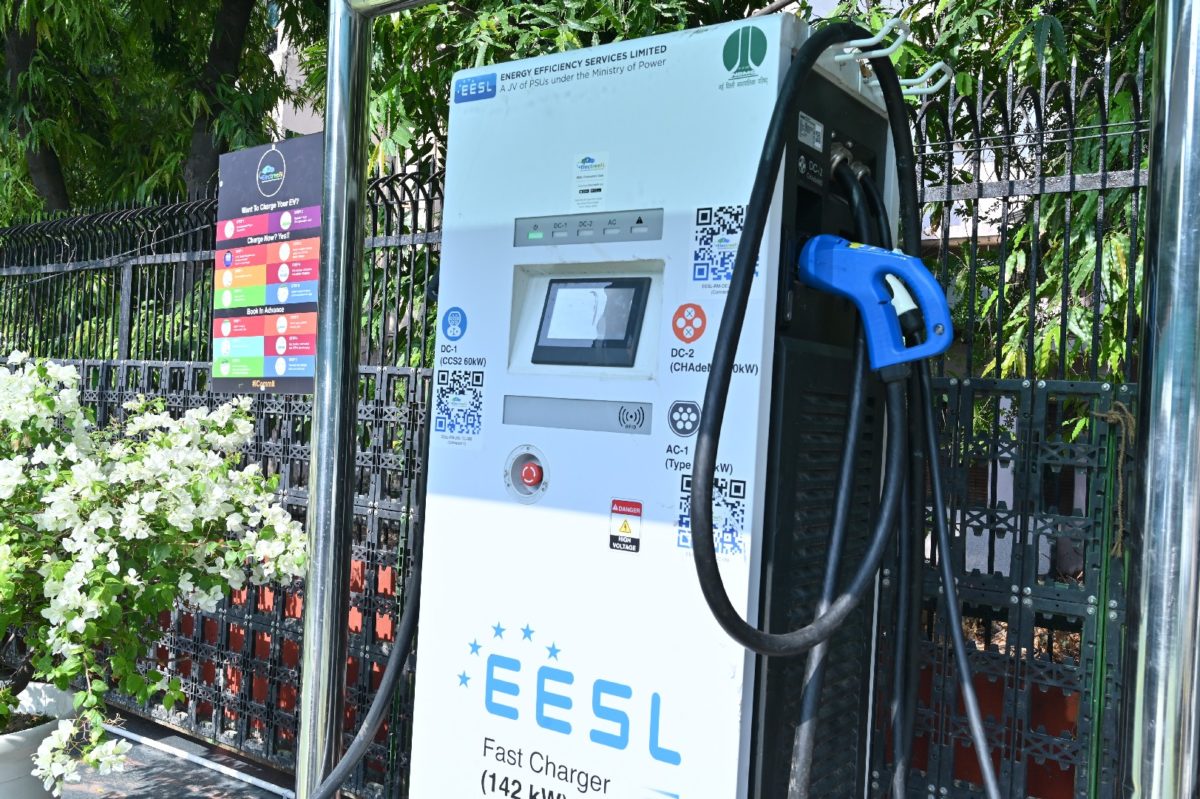





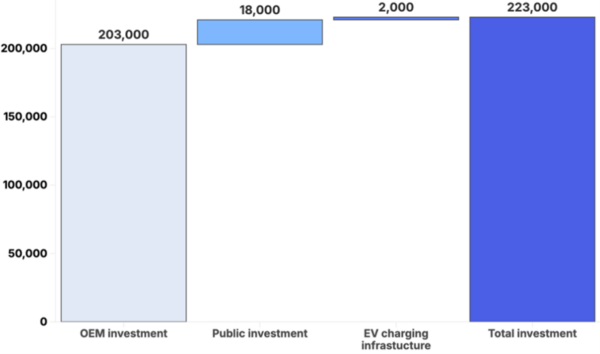
India’s electric vehicle sector attracted INR 2,23,119 crore ($25.6 billion) capital inflows over the past five years (2020-25), which is only about 18% of the total INR 12,50,000 crore investment needed to meet the 2030 electrification target, according to a new report by the Institute for Energy Economics and Financial Analysis (IEEFA).
India targets electric vehicles (EVs) to account for 30% of all private car sales, 70% of commercial vehicles, 40% of buses, and 80% of two- and three-wheelers by 2030. Achieving these goals requires substantial investment in EV manufacturing, charging infrastructure, and supportive ecosystems.
Manufacturing capacity accounted for the bulk of the capital received during 2020-25, followed by public subsidies and incentives, and EV charging infrastructure. Internal accruals accounted for the largest share of realised EV manufacturing investment (INR 1,59,701 crore), followed by debt (INR 36,738 crore) and equity (INR 6,455 crore).
IEEFA
From 2020–2025, electric three-wheelers attracted the largest share (78%) of investments among vehicle segments, due to the segment’s maturity and commercial-scale operations alongside its fragmented OEM base. However, 2024 and 2025 saw a pivot towards electric four-wheelers, driven by rising demand for electric cars.
Government subsidies under the Faster Adoption and Manufacturing of Hybrid and Electric Vehicles (FAME) scheme and other Union- and state-level policies catalysed adoption by disbursing INR 18,251 crore from FY2020–24.
However, investment in public EV charging has not kept pace with other segments of the EV sector. While public EV charging expanded significantly from 5,151 chargers in 2020 to 39,485 in 2025, India’s ratio of chargers to EVs remains far below global benchmarks.
Publicly available estimates suggest that INR 20,600 crore of investment in charging infrastructure will be required for India to achieve its 2030 goals. The authors estimate that capital deployed from 2020–2025 accounted for only 9.6% of this amount, highlighting a significant investment gap.
The report states that with an estimated 82% (INR 10,26,881 crore) of required investments still unmet, the central challenge is no longer policy ambition but the cost and structure of capital. It points out that commercial EV borrowers face interest rates ranging from 15% to 33%, significantly eroding the total cost of ownership advantages that electric vehicles otherwise offer. High financing costs dampen demand, delay fleet expansion, and ultimately slow manufacturing capacity growth.
Bridging the INR 10.3 lakh crore investment gap over the next five years will require moving beyond traditional subsidy-led approaches toward structural risk-sharing mechanisms that lower the cost of credit and attract private capital.
IEEFA proposes an integrated EV financing platform that bundles partial credit guarantees, residual value protection, battery-as-a-service arrangements, and co-lending structures into a unified framework coordinated at the point of lending.
This content is protected by copyright and may not be reused. If you want to cooperate with us and would like to reuse some of our content, please contact: editors@pv-magazine.com.





By submitting this form you agree to pv magazine using your data for the purposes of publishing your comment.
Your personal data will only be disclosed or otherwise transmitted to third parties for the purposes of spam filtering or if this is necessary for technical maintenance of the website. Any other transfer to third parties will not take place unless this is justified on the basis of applicable data protection regulations or if pv magazine is legally obliged to do so.
You may revoke this consent at any time with effect for the future, in which case your personal data will be deleted immediately. Otherwise, your data will be deleted if pv magazine has processed your request or the purpose of data storage is fulfilled.
Further information on data privacy can be found in our Data Protection Policy.