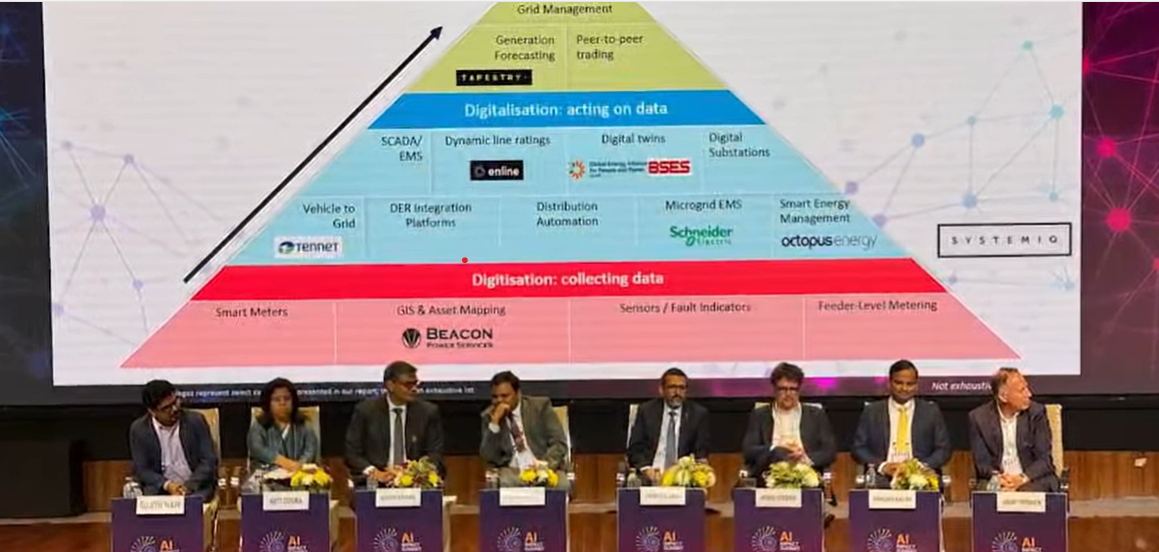





The International Solar Alliance (ISA) convened a high-level session at the India AI Impact Summit 2026 to advance global dialogue on the transformative role of Artificial Intelligence (AI) in the clean energy transition. The session was conducted in partnership with India’s Ministries of Power & Electronics and Information Technology and REC Ltd.
As countries worldwide accelerate their energy transitions, AI is emerging as a powerful enabler to improve energy planning, grid management, and service delivery—particularly in developing and emerging economies where access to reliable electricity remains uneven.
The ISA session explored how AI-driven solutions can help leapfrog traditional infrastructure pathways, reduce costs, and extend clean, affordable power, aiming to align policy, build capacity, strengthen data infrastructure, foster innovation, and mobilise finance to move from pilots to system-wide transformation. It also spotlighted the ISA-led Global Mission on AI for Energy, conceived as a collective effort to bring together governments, industry, financial institutions, and multilateral partners to build citizen-centric energy systems.
Abhishek Singh, Additional Secretary, Ministry of Electronics and Information Technology, said the Global Mission for AI for Energy gives a big opportunity for the developing countries including India, building locally tested AI products for the energy sector, ensuring that these products can ultimately create a whole set of opportunities for local enterprises in global south.
J.V.N. Subramanyam, Joint Secretary, Ministry of New and Renewable Energy, India, said, “India today stands at nearly 520 GW of installed capacity, with over 52% from non-fossil sources and 140GW from solar. What is truly remarkable is the pace of distributed renewables, nearly 15GW of DRE added under PM SuryaGhar in just the last 18 months. What changed in India’s rooftop solar story was not intent, it was technology.
“By bringing consumers, vendors, banks and DISCOMs together on a single digital platform, we created trust, speed and scale. Distributed renewable energy is no longer a pilot, it is scaling at unprecedented speed, and the next frontier is intelligence.
“With millions of prosumers and bidirectional grids, AI will be the backbone that makes our energy ecosystem smarter, more resilient and truly participative. This mission has the potential to be a true game changer—demonstrating how digital public infrastructure and AI can enable countries to leapfrog legacy energy systems and accelerate the shift to a smarter, faster, and more inclusive clean energy future.”
Shashank Misra, Joint Secretary, Ministry of Power, Government of India, said, “India’s Energy Stack demonstrates how digital public infrastructure can transform the energy sector—by integrating data, markets, payments, and consumers into a unified, interoperable system. The ‘Global Mission on AI for Energy’, anchored by ISA, builds on this very principle, taking India’s experience to a global scale. By aligning AI with digital energy stacks, the Mission will help countries modernise grids, scale decentralised renewables, improve financial viability, and place citizens at the centre of the transition. Together, these approaches offer a powerful pathway for nations to leapfrog toward clean, resilient, and inclusive energy systems.”
Ashish Khanna, Director General, ISA, said, “The International Solar Alliance is working at the intersection of AI and energy because the scale of the transition has changed. Nearly 40% of the 1,000 GW of solar added globally in the last two years has been decentralised, placing new demands on grids and financial models. Digitisation and AI are therefore essential to efficiently and affordably scale decentralised clean energy.
“Through a Global Mission on AI for Energy, launching at the AI Summit, ISA will bring together policy, innovation, skills, and finance to ensure consumers benefit and that all 125 Member Countries can digitally leapfrog, leaving no one behind.”
This content is protected by copyright and may not be reused. If you want to cooperate with us and would like to reuse some of our content, please contact: editors@pv-magazine.com.




By submitting this form you agree to pv magazine using your data for the purposes of publishing your comment.
Your personal data will only be disclosed or otherwise transmitted to third parties for the purposes of spam filtering or if this is necessary for technical maintenance of the website. Any other transfer to third parties will not take place unless this is justified on the basis of applicable data protection regulations or if pv magazine is legally obliged to do so.
You may revoke this consent at any time with effect for the future, in which case your personal data will be deleted immediately. Otherwise, your data will be deleted if pv magazine has processed your request or the purpose of data storage is fulfilled.
Further information on data privacy can be found in our Data Protection Policy.