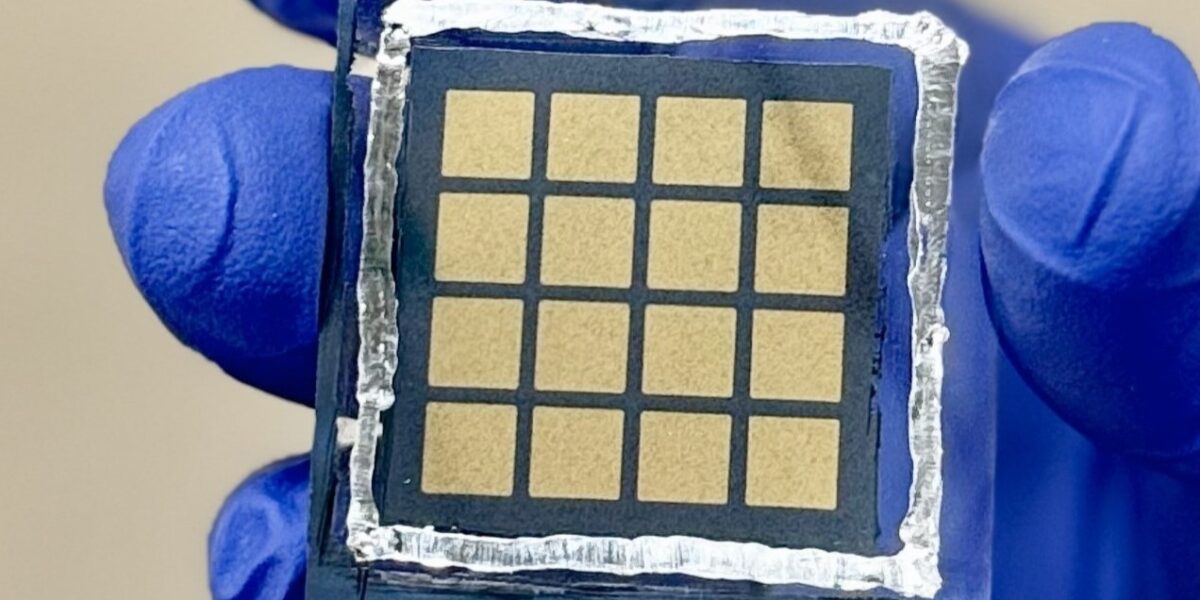





A group of academic, industrial, and institutional researchers, participating in the U.S. Department of Energy’s Cadmium Telluride Accelerator Consortium, have published a perspective paper in Joule on the prospect of expanding production of cadmium telluride solar PV products worldwide to 100 GW annual capacity in 2030.
“Even though cadmium telluride (CdTe) photovoltaics is doing very well in the marketplace already, our paper shows that there is still much room for CdTe to grow. Our work highlights the way for future performance improvements and market expansion,” co-corresponding author of the perspective paper, Michael Heben, told pv magazine.
The analysis, presented in “Roadmap to 100 GWDC: Scientific and supply chain challenges for CdTe photovoltaics,” assessed supply chains and technology developments, factoring in policy influence and the recent growth rate of CdTe manufacturing capacity to inform the outlook.
It noted that CdTe deployment “has been growing disproportionately in the US and the US utility-scale market due to a combination of policy and technology factors.”
“The cost and performance of CdTe modules have continued to improve due to advances in research, development, and manufacturing,” it said.
In addition, total global manufacturing capacity for CdTe PV has been growing at a compound annual growth rate (CAGR) of 37% since 2017. A projection into the future by the researchers indicated that “100 GWDC/year should be possible by 2030.”
The research further established that the supply of tellurium (Te), a mining byproduct, is not expected to be a limit to expansion of CdTe production, noting that U.S. module manufacturer First Solar had already announced capacity expansions for 2026 that exceed earlier predicted limits by 25%.
“There have been limited historic drivers to capture Te, and it is a common misconception that because so little is produced today that this is a fundamental limit,” co-corresponding author Matthew Reese told pv magazine. “There are also device improvements that can be made to dramatically increase the production scale of CdTe to give a longer runway as Te production is scaled.”
As for being able to continue to compete with conventional silicon in the utility scale segment, the research highlighted its bankability, reliability, predictability, and outperformance in hot and humid climates, alongside the high potential of device research and development.
“Future improvements in efficiency in the areas we highlight will further strengthen the competitiveness of CdTe,” said Heben, referring to research to increase module power conversion efficiency, reduce Te intensity, and improve bifaciality.
Also highlighted was the CdTe manufacturing process, which “leverages domestic supply chains,” making it “less sensitive to import restrictions while supporting national energy security.”
The study participants were from the University of Toledo, the U.S. Department of Energy’s National Laboratory of the Rockies, the Missouri University of Science and Technology, Colorado State University, Sivananthan Labs and First Solar.
Looking ahead, there is basic and applied research underway to improve the performance of manufacturable CdTe devices and modules under the umbrella of the U.S. Department of Energy funded Cadmium Telluride Accelerator Consortium.
This content is protected by copyright and may not be reused. If you want to cooperate with us and would like to reuse some of our content, please contact: editors@pv-magazine.com.




By submitting this form you agree to pv magazine using your data for the purposes of publishing your comment.
Your personal data will only be disclosed or otherwise transmitted to third parties for the purposes of spam filtering or if this is necessary for technical maintenance of the website. Any other transfer to third parties will not take place unless this is justified on the basis of applicable data protection regulations or if pv magazine is legally obliged to do so.
You may revoke this consent at any time with effect for the future, in which case your personal data will be deleted immediately. Otherwise, your data will be deleted if pv magazine has processed your request or the purpose of data storage is fulfilled.
Further information on data privacy can be found in our Data Protection Policy.