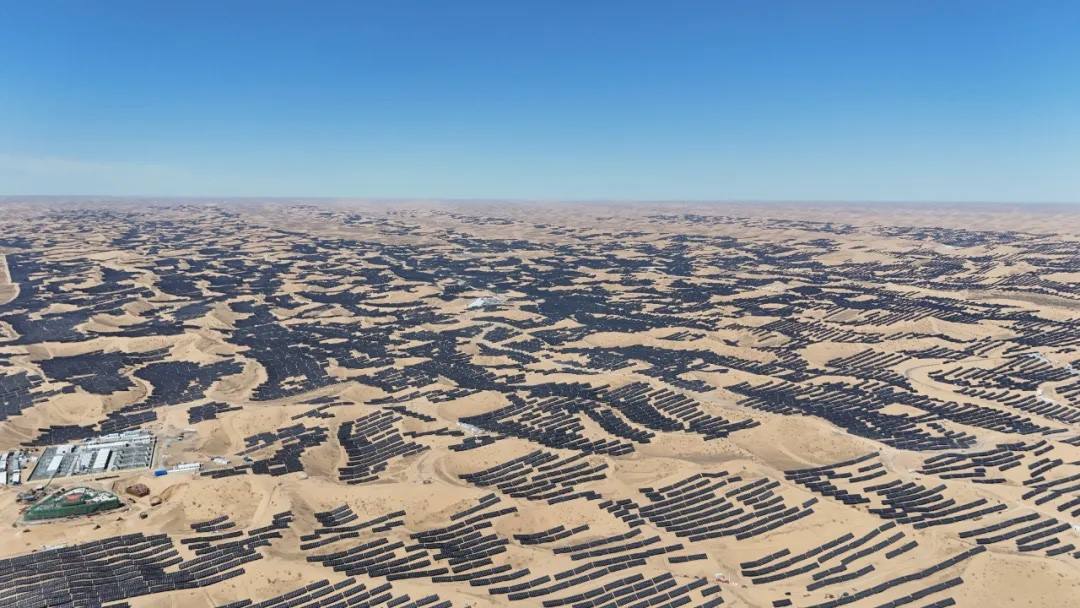





China’s National Energy Administration (NEA) released its 2025 power sector statistics on Jan. 28, showing the country added 315.07 GW of new solar capacity last year, alongside 119.33 GW of wind. Both figures marked new annual records.
By the end of December 2025, China’s cumulative installed power capacity had reached 3.89 TW, an increase of 16.1% year on year. Solar capacity rose to 1.20 TW, up 35.4%, while wind reached 0.64 TW, a 22.9% increase. Together, solar and wind accounted for 47.3% of total installed capacity, according to NEA data.
The figures underline a structural shift in China’s generation mix. When hydropower and nuclear are included, non-fossil sources accounted for 60.4% of total installed capacity in 2025, compared with 39.6% for thermal power, marking a historic crossover in the country’s power system. NEA data also show that large power plants of 6 MW and above averaged 3,119 full-load hours during the year, down 312 hours from 2024, reflecting rising variability and curtailment pressure as variable renewables expand.
Installation momentum accelerated sharply toward year-end. Solar additions in December alone exceeded 40 GW, a level comparable to the annual installations of many major PV markets. Industry analysts attributed the surge to project commissioning deadlines and the continued rollout of large-scale wind and solar bases in western and northern China.
Despite the record year, most institutions expect installations to decline in 2026, citing a high comparison base, power price marketisation, and ongoing supply chain adjustments. The China Photovoltaic Industry Association (CPIA) outlined three scenarios in January: a conservative case of around 185 GW, a mainstream range of 215 GW to 220 GW, and an optimistic case of up to 275 GW. Its central view points to a year-on-year decline of around 20% to 25%.
That outlook contrasts with CPIA’s projections during 2025, when it revised its full-year forecast upward from 215 GW to 255 GW in February to 270 GW to 300 GW in July, following a policy-driven installation surge in the first half of the year. Official NEA data later showed that actual additions exceeded the upper end of CPIA’s revised range.
Other forecasters remain divided on the pace of the expected slowdown. BloombergNEF’s latest baseline points to around 273 GW (AC) of new solar additions in 2026, while several Chinese brokerages and industry publications place their central estimates between 200 GW and 225 GW. Across scenarios, there is broad agreement that utility-scale projects in large desert and renewable base developments will dominate demand, while distributed generation remains the largest source of uncertainty as power price and tariff mechanisms continue to evolve.
With cumulative solar capacity now above 1 TW, China’s market is increasingly shaped by system integration challenges rather than pure build-out. Grid access, storage deployment, and electricity market reforms are expected to play a growing role in determining how quickly new capacity can be absorbed from 2026 onward.
This content is protected by copyright and may not be reused. If you want to cooperate with us and would like to reuse some of our content, please contact: editors@pv-magazine.com.



By submitting this form you agree to pv magazine using your data for the purposes of publishing your comment.
Your personal data will only be disclosed or otherwise transmitted to third parties for the purposes of spam filtering or if this is necessary for technical maintenance of the website. Any other transfer to third parties will not take place unless this is justified on the basis of applicable data protection regulations or if pv magazine is legally obliged to do so.
You may revoke this consent at any time with effect for the future, in which case your personal data will be deleted immediately. Otherwise, your data will be deleted if pv magazine has processed your request or the purpose of data storage is fulfilled.
Further information on data privacy can be found in our Data Protection Policy.