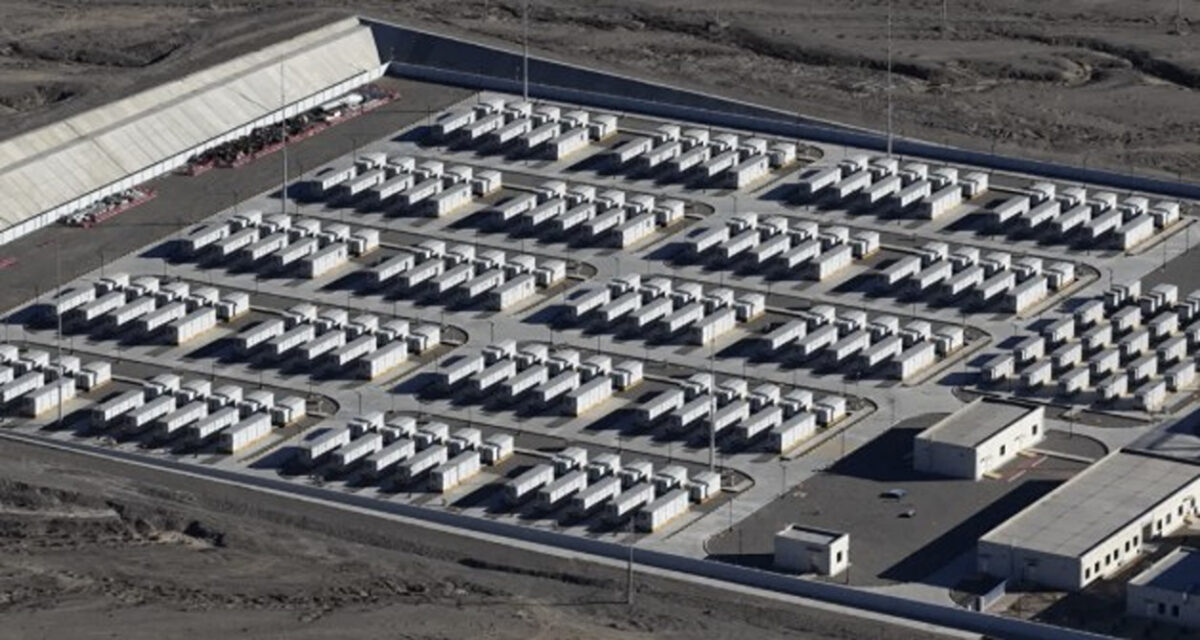





China’s largest supercapacitor-based hybrid energy storage system has been successfully connected to the grid in northwest China, marking a milestone for hybrid of supercapacitor and lithium-based energy storage system.
The Jiayuguan NingSheng 500 MW/1,000 MWh independent energy storage project, invested by China National Nuclear Corporation (CNNC), completed commissioning and achieved grid connection in the early hours of Dec. 30, 2025, according to official disclosures. The project is located in Jiayuguan, Gansu province, within the Jiaxi photovoltaic industrial park, a key renewable energy hub in China’s northwest.
The project adopts a hybrid configuration combining 475 MW/1,000 MWh of lithium iron phosphate (LFP) batteries with a 25 MW supercapacitor system capable of 60-second discharge. While battery storage provides long-duration energy shifting and peak shaving, the supercapacitor segment delivers millisecond-level response, enabling frequency regulation, inertia support, and rapid grid stabilization.
At 25 MW, the supercapacitor installation is currently the largest of its kind in China, and one of the largest globally integrated into a grid-scale project. The hybrid design allows the system to address both energy-type and power-type requirements, a combination increasingly seen as critical for high-renewables power systems.
The facility is connected to the grid via a 330 kV transmission line, feeding into the Jiayuguan Jiaxi solar power aggregation station. Construction began in September 2024 and reached full commission within roughly 15 months, despite challenging desert conditions.
Engineered for Gansu’s extreme climate, the storage system is designed to operate across a –40 C to 60 C temperature range, with liquid cooling, sand and dust protection, and reinforced enclosures tailored for Gobi Desert conditions.
To continue reading, please visit our ESS News website.
This content is protected by copyright and may not be reused. If you want to cooperate with us and would like to reuse some of our content, please contact: editors@pv-magazine.com.





By submitting this form you agree to pv magazine using your data for the purposes of publishing your comment.
Your personal data will only be disclosed or otherwise transmitted to third parties for the purposes of spam filtering or if this is necessary for technical maintenance of the website. Any other transfer to third parties will not take place unless this is justified on the basis of applicable data protection regulations or if pv magazine is legally obliged to do so.
You may revoke this consent at any time with effect for the future, in which case your personal data will be deleted immediately. Otherwise, your data will be deleted if pv magazine has processed your request or the purpose of data storage is fulfilled.
Further information on data privacy can be found in our Data Protection Policy.