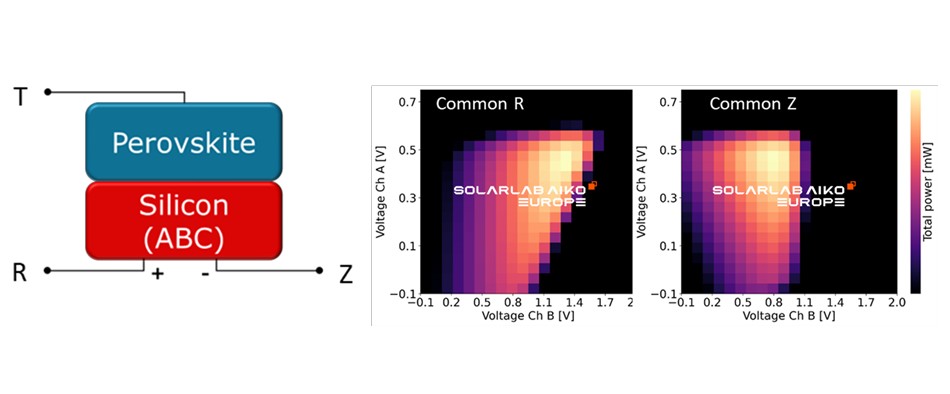





Solarlab Aiko Europe, a Germany-based research unit of Chinese back-contact (BC) module manufacturer Aiko, presented an update on its perovskite-silicon tandem solar cell research based on two-terminal (2T) and three-terminal (3T) tandem configurations at the Become PV 2025 conference in Brussels, organized by the European Energy Research Alliance Joint Programme Photovoltaic Solar Energy earlier this month.
With a focus on record-breaking efficiencies and scalable manufacturing solutions for perovskite-silicon tandem research, its latest 2T perovskite-silicon tandem lab-scale cell achieved a power conversion efficiency of 34.76%, according to Bhaskar Singh, R&D Team Leader at Solarlab Aiko Europe, located in Freiburg, Germany.
The tandem, which had a heterojunction (HJT) silicon bottom cell, was developed in collaboration with researchers at Aiko headquarters and its state-of-the-art Yiwu R&D line. Interface engineering and material passivation methods were used to reduce efficiency losses and enhance stability. No further details were disclosed.
The potential of 2T monolithic tandem devices hinges on compatibility with existing silicon solar module manufacturing processes. “At Solarlab Aiko, we not only focus on the efficiency of tandem devices but also its long-term stability and scalable processing,” Singh told pv magazine.
While 2T tandems offer simplicity and manufacturability, 3T tandem cells present an exciting alternative with greater flexibility and yield enhancement, according to Singh, who highlighted that one of the challenges with 2T tandem cells is current matching between sub-cells. This is unlike 3T designs, which allow for “independent current extraction, making them less sensitive to spectral conditions,” and better suited for bifacial applications.
Besides independent current extraction and potentially higher energy yield via bifaciality, 3T has a third advantage, “greater flexibility in module design to enable more efficient use of materials and reduced costs.”
Early test results of a proof-of-concept 3T perovskite-silicon tandem technology based on Aiko’s All Back Contact (ABC) cell indicate higher energy yields and a lower levelized cost of electricity, according to the company.
Aiko has ongoing research along these lines at its locations in Freiburg, Yiwu, and Zhuhai. Solarlab Aiko Europe was part of a research project using its PERC cells combined with a perovskite cell made by Dutch consortium Solliance to make a 27.7% device in 2021.
This content is protected by copyright and may not be reused. If you want to cooperate with us and would like to reuse some of our content, please contact: editors@pv-magazine.com.


By submitting this form you agree to pv magazine using your data for the purposes of publishing your comment.
Your personal data will only be disclosed or otherwise transmitted to third parties for the purposes of spam filtering or if this is necessary for technical maintenance of the website. Any other transfer to third parties will not take place unless this is justified on the basis of applicable data protection regulations or if pv magazine is legally obliged to do so.
You may revoke this consent at any time with effect for the future, in which case your personal data will be deleted immediately. Otherwise, your data will be deleted if pv magazine has processed your request or the purpose of data storage is fulfilled.
Further information on data privacy can be found in our Data Protection Policy.