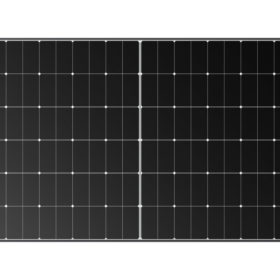
Longi launches all new back contact module, promising 22.8% efficiency
Longi has launched a series of modules featuring an all-new hybrid passivated back contact cell technology, with which it claims a maximum module efficiency of 22.8% in mass production. It will initially offer the modules in 54, 60, 66 and 72 cell formats, targeting rooftop and distributed generation applications.
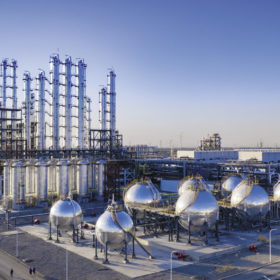
Global polysilicon capacity could hit 536 GW by end of 2023
Clean Energy Associates said in a new report that it expects polysilicon production capacity to exceed PV installations next year.

“n-type module launch reflects our commitment to India”
China’s Trina Solar has shipped more than 8 GW of solar modules to India. It is looking to strengthen its foothold in the market with the launch of n-type PV modules.
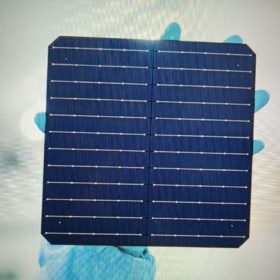
Copper is the new silver lining
As the PV industry scales to annual terawatt-level production to rapidly curtail the world’s emissions, it will become more challenging to continue the cost reduction trajectory. Increasing module production from current levels of 200 GW to 300 GW to several terawatts each year will consume significantly more material resources than the industry currently uses. This will require consideration of the additional materials to be sourced, writes Alison Lennon, chief scientist at Sundrive Solar and professor at the UNSW’s School of Photovoltaic and Renewable Energy Engineering.
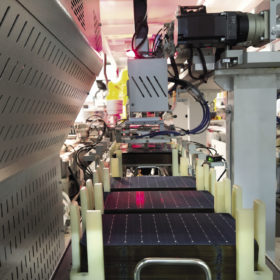
Adani targets 10 GW of polysilicon-to-solar module capacity by 2025
India’s Adani Solar will expand its PV cell and module manufacturing capacity to 10 GW per year by 2025, with backward integration up to the polysilicon stage.
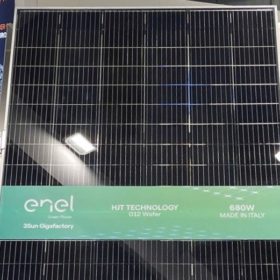
Enel unveils 680 W n-type heterojunction solar panel for utility-scale applications
Enel Green Power’s new solar panel has average efficiencies ranging from 22.6% to 22.9% and a temperature coefficient of -0.24% per degree Celsius. It is based on an n-type solar cell with G12 format and a power conversion efficiency of 24.6%.
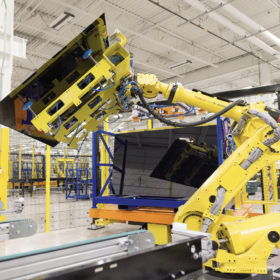
The long read: International investments in Indian PV
India is seeing massive investments in PV manufacturing, with manufacturers from Western countries, led by the United States, eager to get in on the act. Chinese companies have yet to make the same call, however.

Reliance Industries presents scaled-up solar, battery ambitions
Reliance Industries says that production will begin at its 10 GW factory for solar cells and modules by 2024. It plans to double the facility’s capacity to 20 GW by 2026 and is aiming for 50 GWh of annual cell-to-pack battery capacity by 2027.
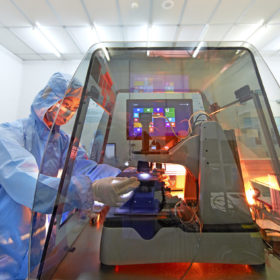
Trina Solar achieves 24.24% efficiency for 210 mm n-type TOPCon solar cell
Trina Solar said Germany’s TÜV Nord has confirmed the efficiency rating of its latest solar cell.
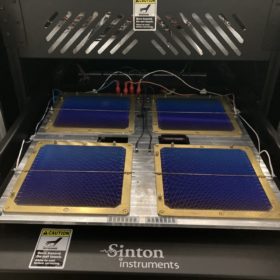
Using p-type wafers in heterojunction solar cells, not a lost battle
An international research group has reconstructed the trajectory of p-type wafers in the heterojunction solar cell segment and has identified the lack of knowledge about boron-oxygen related light-induced degradation (BO-LID) as the main cause for the limited adoption of these wafers and the success of their n-type counterparts. According to the scientists, however, there is still big room for improvement for p-type technologies in heterojunction cells.