JinkoSolar achieves world record efficiency of 27.02% for TOPCon solar cell
The Chinese manufacturer said the result was certified by China’s National Photovoltaic Industry Measurement and Testing Center (NPVM).
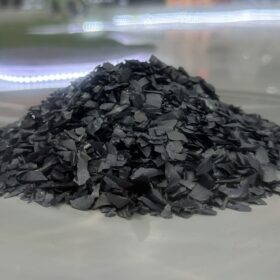
Polysilicon glut may reverse into shortage by 2028, says Bernreuter
China’s polysilicon output hit 3.25 million metric tons (MT) in 2024, driving global prices below $4.50/kg, says Bernreuter Research. The Germany-based market analytics firm warns the market could swing to a shortage by 2028 if capacity cuts overshoot.

From rewards to responsibility: The business case for eco-conscious loyalty programs
The shift from transactional rewards to eco-conscious loyalty programs isn’t just a trend; it’s the future. By integrating renewable energy, sustainable practices, and environmental responsibility into loyalty structures, brands can drive engagement, create meaningful connections, and contribute to a more sustainable future.
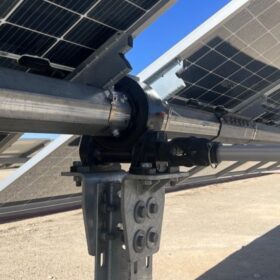
PV Hardware designs solar trackers for resilience in extreme weather
PV Hardware develops solar tracker designs tailored for hurricane and snow-prone regions, such as Florida and the US Midwest.
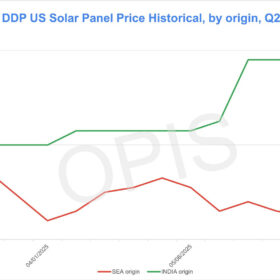
US panel price spread widens between India and Indonesia/Laos origin
In a new weekly update for pv magazine, OPIS, a Dow Jones company, reports that US-assembled modules with imported cells continue to be heard between $0.26/W and $0.33/W, while modules with domestic content – which are still limited to just a handful of producers – are generally quoted between $0.4/W and $0.5/W.
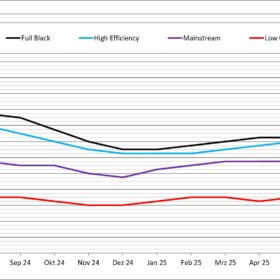
Solar module prices in Europe falling with no clear trend in sight
Solar module prices in Europe have fallen by up to €0.01 ($0.01)/W this month, according to pvXchange.com, as the PV market shows resilience amid policy uncertainty and geopolitical risks.

Monetizing hydrogen and green infrastructure in emerging markets – an EPC perspective
Emerging markets face significant obstacles in the production of green hydrogen, primarily high production costs and limited access to funding. It is crucial for firms to establish strong financial structures to ensure the success of their projects.
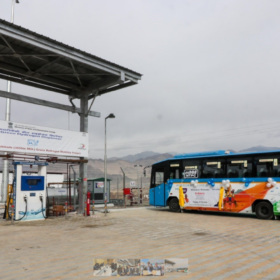
The Hydrogen Stream: NTPC hands over five hydrogen fuel cell buses to Leh Administration
This marks India’s first commercial deployment of hydrogen fuel cell buses and the world’s highest-altitude green hydrogen mobility project.
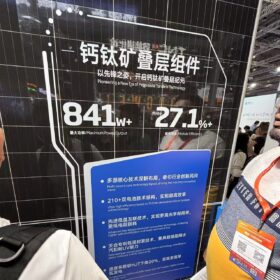
Trina Solar reveals 841 W perovskite-silicon tandem PV module prototype
China’s Trina Solar has unveiled a perovskite‑silicon tandem solar module prototype delivering 841 W and 27.1% efficiency, based on 210 mm tandem cells.
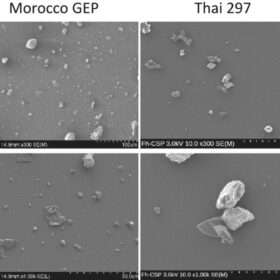
Different dust, different impact on PV module performance
Scientists in Germany have collected dust from Qatar, Morocco and Thailand to analyze the impact on the performance of uncoated solar glass and uncoated PV mini-modules. Their analysis has shown that dust coverage could range from 4% to 60%.